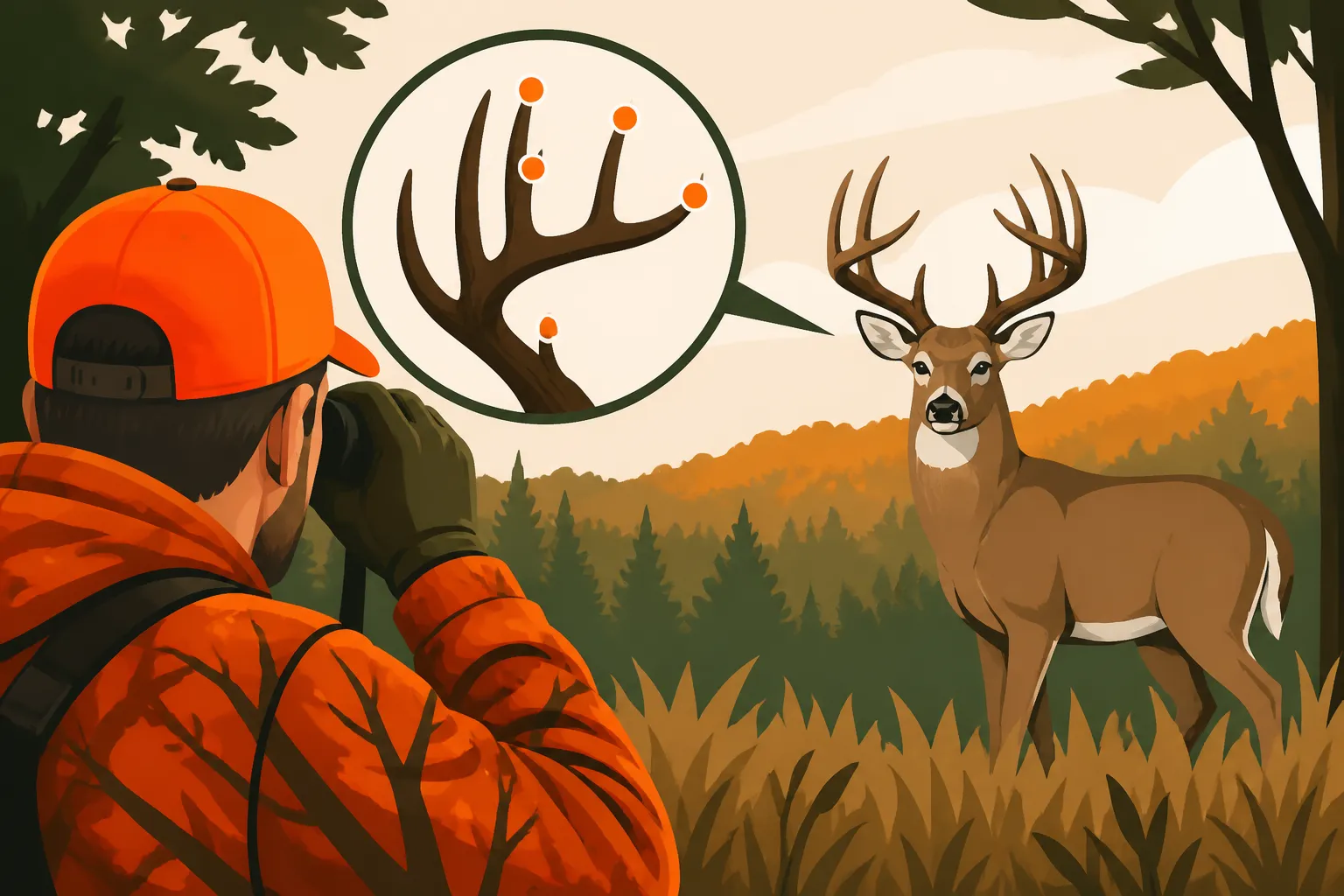
Counting Antler Points Before You Shoot
There’s nothing quite like the rush of adrenaline when a deer steps into your shooting lane, especially a buck. But in Maryland, that excitement often comes with a split-second, high-stakes decision: does this buck meet the antler point restrictions? It's a common frustration for hunters, trying to make an accurate count under pressure, and this guide is here to walk you through exactly how to do it effectively and confidently, ensuring you stay legal and make the right call in the moment.
Understanding Maryland's Antler Point Rules
Maryland has specific regulations regarding antlered deer, primarily aimed at allowing younger bucks to mature. These rules can feel a bit like a pop quiz when you're in the stand, but understanding them thoroughly before you head afield is crucial. The primary rule that trips up many hunters is the "three-point antler restriction" in much of the state, but there are nuances you need to know.
The Three-Point Antler Restriction in Region B
For the vast majority of Maryland, specifically in what’s known as Region B, hunters face the "three-point antler restriction." This means that to legally harvest an antlered deer, it must have at least three points on one antler. This isn't three points total on both sides; it's three points on a single antler. Region B covers almost all of the state’s counties, with only the westernmost counties (Allegany and Garrett, part of Region A) being exempt from this specific rule. If you're hunting deer in counties like Dorchester, Queen Anne's, Frederick, or Charles, this rule applies to you. It’s designed to allow more younger bucks (often spike or fork-horn yearlings) to survive and contribute to a healthier, more balanced deer herd. You can dive deeper into Maryland's Three-Point Antler Restriction to see how this rule impacts your hunting area.
This restriction is a fantastic conservation tool, but it undeniably adds a layer of complexity to hunting. Imagine a beautiful two-year-old buck, full of vigor, sporting perfect 8-point antlers, but with only two points on each side – a common scenario. Under the three-point rule, that buck would be off-limits. This is where the quick calculation comes in. You might see a mainframe 6-point, but if it's a 3×3, it's a shooter in Region B. If it's a 4×2, it's not. The pressure to make this call instantly, often with the buck moving or partially obscured, can be intense. It’s a moment where preparation truly meets opportunity.
The "One Buck" Exemption Explained
While the three-point rule is paramount, Maryland does offer a crucial exception that many hunters often forget or misunderstand: the "one buck" exemption. This rule allows a hunter to harvest one antlered deer per license year that does not meet the three-point restriction, provided it has at least two points (a spike or fork horn). This is a statewide exemption, meaning it applies even in Region B. It's often referred to as your "button buck" or "any antlered deer" tag, though technically, it allows for any antlered deer with at least two points. This can be a lifesaver for hunters who might only see smaller bucks or for those who simply want the opportunity to take any legal buck they encounter.
This exemption is incredibly valuable, especially for younger hunters, new hunters, or those hunting in areas where mature, multi-point bucks are less common. It means that if you haven’t filled your antlered deer bag limit and you encounter a spike or a small fork-horn, you can legally harvest it with this specific exemption. However, remember, once you use this "any antlered deer" exception, any subsequent bucks you harvest in that license year must meet the three-point restriction if you're hunting in Region B. It's a "use it or lose it" scenario for that specific type of tag. Understanding Why One Buck Can Skip the Three-Point Rule can help you strategize your season, especially if you're targeting specific age classes of deer.
The Art of Counting Antler Points in the Field
Counting antler points when a deer is standing perfectly still in a clearing is one thing; doing it when it's walking through thick timber at dawn is another. It takes practice, a good eye, and an understanding of what truly constitutes a "point" in Maryland.
What Actually Counts as a Point
The Maryland Department of Natural Resources (DNR) has a clear definition for what constitutes an antler point: it must be at least one inch long, and its length must be greater than the width of its base. This is a critical distinction. Sometimes, bucks will have small bumps, burrs, or abnormal growths near the base that might look like points from a distance but don't meet the length-to-width ratio. If you can't clearly tell if it's an inch long and narrower than its base, err on the side of caution.
Furthermore, all tines count—brow tines (the ones near the base that point forward), G2s, G3s, and so on. Even if a tine is broken off but still meets the length and base criteria, it counts. However, the main beam itself, where the points originate, does not count as a point. You're looking for individual protrusions extending from the main beam. A common mistake is to count the end of the main beam as a point, but it's not. Only distinct tines qualify. This level of detail is why it's so important to be familiar with the regulations, especially when you're evaluating a potential target through your scope or binoculars.
Tips for Quickly Assessing Points Under Pressure
When that buck finally steps out, your heart rate is probably through the roof. This is where those practice sessions and mental rehearsals pay off. First, try to remain calm and take a deep breath. Often, the deer isn't going anywhere as fast as you think it is. Use your optics – binoculars are great for scanning, but your rifle scope at a lower magnification can also be a point-counting tool. Don't immediately focus on the vitals; instead, take a quick scan of the antlers. Look for the brow tines first, then scan up the main beam, counting each distinct projection.
A good trick is to pick one antler, count its points, and then quickly shift to the other. If you're in Region B, you only need to confirm three points on one antler. If you can quickly identify three on one side, you're good to go, assuming you haven't already used your "one buck" exemption for the season. If the deer is moving, try to pick a moment when its head is relatively still or broadside to get the best view. If you’re unsure, do not shoot. There will always be another deer, and it’s better to pass on an uncertain shot than to risk a violation or an unethical shot. This quick assessment needs to become second nature, much like checking your safety or your shooting form.
Challenges and Common Mistakes in Point Identification
Even seasoned hunters can struggle with accurately counting antler points in the field. There are several factors that can complicate the process, leading to misidentification or missed opportunities. Being aware of these challenges can help you prepare and mitigate the risks.
Low Light and Quick Decisions
One of the most significant challenges is low light conditions, common during prime hunting hours at dawn and dusk. In dim light, shadows can play tricks on your eyes, obscuring smaller points or making non-points appear significant. Combine this with a buck that might only offer a fleeting glimpse as it moves through heavy cover, and you have a recipe for uncertainty. The stress of knowing it could be your only chance of the day adds immense pressure to make a swift decision.
This is precisely why patience and a firm commitment to your ethics are paramount. If you can't clearly see and count the points, you shouldn't shoot. Investing in quality optics, like a pair of good binoculars from brands like Vortex or Leupold, can make a huge difference in clarity during these crucial low-light moments. These optics often perform better in dim conditions, helping you resolve detail more effectively. Remember, a legal deer observed clearly is always better than a questionable shot in the shadows.
Miscounting or Not Seeing All Points
It's astonishingly easy to miscount points, especially on a buck that might have unusual antler growth or is partially obscured. Often, hunters focus on the larger, more obvious tines and miss a small brow tine or a sticker point near the base. Angles also play a huge role; what looks like two points from one perspective might reveal a third when the deer turns its head slightly. The excitement of the moment can also lead to tunnel vision, making it difficult to fully assess the entire antler structure.
To combat this, try to train your eyes to sweep the entire antler, from base to tip, on both sides, if possible. If you use a tool like GoHunt for mapping and scouting, spend time reviewing trail camera photos of local bucks. This helps you get a feel for the typical antler growth patterns in your hunting area, which can aid in faster identification in the field. Overconfidence or rushing the count is a common pitfall. Always double-check, if the situation allows, before making the decision to shoot.
The Stress of the Moment
Let's be real: hunting is exhilarating, and the surge of adrenaline when a buck appears can be overwhelming. This physiological response – increased heart rate, tunnel vision, shaking hands – can severely impair your ability to calmly and accurately count antler points. The fear of making a mistake, either by shooting an illegal deer or by letting a legal one walk, adds to this mental burden. It's a classic example of "buck fever," and it affects almost everyone at some point.
Managing this stress involves mental preparation. Before you even step foot in the woods, visualize the scenario. Imagine bucks of varying antler configurations appearing and practice the mental exercise of quickly counting their points. Establish a personal "no-shoot" rule if you're uncertain. Perhaps tell yourself, "If I can't clearly count three points on one side, I won't shoot." This pre-commitment can provide a solid framework when your emotions are running high. Remember, hunting should be enjoyable and ethical, not just about punching a tag.
Tools and Strategies for Better Point Identification
Beyond mental preparation and good eyesight, modern hunting offers several tools and strategies that can significantly improve your ability to identify and count antler points accurately. These resources can give you an edge, both before and during your hunt.
The Power of Quality Optics
High-quality binoculars and spotting scopes are your best friends when it comes to assessing antlers from a distance. While your rifle scope is great for aiming, binoculars provide a wider field of view and are often easier to hold steady for detailed observation. Brands like Nikon, Zeiss, or Swarovski offer exceptional clarity, especially in challenging light conditions, which can highlight those elusive small points. Having a steady rest for your binoculars, even a simple monopod or leaning against a tree, can drastically improve your ability to count points accurately.
Before heading into your deer stand or blind, take a few minutes to scan the surrounding area with your binoculars. Get familiar with the terrain and potential shooting lanes. When a deer appears, first grab your binoculars to get a positive ID and count points. Only after confirming it's a legal animal should you bring your rifle to bear. This two-step process helps you stay calm and make a more informed decision. Using your binoculars effectively is a skill that develops with practice, and it’s invaluable for all aspects of deer hunting, not just point counting.
Trail Cameras and Scouting Intelligence
Trail cameras are arguably one of the most powerful scouting tools available to hunters today. Setting up cameras on your hunting property, especially near food sources, pinch points, or bedding areas, allows you to monitor deer activity and, crucially, inventory the bucks in your area. You can capture countless photos and videos of individual bucks, allowing you to study their antler characteristics at your leisure, well before hunting season begins. This helps you recognize specific deer and know their point count beforehand, eliminating guesswork in the field.
When you're sifting through your trail camera photos, pay close attention to the details of each buck's rack. If you use a mapping tool like GoHunt, you can even drop pins where you captured photos of specific bucks, helping you understand their patterns and preferred locations. This pre-season intelligence is a game-changer. If you know "that big 8-point with the broken G3" is frequenting a certain food plot, you won't be surprised when he steps out, and you’ll already know his legal status. Check out our guide on Where to Hang a Camera on a Maryland Field Edge for tips on strategic placement.
Understanding and Utilizing Aerial Photos
Before you even step foot in the woods, modern mapping applications provide an incredible advantage. Programs like GoHunt or OnX Hunt offer detailed aerial imagery, topographical maps, and public/private land boundaries right on your phone or computer. While these tools won't help you count points in real-time, they are invaluable for pre-season scouting. By studying aerial photos, you can identify potential travel corridors, bedding areas, and food sources where bucks are likely to be found. This knowledge helps you strategically place stands or plan still-hunting routes, putting you in a better position to get a clear, calm look at a buck’s antlers.
Think about it: if you've studied the terrain using aerial photos, you might discover a natural funnel that forces deer to walk closer to a particular tree line. Setting up your stand there could provide a longer, clearer shot opportunity, giving you more time to assess antler points. You can also identify dense cover where bucks might hide, allowing you to anticipate quick glimpses and prepare your response. Combine this with trail camera data, and you're building a comprehensive picture of your hunting grounds and the deer that inhabit them. For more scouting insights, consider reading about Scouting Maryland Public Land With Aerial Photos.
Consequences of Miscounting Antler Points
Making a mistake when counting antler points isn't just a missed opportunity; it can lead to serious legal and ethical repercussions. Understanding these consequences should reinforce the importance of accurate identification before you decide to take a shot.
Legal Ramifications
Shooting an antlered deer that does not meet Maryland's point restrictions, or if you've already used your "one buck" exemption and harvested a smaller buck, can lead to significant legal penalties. These consequences are not trivial. You could face substantial fines, forfeiture of your hunting license for a period of time, and even seizure of your firearm and the harvested deer. The Maryland Department of Natural Resources takes wildlife violations seriously, and ignorance of the law is generally not considered a valid excuse.
Imagine the scenario: you're excited about your hunt, you take a shot, and retrieve what you thought was a legal buck. Only after a closer inspection do you realize it only has two points on each side, and you've already filled your "one buck" exemption. Now, instead of celebrating a successful hunt, you're looking at potential legal trouble. This stress, along with the financial penalties and loss of hunting privileges, is far worse than the disappointment of letting a questionable buck walk. It's a stark reminder that responsible hunting means knowing and adhering to all regulations, including Maryland's Deer Bag Limits and Antler Rule.
Ethical Considerations
Beyond the legal aspects, there's a profound ethical responsibility that comes with hunting. As hunters, we are stewards of the wildlife resource. Intentionally or negligently harvesting an illegal deer undermines conservation efforts and reflects poorly on the hunting community as a whole. Each deer is a living creature, and taking its life carries with it the responsibility to do so legally, ethically, and respectfully.
Passing on a buck because you're unsure of its legality, even if it turns out to be a shooter, is always the more ethical choice. It demonstrates respect for the animal, the law, and the privilege of hunting. Conversely, shooting an illegal deer, whether by accident or rushing the decision, can leave you with a lingering sense of guilt and regret, detracting from the overall hunting experience. We strive to be ethical hunters who make good decisions in the field, contributing positively to Maryland's wildlife management.
| Antler Point Scenario (Region B) | Legal Status | Notes |
|---|---|---|
| Spike (single point per side) | Illegal | Unless using "one buck" exemption. |
| Fork Horn (two points per side) | Illegal | Unless using "one buck" exemption. |
| 3×2 (three points on one, two on other) | Legal | Meets 3-point rule on one antler. |
| 3×3 (three points per side) | Legal | Clearly meets 3-point rule. |
| Any buck with at least 2 points total | Legal | If using your single "one buck" exemption for the year. |
Disclaimer
Please note that hunting regulations, seasons, and licensing requirements can change. While this guide provides comprehensive information, it is always your responsibility as a hunter to consult the most current Maryland Department of Natural Resources (DNR) official hunting guide and regulations before heading afield. This content is for informational purposes only and should not be considered legal advice.