Why Bobwhite Quail Vanished From Maryland Farms
Remember when the whir of a bobwhite covey rising from a hedgerow was a common sound on Maryland farms? If you’ve been around the Free State’s rural landscapes for a while, especially on the Eastern Shore or in the Piedmont, you know that sound has largely gone silent. It’s a loss many of us who cherish our wild game feel deeply, wondering what exactly happened to these iconic birds. This guide will dive deep into the complex and often intertwined reasons why bobwhite quail, once a staple of Maryland's agricultural lands, have all but vanished, detailing the environmental and agricultural shifts that led to their dramatic decline.
The Ghost of the Past: Maryland's Quail-Rich History
For generations, the distinctive "bob-white!" whistle was as much a part of the Maryland countryside as the red-winged blackbird in a marsh or the distant lowing of cattle. Our grandparents and great-grandparents, especially those who grew up in the early to mid-20th century, probably remember coveys of a dozen or more quail erupting from field edges and brushy draws. These weren't just anecdotal sightings; bobwhite quail were a significant small game species, offering challenging and rewarding hunts.
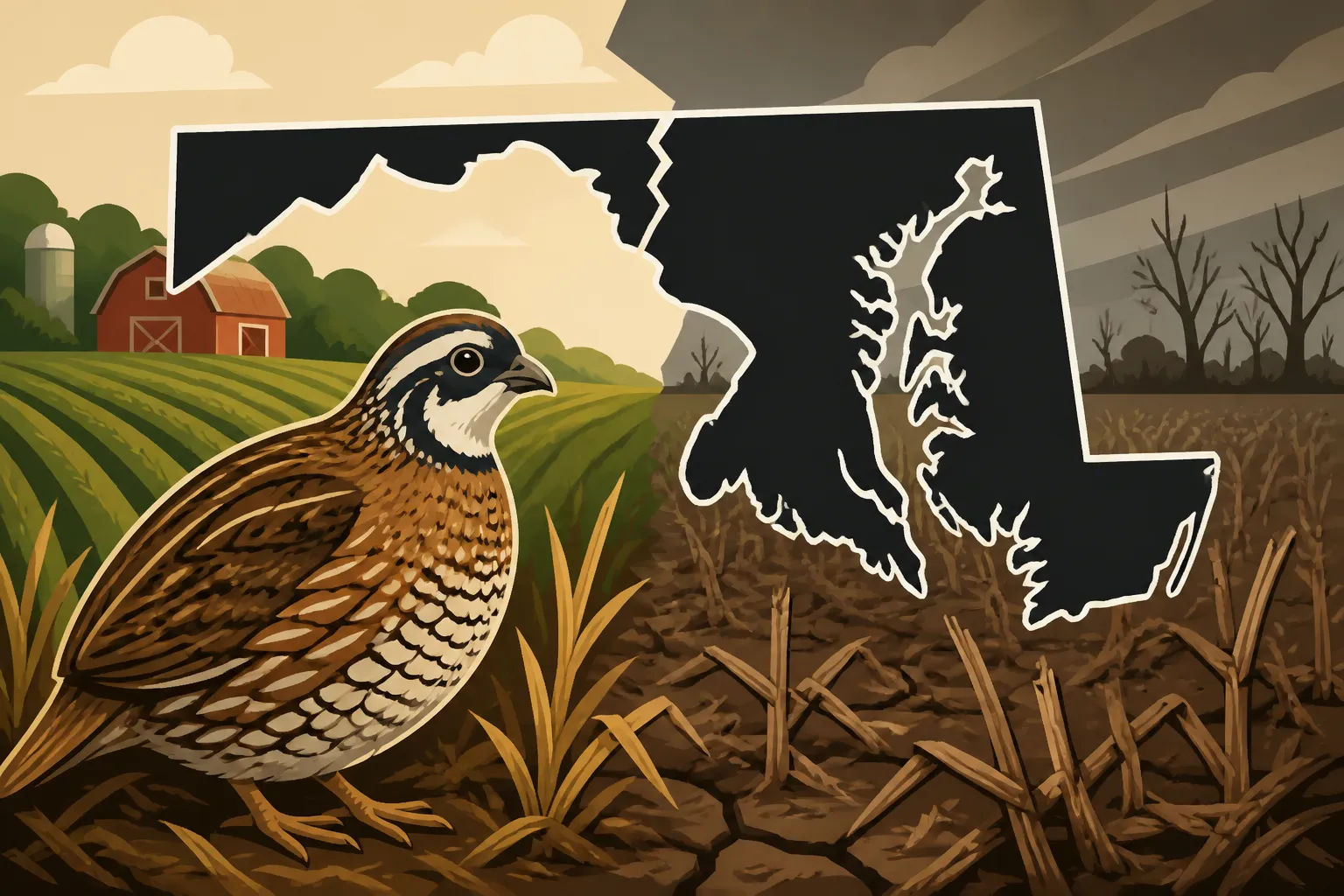
The landscapes of Maryland farms back then were incredibly diverse, albeit often unintentionally so. Picture a mosaic of small, irregularly shaped fields, often separated by dense fencerows thick with brambles, multiflora rose, small trees, and tangles of native grasses. These fencerows weren't just property boundaries; they were highways and havens for wildlife. Farmers might leave corners unplanted, or allow small woodlots to grow right up to a field edge, creating what we now call "edge habitat." Think about a field of corn, a patch of soybeans, and then a strip of wheat stubble, all within a stone's throw of each other, bordered by a brushy ditch. This kind of varied landscape provided everything a bobwhite quail needed: dense cover for nesting and protection, open areas for foraging insects and seeds, and readily available food sources through all seasons. Small Game Species in Maryland would have included quail prominently.
Farming practices themselves were less intensive. Equipment was smaller, fields were tilled less frequently, and crop rotations were common. This meant more idle land, more weedy borders, and more pockets of early successional habitat – those transitional areas where old fields began to grow back into brush before becoming mature forest. These "weedy fields" were gold mines for quail, offering abundant seeds and insects. The very nature of farming created an ideal environment, and for a long time, we didn't even realize how good we had it, or how precarious it was.
The Modern Agricultural Shift: A Habitat Desert
The single biggest reason bobwhite quail vanished from Maryland farms boils down to one critical factor: habitat loss and degradation. It wasn't one sudden event, but a slow, creeping transformation of our agricultural landscapes that gradually squeezed the life out of quail populations.
The Rise of "Clean Farming" and Monoculture
The post-World War II agricultural boom brought with it a revolution in farming. To maximize efficiency and output, farms grew larger, fields became enormous, and practices shifted. Farmers, driven by economic necessity and new technologies, adopted what became known as "clean farming." This meant eliminating anything that didn't directly contribute to the crop yield. Those diverse fencerows? They were cleared to make way for larger equipment and maximize every square foot for planting. Small, irregular fields were combined into vast, uniform expanses. Woodlots that bordered fields were often pushed back or cleared entirely.
This push for efficiency created monocultures – vast fields dominated by a single crop, like corn or soybeans, often planted right up to the property line. While efficient for agriculture, this creates a biological desert for quail. A bobwhite quail can't survive in the middle of a 100-acre cornfield, no matter how much corn is there. They need different types of cover and food sources in close proximity. Imagine trying to live in a house where your bedroom is miles from your kitchen, which is miles from your bathroom – it's simply not feasible. Quail need to be able to move between nesting cover, foraging areas, and escape cover quickly and safely, without exposing themselves to predators for long distances.
The Problem with Fescue and Lack of Early Successional Habitat
Beyond just the size and uniformity of fields, the types of vegetation changed dramatically. Many farms, especially for pasture or hay, adopted non-native cool-season grasses like tall fescue. While great for livestock, fescue grows in a dense, uniform mat that provides almost no benefit for ground-nesting birds like quail. Its thick thatch prevents young chicks from moving through it to find insects, and it offers little in the way of beneficial seeds. Native warm-season grasses, which grow in clumps and provide open ground underneath for movement and foraging, were largely replaced.
The crucial early successional habitat – those weedy fields, brushy edges, and young regrowth areas – also dwindled. Farmers no longer left fields fallow for extended periods, and herbicides became widely used to control "weeds." What a farmer considers a weed, a quail considers dinner or a nursery. The diverse array of native forbs, legumes, and annual weeds that produced the seeds and insects essential for quail survival simply disappeared from the landscape. Without these critical components, quail lost their food supply and the protective cover necessary for nesting and raising broods. If you were using a tool like GoHunt to scout land from decades past, you'd see a patchwork of diverse fields, woodlots, and overgrown edges that are now often completely gone, replaced by sprawling, homogenous agricultural zones.
Beyond the Plow: Other Pressures on Quail Populations
While habitat loss is undeniably the primary driver behind the bobwhite's disappearance, it wasn't the only factor. Several other pressures, often exacerbated by a degraded habitat, contributed to the species' decline.
Increased Predation Pressure
With less dense, continuous cover, quail became far more vulnerable to predators. Modern farming has inadvertently created conditions favorable to many predators while making conditions terrible for quail. Think about it: a small covey trying to navigate a narrow, sparse hedgerow between two massive crop fields is a sitting duck compared to a covey moving through a wide, dense strip of native grasses and brush.
The populations of generalist predators like raccoons, opossums, skunks, and foxes have remained robust or even increased in many areas. Furthermore, the expansion of species like coyotes into Maryland, as detailed in posts like Coyote Calling in Maryland Farm Country, has introduced another efficient predator into the mix. While these predators have always existed, their impact is magnified when quail have nowhere to hide effectively, and their nests are more easily discovered. Raptors, too, find easier targets in fragmented or sparse cover. Less protective cover means higher rates of nest depredation and adult quail falling victim to hawks and owls.
Pesticides and Their Unseen Impact
The intensification of agriculture brought with it a significant increase in the use of pesticides and herbicides. While designed to protect crops from insects and weeds, these chemicals have broader ecological impacts. Herbicides, as mentioned, eliminate the very plants that provide seeds and insect food for quail. Pesticides, particularly insecticides, directly reduce the insect populations that are absolutely vital for young quail chicks.
Young bobwhite quail are almost entirely dependent on insects for their first few weeks of life to get the protein they need for rapid growth. If the landscape is sprayed clean of insects, chicks simply can't find enough food to survive. Even if they hatch, they might not make it past a few days or weeks due to starvation. This insidious effect is often harder to quantify than habitat loss but is a significant factor in preventing any potential rebound of quail populations even in areas where some cover might still exist.
Weather Extremes and Disease
Bobwhite quail are resilient, but they are still susceptible to environmental stressors. Severe winter weather, especially prolonged periods of deep snow and ice, can be devastating, particularly when food and cover are already scarce. When the ground is covered in a thick blanket of snow, quail can't access the seeds they need, and without dense thermal cover, they can succumb to exposure. This is a cruel reality of living in a state like Maryland, which can experience harsh winters.
Likewise, disease can play a role, especially in smaller, fragmented populations that are already stressed. While not as dominant a factor as habitat or predation, a localized disease outbreak can quickly wipe out a struggling covey. The overall decline in population numbers means that even small stressors have a disproportionately large impact, as there are fewer birds to repopulate an area.
The Uphill Battle: Conservation Efforts and Challenges for Recovery
Despite the bleak picture, dedicated conservationists and landowners in Maryland haven't given up on the bobwhite quail. There are ongoing efforts, often through programs designed to restore native habitats, but the scale of the challenge is immense.
One of the most promising avenues is the reintroduction of early successional habitat and native warm-season grasses. Programs like the Conservation Reserve Program (CRP) incentivize landowners to take marginal agricultural land out of production and plant it with beneficial native grasses and wildflowers. These areas, when properly managed, can provide excellent nesting, brooding, and escape cover for quail and many other ground-nesting birds and pollinators. You can often see these efforts, sometimes on a larger scale, on public lands, as highlighted in guides like Habitat Work on Maryland Wildlife Management Areas.
Restoring fencerows and creating wider, brushy borders along field edges are also critical. This means planting native shrubs and leaving areas to grow wild, providing those crucial corridors and patches of dense cover that quail need to move safely and find refuge. Imagine using a GoHunt app's habitat layers to identify potential areas on private or public land where such improvements could be made, helping to visualize how these fragmented pieces could connect.
However, the economic realities of modern farming often make large-scale habitat restoration difficult for private landowners. Every acre taken out of production represents a potential loss of income. While there are incentives, they often don't fully compensate for the profit margins of intensive agriculture. This means that quail recovery efforts are often isolated, creating small "islands" of good habitat in a sea of unfavorable conditions. For a species that relies on connectivity and a certain population density to thrive, these fragmented efforts can be a slow, difficult path.
Ultimately, the vanishing of bobwhite quail from Maryland farms is a testament to the profound changes our landscapes have undergone. It’s a somber reminder of how interconnected our ecosystems are and how quickly seemingly minor alterations can have catastrophic effects on wildlife. The whistle of the bobwhite may be largely gone, but the efforts to bring it back continue, one patch of native grass and one brushy hedgerow at a time. It's a long road, but for those who remember, and for those who dream of hearing that call again, it's a journey worth taking. For hunters interested in other small game, exploring Rabbit Hunting Maryland Farm Hedgerows might offer some solace, as rabbits often benefit from similar habitat features.
| Feature Type | Quail-Friendly Farm (Past) | Modern Farm (Present) | Impact on Quail |
|---|---|---|---|
| Field Size | Small, irregular | Large, uniform | Reduced travel distance, diverse edges vs. exposed travel |
| Field Edges | Wide, brushy fencerows, small woodlots | Clean-cut, narrow or absent | Abundant cover/food vs. minimal cover, increased predation |
| Crops | Diverse rotation, small grains | Monoculture (corn, soybeans) | Varied food/cover vs. limited food/cover diversity |
| Weeds/Forbs | Common, tolerated | Controlled with herbicides | Essential food/insect source vs. eliminated |
| Pasture/Hay | Native warm-season grasses | Tall fescue, non-native cool-season grasses | Good nesting/brooding cover vs. dense, unusable thatch |
| Pesticide Use | Limited or none | Extensive | Healthy insect populations vs. reduced insect food source |
| Fallow Fields | Common practice | Rare | Crucial early successional habitat vs. eliminated |
| Equipment | Smaller, less intrusive | Larger, high-speed | Less habitat disturbance vs. extensive habitat disturbance |
Disclaimer
This article is for general informational purposes only and does not constitute professional advice. Laws, prices and regulations vary by location and change over time. Consult a qualified professional for guidance on your specific situation.