What the Nutria Eradication Changed for Marshes
For years, hunters, trappers, and conservationists across Maryland watched in dismay as our precious Chesapeake Bay tidal marshes seemed to be vanishing before our very eyes. It wasn't just a natural process; an invasive, destructive force was literally eating away the very foundations of these critical ecosystems. This guide delves into the profound impact of nutria on Maryland's marshes and chronicles the massive, successful effort to eradicate them, revealing how this monumental undertaking has forever changed the landscape and the hunting opportunities within these unique habitats.
The Marsh Menace: Understanding Nutria and Their Impact
Before we can truly appreciate what the nutria eradication changed for Maryland's marshes, we have to understand just how devastating these furry invaders were. Imagine a landscape, rich with life, that suddenly finds itself under siege by an army of relentless, digging, eating machines. That's essentially what happened when nutria populations exploded across the Eastern Shore.
These large, semi-aquatic rodents, often mistaken for oversized muskrats, were introduced to Maryland in the 1940s from South America, initially for the fur trade. Like many well-intentioned but ultimately ill-fated introductions, they quickly escaped captivity and found the mild climate and abundant marsh vegetation of the Delmarva Peninsula to be an absolute paradise. Without natural predators to keep their numbers in check, their populations soared, and with them, a wave of environmental destruction. Their massive appetites and relentless burrowing habits were a death sentence for delicate marsh grasses and the intricate root systems that held the marsh together.
The Devastating Effect on Marsh Vegetation
Nutria are voracious herbivores, and their preferred diet consisted of the rhizomes and roots of marsh plants, especially the highly valuable three-square rush and cattail that form the backbone of our tidal wetlands. They don't just eat the above-ground parts; they dig down, often creating "eat-outs" that leave behind barren mudflats. Think of it like this: the marsh grass is the skin and bones of the marsh, and the nutria were stripping it bare.
These eat-outs weren't just ugly to look at; they were catastrophic for the entire ecosystem. Marsh vegetation is critical for filtering pollutants, protecting shorelines from erosion, and providing essential habitat for countless species. When nutria would clear an area, the exposed mud became highly vulnerable to the daily tides and storm surges. What once was a vibrant, living marsh quickly turned into an open expanse of shallow water or barren muck, unable to recover naturally because the seed bank and root systems were completely destroyed. It was a vicious cycle of destruction, with vast acres of marsh disappearing annually. Anyone who hunted or trapped the Dorchester County marshes in the late 90s or early 2000s saw this firsthand—places that were once vibrant and alive were becoming open water. Why Chesapeake Marshes Are Sinking was a concern for many reasons, but nutria accelerated that loss dramatically.
Consequences for Wildlife and the Ecosystem
The loss of marsh vegetation had a ripple effect that impacted almost every creature reliant on these wetlands. Waterfowl, from mallards and black ducks to pintails and green-winged teal, depend on healthy marshes for food, nesting sites, and critical cover from predators. With the grasses gone, these birds lost their groceries and their homes. Migratory birds, using the Chesapeake Bay as a vital stopover on the Atlantic Flyway, found fewer resources available to them.
Native furbearers like muskrats, which are a vital part of the marsh ecosystem and a traditional trapping quarry, suffered immensely. Nutria directly competed with muskrats for food, and their superior size and destructive feeding habits often meant the muskrats simply couldn't compete. Trappers noted huge declines in muskrat populations in nutria-infested areas. Muskrats of the Chesapeake Marshes saw their populations dwindle. Even sika deer, which thrive in Maryland's tidal marshes, found their prime bedding and feeding areas degraded, forcing them into less ideal habitats or higher densities in remaining healthy pockets. The entire food web was disrupted, from small marsh fish and invertebrates that relied on the vegetation for shelter, all the way up to the raptors and mammals that hunted in these rich environments. It was an ecological disaster unfolding in slow motion.
The Herculean Effort: How Maryland Tackled the Nutria Problem
The scale of the nutria problem became so immense that it was clear something drastic had to be done. Maryland's marshes weren't just degrading; they were actively collapsing, and the implications for the Chesapeake Bay ecosystem and the local economy were dire. The state, along with federal partners, realized that managing the problem was no longer an option; complete eradication was the only way to save these invaluable wetlands.
This was no small feat. Nutria are elusive, reproduce quickly, and inhabit vast, often inaccessible marshlands. The idea of completely removing an established invasive species from such a large area was, frankly, audacious. But the stakes were too high to do nothing.
The Scale of the Problem and the Need for Action
By the late 1990s and early 2000s, it was estimated that tens of thousands of acres of marsh had already been severely damaged or lost due to nutria. Satellite imagery and aerial surveys confirmed what ground observations were showing: vast areas of what should have been vibrant marsh were turning into open water. The Blackwater National Wildlife Refuge, a jewel of the Eastern Shore and prime sika deer habitat, was particularly hard hit, losing thousands of acres of marsh to nutria. This habitat loss not only threatened wildlife but also compromised the marshes' ability to buffer coastal communities from storms and filter the Bay's waters.
The decision to embark on a full-scale eradication program, rather than just control, was driven by scientific consensus and the dire reality on the ground. It was an acknowledgment that half-measures would simply delay the inevitable collapse. This required significant investment in funding, technology, and most importantly, highly dedicated and skilled personnel. Maryland understood that if we wanted to preserve our hunting heritage and the ecological integrity of our marshes, we had to go all-in.
The Nutria Eradication Program's Strategy
The Nutria Eradication Program officially kicked off in the early 2000s, primarily funded by federal and state grants, and managed by the U.S. Fish and Wildlife Service and the Maryland Department of Natural Resources. The strategy was sophisticated and multi-faceted, relying on a combination of traditional trapping methods and innovative scientific approaches. It wasn't just about setting traps; it was about understanding nutria behavior, movement patterns, and population dynamics across a vast and challenging landscape.
Trappers, many of whom were local watermen and experienced outdoorsmen, were employed as eradication technicians. They utilized a variety of traps, often baited, and worked systematically through designated zones. Crucially, the program employed radio telemetry and "Judas animals"—nutria fitted with radio collars that, when released, would lead trappers to other nutria, especially in hard-to-find, residual populations. This was a game-changer for targeting the last remaining animals. Teams conducted extensive surveys, using aerial observations, ground surveys, and even detector dogs to confirm eradication in an area before moving on. The sheer diligence and scientific rigor applied to the effort were extraordinary, ensuring that once a marsh was cleared, it truly stayed clear. The efforts were so successful that by 2015, after over a decade of intensive work, Maryland was declared nutria-free.
Challenges and Successes in the Field
The eradication program faced immense challenges. Maryland's marshes are incredibly diverse and often difficult to access. Think about the thick mud, dense phragmites, and countless tidal guts that make up places like Fishing Bay or Deal Island. Hunting Fishing Bay's Marsh Guts by Boat would give you an idea of how challenging traversing these areas can be. Navigating these environments daily, in all weather conditions, was physically demanding and required specialized equipment like airboats, marsh buggies, and countless hours in small skiffs.
Funding was another constant challenge, as was public awareness and support. However, the dedication of the eradication teams, many of whom became absolute experts in finding and removing nutria, was unwavering. Their persistence paid off. Over 14,000 nutria were removed from Maryland's marshes, culminating in the official declaration of success. This was a monumental achievement, hailed as one of the most successful invasive species eradications of its kind globally. The success wasn't just about removing an animal; it was about giving an entire ecosystem a second chance.
A Healing Landscape: What the Eradication Changed for Maryland Marshes
The most profound change brought about by the nutria eradication is, without a doubt, the remarkable recovery of Maryland's tidal marshes. It wasn't an instant transformation, but over time, as the pressure from the destructive rodents was lifted, the marshes began to breathe again, and the results have been nothing short of inspiring.
Imagine a patient recovering from a long, debilitating illness. That's what our marshes have been doing. Slowly but surely, the vegetation has returned, providing the critical foundation for the entire ecosystem. This recovery has had widespread benefits, not just for the plants themselves, but for the diverse array of wildlife that calls these marshes home.
Marsh Recovery and Vegetation Regrowth
Once the nutria were gone, the native marsh grasses, particularly the three-square rush and cattail, started to rebound. This regrowth wasn't uniform across all areas; some severely damaged sites required more time or even some human intervention, like planting efforts. But in many places, the resilient marsh began to heal itself. The submerged aquatic vegetation (SAV), another vital component of the Bay ecosystem, also benefited as clearer waters and healthier substrate allowed it to flourish.
This returning vegetation has fundamentally changed the physical structure of the marshes. Where there were once open, eroding mudflats, now there are dense stands of grass, trapping sediment, stabilizing the shoreline, and rebuilding the very land itself. It's a slow process, but it's a testament to nature's ability to recover when given a chance. Hunters visiting areas that were once barren might now find lush cover and thriving plant life, making Reading a Marsh Trail for Sika Sign a much more productive endeavor.
Impact on Native Wildlife: Waterfowl, Muskrats, Sika Deer
The recovery of the marsh vegetation has had a profoundly positive impact on native wildlife.
- Waterfowl: Duck populations, especially those that rely on marsh vegetation for food and cover, have seen a boost. With more natural food sources and places to hide and nest, the marshes once again support healthy numbers of puddle ducks like black ducks and mallards. For waterfowl hunters, this means more robust populations and better hunting opportunities in the rejuvenated marshes. Jump-Shooting Ducks on an Eastern Shore Gut becomes more viable when there's more healthy gut and marsh to jump.
- Muskrats: Perhaps no species benefited more directly than the muskrat. Released from competition and predation by nutria, muskrat populations have surged in many areas. Trappers have reported a significant increase in catches, signaling a return to a more balanced and healthy marsh furbearer community. The marshes are once again full of their characteristic lodges and feeding platforms.
- Sika Deer: Sika deer, Maryland's "miniature elk," are inextricably linked to the tidal marshes. They use the dense vegetation for bedding, feeding, and fawning. As the marshes recovered, so too did the quality of sika habitat. Hunters pursuing sika in places like Dorchester County have noted the return of prime bedding areas in phragmites and the increased availability of nutritious marsh plants. This has made Sika Deer Hunting in Maryland's Tidal Marshes even more exciting and productive for many. When you're Wading Into a Dorchester Marsh Before Daylight, you're now likely to find a much healthier, more diverse habitat than two decades ago.
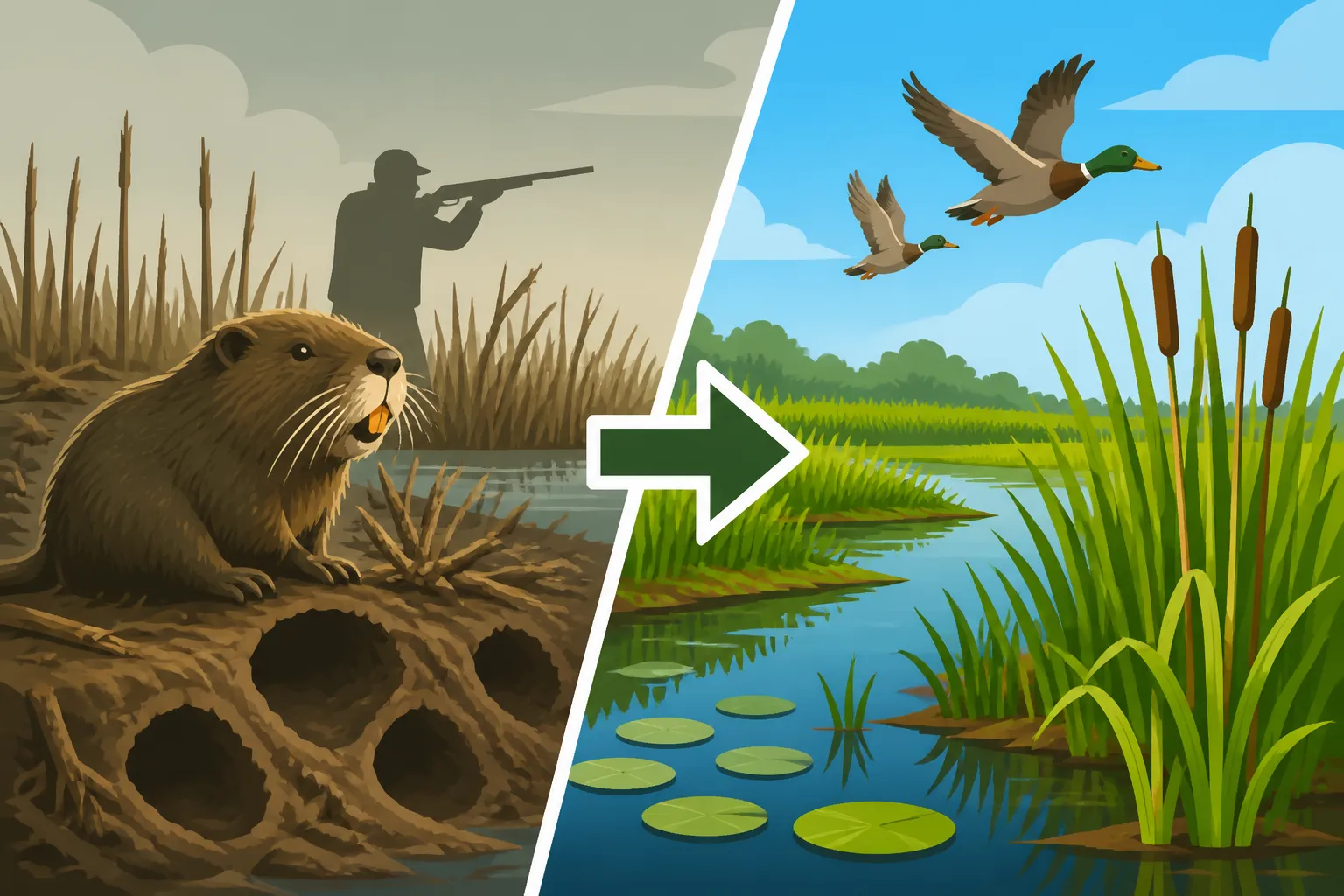
This table illustrates the stark contrast between a nutria-dominated marsh and a recovered, nutria-free marsh:
| Feature | Before Nutria Eradication (Nutria Dominant) | After Nutria Eradication (Marsh Recovered) |
|---|---|---|
| Vegetation | Severely degraded, eat-outs, barren mudflats | Dense native grasses (three-square, cattail) |
| Erosion | High, rapid marsh loss | Reduced, stabilized shorelines |
| Waterfowl | Declining populations, poor habitat | Increased populations, abundant food/cover |
| Muskrats | Severely reduced due to competition | Thriving populations, increased trapping |
| Sika Deer | Degraded habitat, forced movement | Improved habitat, healthier populations |
| Overall Health | Unstable, collapsing ecosystem | Resilient, diverse, thriving ecosystem |
Long-Term Implications for Marsh Health and Hunting
The long-term implications of the nutria eradication are overwhelmingly positive. It stands as a powerful example of successful conservation intervention. The marshes are more resilient, better able to withstand the impacts of rising sea levels and intense storms, and more effectively filter water entering the Chesapeake Bay. This ecological restoration is a massive win for everyone who values the Bay.
For hunters, the eradication has revitalized opportunities. Whether you're chasing sika deer through the tall marsh grasses or setting out decoys for ducks in a rejuvenated tidal gut, the health of the marsh directly translates to the health of the game populations. It underscores the importance of habitat in maintaining sustainable hunting. It also highlights the responsibility we, as hunters and conservationists, have to be vigilant about protecting these fragile ecosystems from future threats. Using tools like GoHunt, hunters can better visualize and understand the changes in marsh topography and vegetation density over time, helping them adapt their strategies to these healthier environments.
Sustaining the Recovery: Looking Ahead for Maryland's Marshes
While the nutria eradication was a monumental success, the work of preserving Maryland's marshes is never truly finished. Nature is dynamic, and new challenges are always on the horizon. The ongoing health of these wetlands, and the hunting opportunities they provide, depend on continued vigilance and proactive management.
The story of the nutria eradication is a powerful reminder that invasive species can have devastating effects, but also that dedicated, science-driven conservation efforts can make a world of difference.
Continued Monitoring and Management
One of the key lessons learned from the nutria saga is the importance of ongoing monitoring. While Maryland is currently considered nutria-free, there's always a risk of reintroduction from neighboring states or accidental release. Therefore, regular surveillance programs are essential to detect any potential new incursions quickly and address them before they can establish a foothold.
Conservation agencies continue to monitor marsh health, tracking vegetation growth, erosion rates, and wildlife populations. This data helps them understand the long-term trends and identify any new threats or areas that might need intervention. This isn't just about preventing another nutria crisis; it's about continuously adapting to the challenges of climate change, pollution, and development pressures that impact our wetlands. Land management agencies, often working with organizations like GoHunt to track habitat changes, are always striving to keep our marshes healthy and vibrant.
The Role of Hunters in Conservation
Hunters play a crucial role in sustaining the recovery of Maryland's marshes. Our passion for the outdoors and our reliance on healthy ecosystems make us natural conservation partners. One of the most important ways hunters contribute is through purchasing hunting licenses and stamps, the funds from which directly support wildlife management and habitat restoration projects, including those in marsh environments.
Beyond financial contributions, hunters are often the first to notice changes in the landscape or wildlife populations. Being observant in the field, reporting unusual sightings of potentially invasive species, or participating in volunteer habitat projects all contribute to the long-term health of the marshes. When you're out Marsh Hunting Sika Deer by Boat or pursuing ducks, you're not just enjoying the sport; you're also serving as an extra set of eyes and ears for the health of that ecosystem. Understanding the regulations for Boat Safety on the Chesapeake in December and adhering to them also ensures we're not inadvertently harming the very environment we love.
Protecting Marshes from Other Threats
Even without nutria, Maryland's marshes face a host of other challenges. Sea level rise is a significant long-term threat, gradually submerging coastal wetlands and altering salinity levels. Pollution from agricultural runoff and urban development can degrade water quality and harm marsh vegetation. Habitat fragmentation due to construction and infrastructure projects also takes its toll.
The success of the nutria eradication provides a blueprint for tackling these other threats: a combination of scientific research, dedicated funding, collaborative partnerships, and public engagement. Protecting our remaining marshes and restoring degraded areas is vital for the future of Maryland's hunting opportunities and the overall health of the Chesapeake Bay. It's a continuous effort that requires all of us to stay informed, engaged, and committed to being stewards of these incredible, irreplaceable natural resources. The lessons learned from fighting the nutria can empower us to face future challenges and ensure that Maryland's marshes continue to thrive for generations to come.
Disclaimer
This article is for general informational purposes only and does not constitute professional advice. Laws, prices and regulations vary by location and change over time. Consult a qualified professional for guidance on your specific situation.