Airgun Caliber Rules for Deer Hunting
It can feel like the world of deer hunting regulations is constantly shifting, especially when new technologies emerge. Many Maryland hunters are curious about airguns, looking for a different challenge or a quieter option, but the rules around what's legal for taking deer with them can be confusing and hard to nail down. This guide is here to unravel those specifics, helping you understand Maryland's airgun caliber requirements so you can pursue whitetails and sika deer ethically and within the law.
Understanding Maryland's Approach to Airguns for Deer
Airguns, sometimes referred to as pre-charged pneumatics (PCPs), have seen a resurgence in popularity among hunters. They offer a unique set of characteristics that appeal to many, but like any new tool, their integration into existing hunting regulations takes time and careful consideration by wildlife agencies. Maryland has embraced this new method, but with specific guidelines to ensure humane and responsible hunting practices.
Why Hunters Are Considering Airguns
The appeal of airguns for deer hunting is multifaceted. For starters, they are generally much quieter than traditional firearms, which can be a significant advantage in areas where noise might be a concern, or simply for a more stealthy approach in the woods. The recoil is also considerably less, making them more comfortable for some shooters, particularly those who might be sensitive to the kick of a high-powered rifle or shotgun. Plus, for many, it presents a fresh, often more challenging, way to hunt, demanding a higher level of precision and understanding of ballistics due to typically lower velocities and different projectile characteristics compared to centerfire cartridges.
There's a growing community of airgun enthusiasts who appreciate the engineering and accuracy modern airguns offer. These aren't your grandpa's pellet guns; today's high-powered air rifles are capable of delivering serious energy downrange, making them viable tools for medium-sized game like deer. They offer a unique opportunity to expand your hunting season options, especially in areas where firearms may have limited seasons or restrictions.
Maryland's Stance on Airguns for Deer
Maryland has been progressive in recognizing airguns as a legal method for hunting deer. The Maryland Department of Natural Resources (DNR) regularly reviews hunting methods and equipment, adapting regulations to incorporate safe and effective tools while maintaining conservation principles. This means that while airguns are permitted, they come with clear parameters that must be met to ensure they are used appropriately for the species in question. These regulations are designed to ensure that any animal harvested is done so quickly and humanely, reflecting a core principle of ethical hunting.
It's important to remember that these regulations are specific to deer. Airguns may or may not be legal for other game species, and the calibers and energy requirements would likely differ. Always consult the most current Maryland hunting guide for all species you intend to pursue. The inclusion of airguns reflects an understanding that technology can advance hunting methods, provided it aligns with responsible wildlife management.
The Specifics: Legal Airgun Calibers and Projectiles for Maryland Deer
When it comes to using an airgun for deer in Maryland, the devil is truly in the details. You can't just grab any air rifle; there are precise requirements for caliber and projectile energy that must be met to ensure a humane kill. Understanding these specifics is paramount before heading afield.
Minimum Caliber for Whitetails and Sika
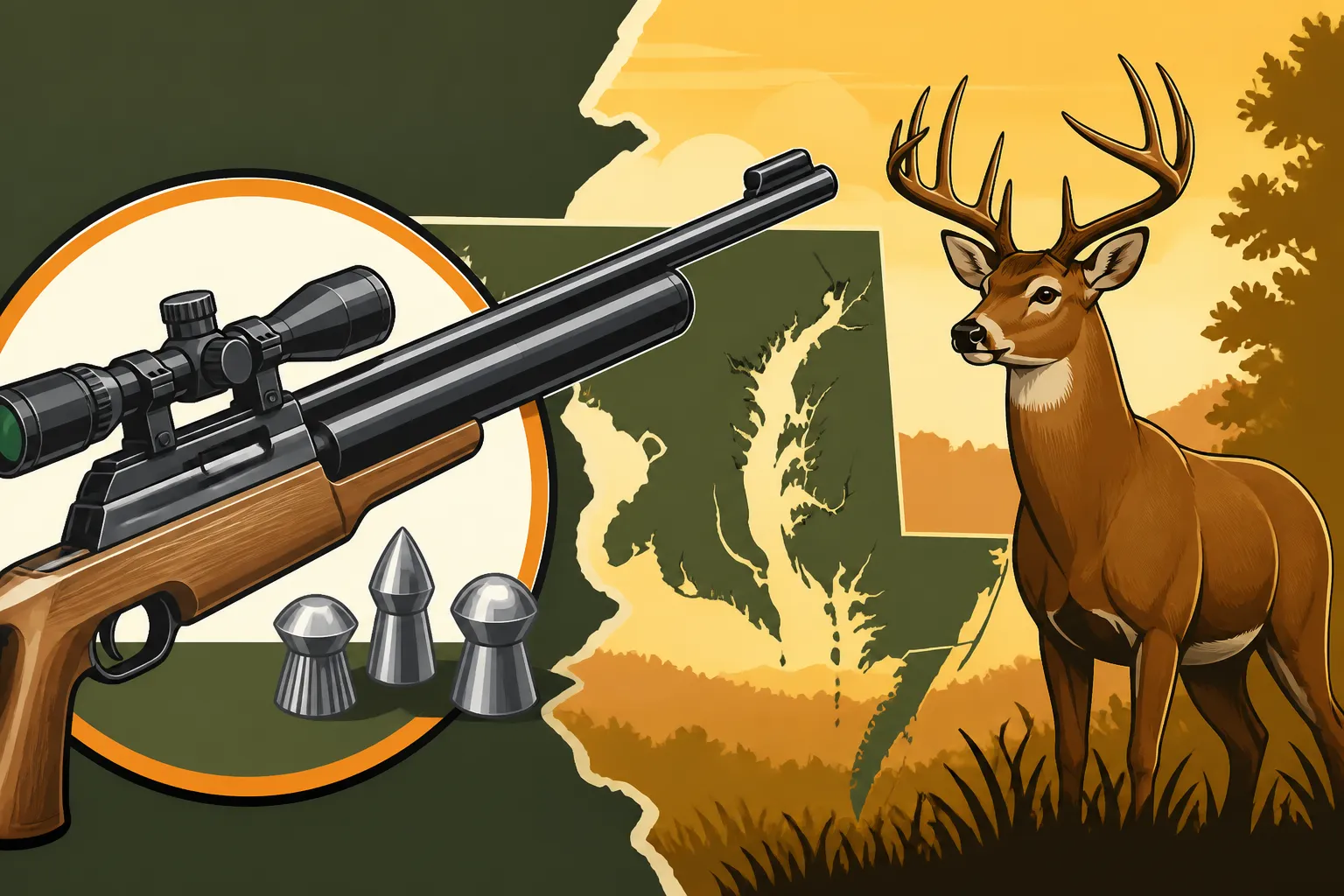
Maryland law explicitly states the minimum caliber for airguns used to hunt deer. For both white-tailed deer and sika deer, your airgun must be a minimum of .40 caliber. This isn't just a suggestion; it's a hard rule. Anything smaller, regardless of its perceived power or bullet design, is not legal for deer hunting in the state. This minimum caliber ensures that the projectile has sufficient mass and diameter to create an adequate wound channel for a quick, ethical harvest.
This requirement is in line with many other states that have opened up airgun hunting for deer, aiming for a balance between allowing new hunting methods and upholding responsible hunting practices. If you're out scouting and using a comprehensive tool like GoHunt to mark your property boundaries and potential deer movement, it's just as crucial to know that your chosen weapon system aligns with the law as it is to know where you can legally hunt. Failing to meet this caliber requirement can lead to fines and penalties, and more importantly, risks injuring an animal without harvesting it.
Projectile Types and Energy Considerations
Beyond the .40 caliber minimum, Maryland regulations also specify that the airgun must use a single projectile. This means no shotgun-style loads or multiple pellets from one shot. We're talking about a solid slug or pellet designed for big game. While the regulations don't explicitly state a minimum foot-pounds of energy (FPE) at the muzzle or at impact for airguns, the .40 caliber minimum strongly implies an expectation of sufficient power. Generally, for ethical deer hunting with any weapon, a projectile needs to deliver enough energy to penetrate vital organs and cause rapid incapacitation.
Many reputable airgun manufacturers, such as those producing models like the Umarex Hammer or the Benjamin Bulldog, design their .40 caliber and larger air rifles specifically for big game, ensuring they meet the energy demands for humane hunting. When selecting your ammunition, look for heavy, solid slugs designed for deep penetration, rather than lighter, hollow-point pellets meant for small game or target shooting. The effectiveness of your airgun isn't just about caliber, but also about the projectile's weight, construction, and its ability to retain energy downrange.
Here's a quick reference for common airgun calibers and their suitability for deer in Maryland:
| Caliber | Maryland Deer Legal | Common Use | Notes |
|---|---|---|---|
| .177 | No | Small Game, Target | Far too small for deer. |
| .22 | No | Small Game, Target | Too small for deer. |
| .25 | No | Small Game, Target | Insufficient for deer. |
| .30 | No | Medium Game (hogs, coyotes in some states) | Below Maryland's minimum for deer. |
| .357/.9mm | No | Medium Game | Below Maryland's minimum for deer. |
| .40 | Yes | Deer, Hogs, Predator | Minimum legal caliber for deer in MD. |
| .45 | Yes | Deer, Hogs, Bear | Excellent choice if you meet other regulations. |
| .50+ | Yes | Deer, Hogs, Bear | Powerful options, ensure accuracy. |
Note: This table focuses solely on Maryland deer hunting regulations. Always verify local and state laws for other game species or locations.
Airgun Restrictions by County and Public Land
One of the often-overlooked aspects of Maryland hunting is that weapon restrictions can vary by county and even by specific public lands. While airguns are generally legal statewide for deer if they meet the caliber requirements, it is absolutely critical to check county-specific regulations, especially in more populated areas. Some counties have restrictions on discharging firearms that might extend to airguns, or they may specify particular weapons like shotguns-only for deer hunting. For instance, counties within Region B often have more liberal antlerless deer bag limits, but the legal weapons might be restricted.
Similarly, if you plan on hunting Maryland's Public Hunting Land in a Wildlife Management Area (WMA) or State Forest, always check their specific rules. Some WMAs may have additional restrictions or require special permits, which could impact airgun use. This is where tools like GoHunt become invaluable for overlaying public land boundaries with regulatory information, helping you avoid accidental trespass or violations. For example, some areas might be designated "Archery Only" or restrict specific weapon types. Never assume your legal airgun caliber is permissible everywhere without confirming. These localized rules are crucial to avoid any unwelcome surprises during your hunt.
Practical Considerations for Airgun Deer Hunters
Once you've confirmed that your airgun meets Maryland's caliber requirements, the next step is to prepare for a successful and ethical hunt. Airgun hunting, while similar to other methods in many respects, has its own nuances that require careful consideration.
Choosing the Right Airgun for Maryland Deer
Selecting the right airgun goes beyond just meeting the .40 caliber minimum. You need a rifle that is powerful enough, accurate, and reliable. Look for high-quality Pre-Charged Pneumatic (PCP) air rifles from reputable brands that specialize in big game hunting. These will typically offer consistent power delivery and the accuracy needed for ethical shots. Brands like AirForce Airguns, Benjamin, Umarex, and FX Airguns produce models that are well-regarded for their power and precision. The rifle's power plant, often measured in foot-pounds of energy (FPE), needs to be substantial enough to drive a heavy .40 caliber slug with enough velocity for penetration.
Consider the rifle's ergonomics and weight. You'll be carrying this through the woods, potentially for long hours, so it needs to be comfortable to handle and steady to shoot. A good scope is non-negotiable for airgun hunting, as precise shot placement is paramount. Invest in quality optics that can hold zero and offer clarity, especially in low light. Many airgun hunters opt for variable power scopes that allow for versatility between close-range and slightly longer shots. Remember, this isn't just about taking any shot, but taking an ethical shot.
Ethical Shooting and Shot Placement
This is where airgun hunting truly demands discipline and skill. Due to the inherent ballistic characteristics of airgun projectiles (generally lower velocity and a more pronounced trajectory arc compared to centerfire rifles), shot placement becomes even more critical. You must aim for the absolute vitals – the heart and lungs – and only take shots when you are confident in your ability to hit that precise spot. Broadside shots are typically preferred, aiming just behind the shoulder. Avoid quartering shots or head-on shots unless you have absolute confidence and an intimate understanding of deer anatomy and your airgun's capabilities.
The effective range of an airgun for deer is significantly shorter than a high-powered rifle. While a .40 caliber airgun might be capable of sending a slug out to 100 yards, the ethical hunting range for deer is often much closer, typically within 50-70 yards, depending on the specific rifle, projectile, and shooter's proficiency. It’s crucial to establish your maximum ethical range through extensive practice at the shooting range. This range is where you can consistently place shots within a 2-3 inch circle, mimicking the vital zone of a deer. If you're used to longer shots with a rifle, this will be a significant adjustment, requiring you to get much closer to your quarry, much like a bowhunter would. This close-range requirement makes scouting for pinch points and dense cover even more important. Learning to read sign in Maryland Mountain Timber or even just how to set up on a Maryland Grain Field Edge will be essential for closing the distance.
Preparing for an Airgun Deer Hunt
Preparation for an airgun deer hunt mirrors that of any other hunting method, but with some specific additions. First, zero your rifle meticulously. Since trajectory is more pronounced, knowing your holdovers or hold-unders at various distances is critical. Practice at different ranges to understand your airgun's ballistic curve. Many airgunners use ballistic calculators or apps, some even integrating with tools like GoHunt to visualize shot trajectories in relation to terrain.
Secondly, you'll need a reliable way to recharge your airgun. Most high-powered PCPs require a high-pressure air source, either from a dedicated carbon fiber tank (often filled at dive shops or specialty airgun stores) or a hand pump. Ensure you have enough air for your hunting trip, considering multiple shots or potential misses. Carrying a smaller buddy bottle or a portable hand pump might be wise for multi-day hunts or remote locations.
Lastly, scout your hunting area with your airgun's effective range in mind. Identify natural funnels, bedding areas, and feeding zones that will allow you to get within your ethical shooting distance. Consider the quiet nature of the airgun; you might be able to get closer to deer than with a firearm. However, the limited range also means you must be more patient and strategic in your movements. Understanding the deer movement patterns, like those created by Late Season Food Sources for Maryland Deer, becomes vital.
Integrating Airguns into Your Maryland Deer Hunting Strategy
Embracing airguns for deer hunting in Maryland isn't just about the hardware; it's about fitting this method into the broader regulatory framework and your personal hunting strategy.
Obtaining Your Maryland Hunting License and Stamps
Before you even think about purchasing an airgun for deer, you must have the proper Maryland Hunting Licenses and What They Cost. This includes a basic hunting license, and importantly, an Archery Stamp Cost and Who Needs One. Yes, even though it's not a bow, Maryland often classifies airguns for deer under the "Archery" or "Muzzleloader" regulations when it comes to season dates and stamps, primarily due to their shorter effective range and similar hunting tactics. Always confirm the most current stamp requirements with the Maryland DNR. A quick check of the Maryland Resident License Options will show you exactly what's needed.
Beyond the general license, you'll also need the appropriate deer stamps to cover the antlered or antlerless deer you plan to harvest. The process for buying a Maryland License Through COMPASS is straightforward, but don't wait until the last minute. Ensure all your paperwork is in order before you step foot in the woods.
Understanding Deer Bag Limits and Seasons
Your airgun, once properly licensed, will typically fall into the same season dates as archery or muzzleloader hunting, providing ample opportunity to hunt both white-tailed deer and sika deer. This means you can take advantage of the extended archery seasons, which often open earlier than firearms seasons, allowing for a long archery season. Check the Maryland Deer Season Dates by Weapon for precise timings. Be aware of Maryland's Deer Bag Limits and Antler Rule, which apply universally regardless of weapon choice. For instance, in Region B, you might have How Many Antlerless Deer Region B Allows, which an airgun can help you fulfill.
Hunting in the early to mid-November rut is a prime time, and an airgun allows you to be in the woods during this peak activity, potentially catching bucks on the move. Similarly, understanding the nuances of the late season, when deer are focused on remaining food sources, can be highly effective. The key is to match your hunting strategy to the capabilities of your airgun and the specific season dates it's legal for.
Registering Your Harvest and Other Important Rules
After a successful airgun hunt, the process for registering your deer is the same as for any other legal weapon. You must register your deer within 24 hours of harvest. This can typically be done online through the Maryland DNR's COMPASS portal or by phone. Make sure you have your confirmation number readily available, as this is crucial for legal possession. What a Deer Confirmation Number Is For is to prove your harvest is legal.
It's also essential to be aware of other general hunting regulations that apply to all hunters, such as Maryland Blaze Orange Requirements, especially if you're hunting during periods when firearms hunters are also in the field. Even if you're using a quieter airgun, safety regulations around visibility are paramount. Additionally, if you're considering hunting in a CWD Management Area, be aware of any special rules regarding carcass movement or testing, as these rules apply to all harvested deer, regardless of weapon type. Always err on the side of caution and adhere strictly to all Maryland hunting regulations to ensure a safe, legal, and responsible hunting experience.
Disclaimer
The information provided in this guide is for general informational purposes only and does not constitute legal advice. Hunting regulations in Maryland are subject to change. It is the responsibility of every hunter to consult the most current Maryland Department of Natural Resources (DNR) hunting guide and relevant county or public land regulations before engaging in any hunting activities. Always prioritize safety and ethical hunting practices.