Aging a Deer by Its Teeth
It's an age-old question every hunter asks themselves when they walk up to a harvested deer: "How old was this animal, really?" We might make a quick guess based on antler size or body mass, but those can be deceiving. If you're serious about understanding the deer you harvest and contributing to better management, learning to age a deer by its teeth offers a scientific, reliable method to gain valuable insight after the shot. This guide will walk you through the practical steps and knowledge you need to become proficient at this crucial skill right here in Maryland.
Why Aging a Deer Matters Beyond Bragging Rights
For many years, hunters often focused solely on antler size to judge a buck, but as we’ve learned more about deer biology and herd health, the importance of age has become clearer. Knowing the true age of a deer adds a whole new layer to your hunting experience and decision-making.
Making Informed Management Decisions
Understanding the age structure of your local deer herd, whether on public land or a private lease, is a cornerstone of effective wildlife management. If you consistently harvest young deer, it might indicate a herd struggling to reach maturity, perhaps due to overharvesting or poor habitat. Conversely, a good mix of age classes suggests a healthy, balanced population. When you register a deer in Maryland, providing accurate age data, even if you just record it for your own records, helps build a larger picture. It helps us understand how many deer Maryland holds and their general health.
Improving Your Hunting Strategy
Think about it: a 1.5-year-old buck is going to behave very differently from a 4.5-year-old patriarch. Knowing the age structure on your hunting grounds helps you tailor your approach. For example, if you're consistently seeing younger bucks and want to target more mature animals, you might adjust your stand locations, hunting times, or even your overall strategy to focus on areas where older deer might be present. This knowledge can influence decisions like where to hang a stand on a Maryland farm edge or what kind of grunt calls in Maryland hardwoods might be most effective for different age classes. It's about more than just pulling the trigger; it's about understanding the nuances of the game you pursue.
Personal Satisfaction and Connection to the Animal
Beyond the scientific and strategic benefits, there's a profound sense of satisfaction that comes from truly understanding the animal you've harvested. Knowing its age, envisioning its life cycle, and appreciating its journey adds a deeper, more respectful connection to the hunt. It moves beyond just a trophy and becomes a narrative. While antlers are often the initial draw, understanding how old a three-point buck usually is, and comparing that to its overall body size, can be very revealing. It helps you appreciate the individual animal and its place within the larger ecosystem.
Understanding Deer Anatomy: The Teeth You Need to Know
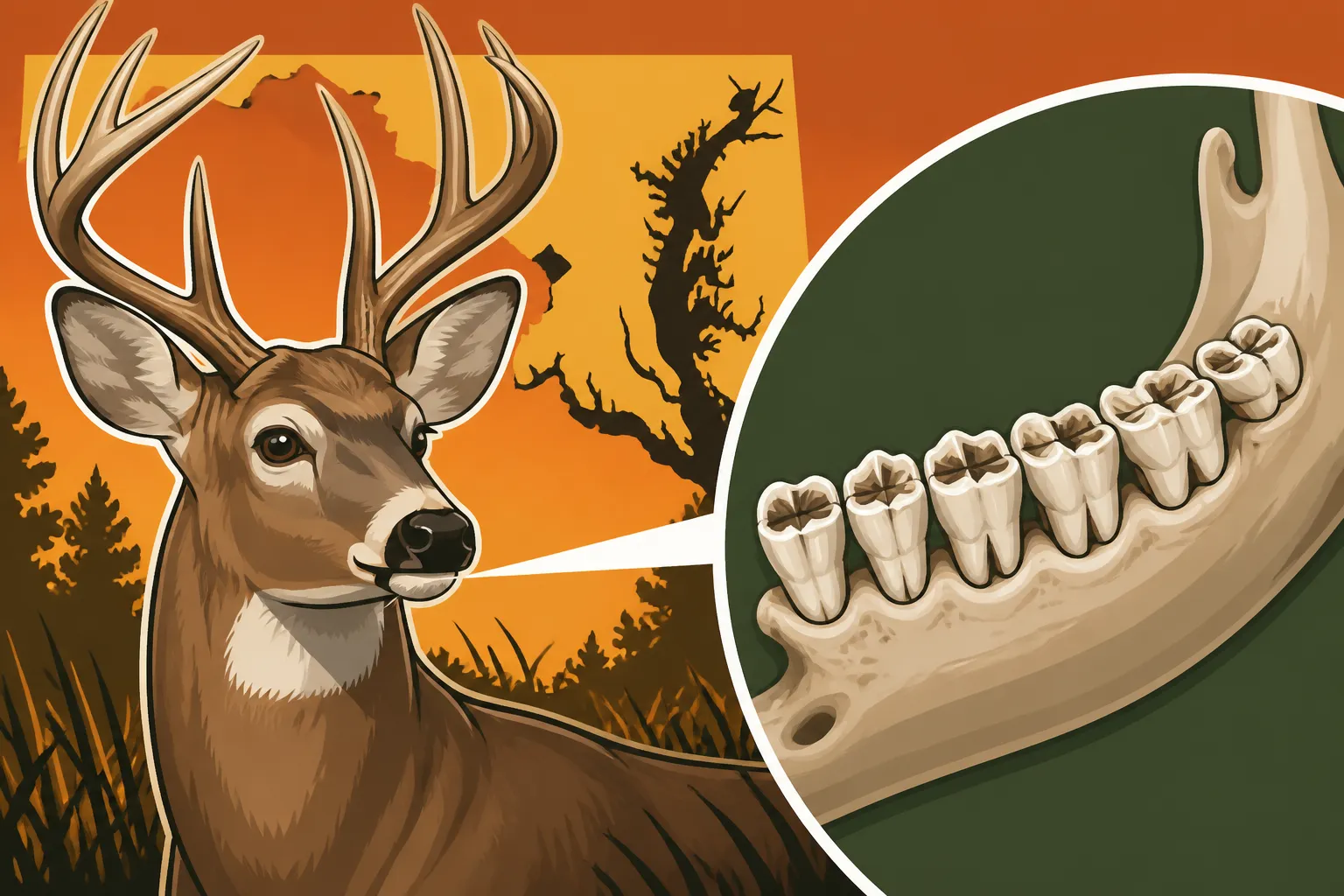
Before we dive into the specifics of aging, it's essential to familiarize yourself with the deer's dental structure. It might sound a bit academic, but trust me, a quick primer on which teeth are where will make the actual aging process much smoother. We're primarily looking at the lower jaw, as these teeth are the most reliable indicators of age.
The Incisors and Canines
At the very front of the lower jaw, you'll find the incisors. These are the flat, chisel-like teeth that deer use for biting and tearing vegetation. Behind them, though less prominent, are the canines. While important for feeding, these front teeth aren't as crucial for aging as the teeth further back in the jaw. They're good for quick glances to make sure the jaw is complete, but the real work happens with the molars and premolars.
The Premolars and Molars
This is where the magic happens for aging. Deer have three premolars and three molars on each side of their lower jaw, for a total of six chewing teeth per side.
- Premolars: These are the first three chewing teeth, located towards the front of the jaw, just behind the canines (if present). They are usually replaced by permanent teeth as the deer matures.
- Molars: These are the last three chewing teeth, located further back in the jaw. Unlike premolars, molars are not replaced; they erupt and wear down over time.
The distinction between premolars and molars, and whether they are milk teeth or permanent teeth, is fundamental to accurately aging younger deer.
Deciduous (Milk) Teeth vs. Permanent Teeth
Just like humans, deer are born with a set of "milk teeth" (deciduous teeth) that are eventually replaced by permanent adult teeth. This transition is a key indicator for aging deer up to about 2.5 years old. The deciduous premolars are typically smaller and have a different crown shape than their permanent counterparts. They also tend to be much sharper and less worn than the permanent teeth that replace them.
The Nitty-Gritty: How to Age a Deer by Tooth Wear
Now, let's get down to business. Aging a deer by its teeth involves carefully examining the lower jaw to assess the presence of milk teeth, the eruption sequence of permanent teeth, and the degree of wear on the chewing surfaces of the molars. Always remember to check both sides of the jaw, as wear can sometimes be uneven. Using a tool like GoHunt's habitat maps can sometimes give you clues about the types of forage available in the area, which might influence tooth wear patterns, although this is secondary to direct observation.
Aging Fawns and Yearlings (0.5 to 1.5 Years Old)
This is perhaps the easiest age group to identify due to the distinct changes happening in their dentition.
- 0.5 years (Fawn): At six months old, a fawn typically has three milk premolars and one to two permanent molars erupted. The key identifier here is the third premolar, which will have three cusps (or points). This three-cusp milk premolar is a dead giveaway for a fawn. The first molar will usually be fully erupted, and the second molar might be just breaking through the gum line.
- 1.5 years (Yearling): By 18 months, significant changes have occurred. The most important indicator is the replacement of the milk premolars with permanent premolars. The permanent third premolar will have two cusps, not three. This is the critical difference from a fawn. All three permanent molars (M1, M2, M3) should be fully erupted, but they will show very little wear. The third molar (M3) might still be relatively unworn compared to the first and second molars, which will have sharp, defined cusps.
Aging Young Adults (2.5 to 3.5 Years Old)
Once a deer has all its permanent teeth, we start relying more on wear patterns. This takes a bit more practice and a keen eye.
- 2.5 years: All permanent teeth are now fully erupted. The cusps on the first molar (M1) will show some noticeable wear, but the distinct enamel ridges will still be higher than the dentin (the darker, softer material inside the tooth). The third molar (M3) will likely still have relatively sharp cusps, particularly on the back edge.
- 3.5 years: At this age, the wear on the first molar (M1) will be more pronounced, with the dentin starting to broaden and merge, making the enamel "islands" appear smaller. The second molar (M2) will also show significant wear, but the cusps are still well-defined. The third molar (M3) will have begun to show moderate wear, particularly on the front cusps. You might start to see the dentin of the back cusps on the M3 widening.
Aging Mature Deer (4.5+ Years Old)
Aging older deer becomes increasingly challenging, as tooth wear rates can vary based on diet. For instance, deer in areas with abrasive forage, like certain parts of Western Maryland's mountains, might show more wear than deer in areas with softer vegetation. This is why consistently checking what Maryland deer eat through winter or in different seasons can help contextualize your findings.
- 4.5 years: The first molar (M1) will be heavily worn, with the cusps often worn flat and the dentin usually wider than the surrounding enamel. The second molar (M2) will show heavy wear, with broad dentin. The third molar (M3) will have considerable wear, with the front cusps often worn completely flat or significantly rounded. The back cusps of M3 will also show substantial rounding and flattening.
- 5.5 years and older: Beyond 5.5 years, it gets much tougher to distinguish individual age classes. The teeth become progressively flatter, with enamel ridges often disappearing, and the chewing surfaces becoming smooth, like dinner plates. The teeth may also begin to angle outwards as they wear down further into the jaw. The overall height of the crown of the tooth will be much shorter, and the roots of the teeth might even be visible above the gum line in very old deer.
Step-by-Step Tooth Examination
Here’s a practical guide to examining a deer’s jaw:
- Prepare the Jaw: The best way to get a clear view is to remove the lower jawbone. You can do this by making an incision from the corner of the mouth, cutting along the jawline to the back, and then cutting through the soft tissue and muscle connecting the jaw to the skull. A stout knife or even a small saw might be needed to separate the jaw at the hinge and at the front where the two halves meet. For more detailed insights, you can even boil the jawbone to clean it thoroughly, but this isn't strictly necessary for field aging.
- Locate the Key Teeth: Focus on the premolars and molars on one side of the lower jaw.
- Check for Premolar Replacement: First, identify if the third premolar has three cusps (fawn) or two cusps (1.5 years and older). This is your initial, crucial step.
- Assess Molar Eruption: For young deer, confirm that all three molars are fully erupted.
- Examine Wear Patterns: Once you know all permanent teeth are in, you'll start looking at the wear. Pay close attention to the distinctness of the cusps versus the width of the dentin. Look for the "dark islands" of dentin versus the surrounding enamel. As deer age, these dentin islands become wider and eventually merge.
- Use a Magnifying Glass (Optional but Recommended): A small jeweler's loupe or magnifying glass can be incredibly helpful for seeing the fine details of tooth wear.
Here’s a summary table to help you in the field:
| Age Class (Years) | Key Characteristics of Lower Jaw Teeth |
|---|---|
| 0.5 (Fawn) | 3rd premolar has 3 cusps (milk tooth); 1st and often 2nd molars erupted; very little wear. |
| 1.5 (Yearling) | 3rd premolar has 2 cusps (permanent tooth); all 3 molars erupted; very little wear on molars, especially M3. |
| 2.5 | All permanent teeth; M1 shows moderate wear (dentin narrower than enamel); M2 and M3 have sharp cusps, minimal M3 wear. |
| 3.5 | M1 shows heavy wear (dentin as wide or wider than enamel); M2 shows moderate wear; M3 has noticeable wear, particularly on front cusps. |
| 4.5 | M1 heavily worn, cusps often flat; M2 shows heavy wear with broad dentin; M3 shows considerable wear, cusps rounded/flattened. |
| 5.5+ | Teeth are very flat, enamel ridges disappearing; dentin much wider than enamel on all molars; teeth may appear shorter or angled in jaw. |
Limitations and Other Factors to Consider
While tooth aging is a powerful tool, it’s not without its nuances. Being aware of these limitations can help you make the most accurate assessment possible.
Regional Differences in Diet and Wear
The type of forage a deer consumes can significantly impact how quickly its teeth wear down. Deer living in areas with sandy soils or tough, fibrous plants might exhibit more rapid tooth wear than those in lush agricultural areas. In Maryland, a deer grazing on acorns and hard mast in a Western Maryland forest might show different wear patterns than one primarily eating soybeans on the Eastern Shore, or the specific marsh grass of the Sika deer in Dorchester County. These are subtle differences that experience helps you calibrate for. This is where understanding late season food sources for Maryland deer can provide context to your observations.
Beyond Just Teeth: Antler Development and Body Condition
While teeth provide the most accurate age, other factors can offer supporting evidence or help you make a field estimate. Antler development is often a poor indicator of age alone, as genetics, nutrition, and habitat quality play huge roles. For instance, a 2.5-year-old buck in prime habitat might have a much larger rack than a 3.5-year-old buck in poor habitat. However, a heavily worn set of teeth on a deer with a small, spindly rack might suggest an older deer whose body is past its prime, whereas a deer with robust antlers and body size and moderate tooth wear points to a younger, healthier animal. When you're in the field, tools like GoHunt can help you scout Maryland public land before season by revealing potential food sources and habitat types that influence antler growth and body condition.
When to Seek Expert Confirmation
Don't feel like you have to be a dental expert overnight! There are resources available. Maryland DNR staff are often willing to help age deer, particularly during check-ins at designated locations or through specific programs. If you’re truly stumped, or just want to confirm your assessment, don't hesitate to reach out. It’s all part of the learning process and contributes to better data for everyone involved in Maryland's deer management, especially when considering the rules for Maryland's two deer management regions. Knowing how to register a Maryland deer by phone or app also provides an opportunity to share information that contributes to these larger data sets.
Learning to age a deer by its teeth is a skill that takes practice, but it's incredibly rewarding. It allows you to move beyond simple guesswork and truly understand the individual animals you encounter in the field, making you a more informed and conscientious hunter.
Disclaimer
This article is for general informational purposes only and does not constitute professional advice. Laws, prices and regulations vary by location and change over time. Consult a qualified professional for guidance on your specific situation.