Hunting a Utility Right-of-Way Cut
It's tough out there trying to find a consistent honey hole, especially in Maryland where public land can feel like a parking lot on opening day or private ground is locked up tighter than Fort Knox. But what if I told you there are overlooked corridors weaving through our landscape, often holding deer, turkeys, and small game, that many hunters completely miss or dismiss? We're talking about utility right-of-way cuts – those linear clearings beneath power lines, gas pipelines, or other infrastructure that carve through woods and fields. This guide is all about helping you unlock the hunting potential of these unique, often-productive areas, whether you're dealing with crowded public tracts or trying to maximize a small private parcel.
Why Utility Rights-of-Way are Game Magnets in Maryland
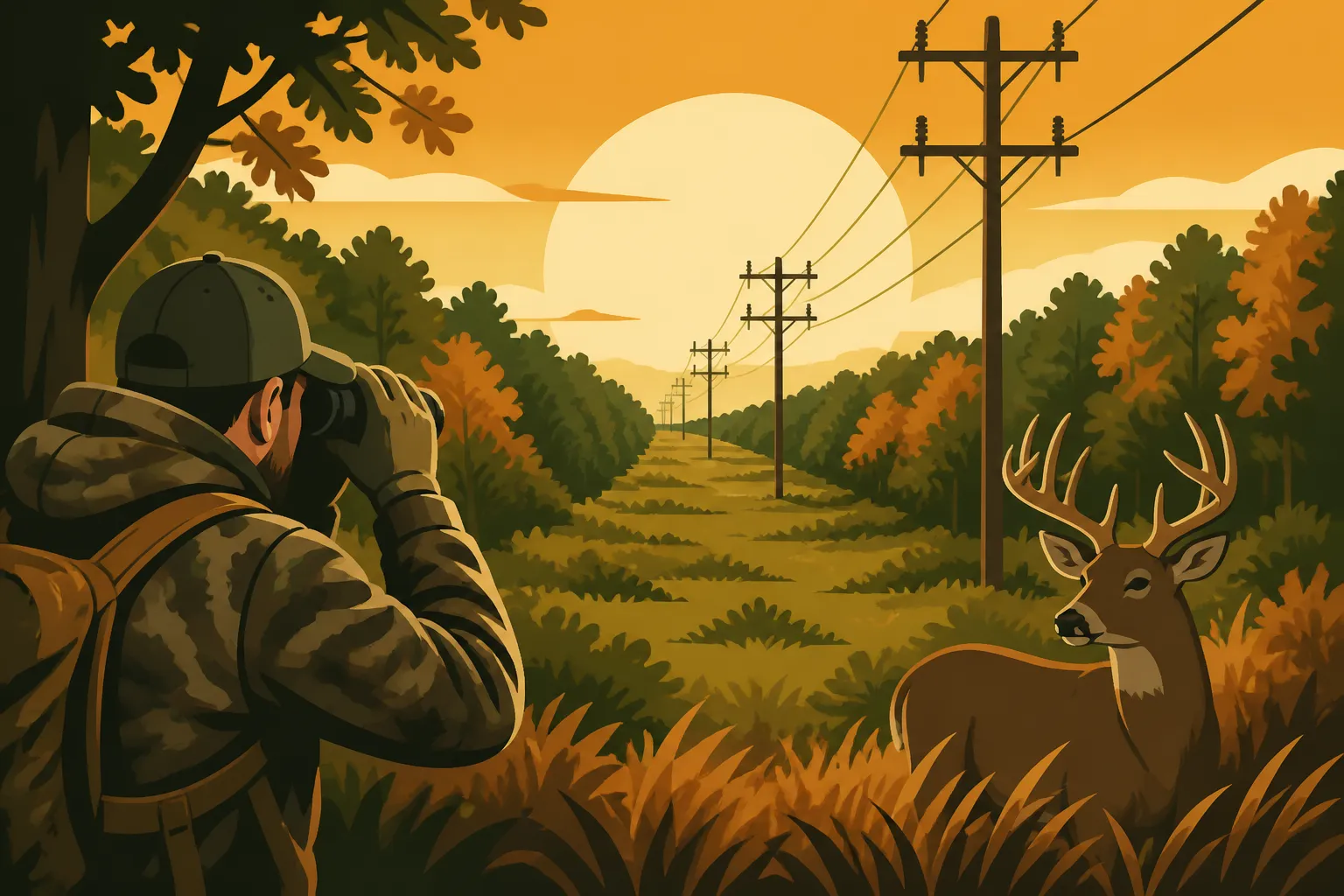
When you look at a utility right-of-way (ROW) on a map, it might just seem like a straight, open line. But to a deer, a turkey, or even a rabbit, it can represent a smorgasbord of food, a safe travel lane, and prime bedding cover. These cuts are maintained clear of tall trees, creating a perpetually "disturbed" edge habitat that wildlife absolutely thrives in, especially in an otherwise mature, monotonous forest.
Edge Habitat and Food Sources
Think about it: wherever you have a sharp transition between two different habitat types, you create an "edge effect." Utility rights-of-way are essentially massive, linear edges. On one side, you have the tall, mature timber that might not produce much browse close to the ground. On the other, you have the open, sun-drenched corridor itself. This sun exposure allows a diverse array of early successional plants to flourish – native grasses, briars, berry bushes, young saplings, and all sorts of forbs that are incredibly nutritious for deer. These are often plants that wouldn't stand a chance under a dense forest canopy. For instance, in the fall, those blackberry thickets or wild apple trees along the edge of a powerline can be absolute magnets for a hungry whitetail or even a opportunistic black bear searching for a meal before denning up.
This isn't just about deer, either. Turkeys love the insects found in these open, grassy areas and will often scratch for bugs or dust themselves in the exposed dirt. Rabbits and various small game species like the dense briar patches and low-lying vegetation for both food and escape cover. The repeated cutting to maintain the ROW keeps this vegetation in a state of constant regeneration, providing fresh, tender growth year after year. It’s like a perpetually regenerating buffet for a lot of our game animals, which is why you’ll often find sign here even when the surrounding woods seem quiet.
Travel Corridors and Funnels
Beyond the food, these clearings act as natural superhighways for wildlife. Imagine a dense forest where a deer has to pick its way through thick underbrush and mature trees. Now picture that same deer encountering a wide-open utility cut. It’s often much easier and faster for them to travel along the edge of that clearing, or even directly across it, especially when moving between different bedding and feeding areas. These linear features naturally funnel movement. A deer might be bedding on one side of a ridge and feeding in a valley on the other. Instead of navigating the entire slope through thick timber, it might opt to follow a powerline cut that provides easier passage down or across.
Think about how human development impacts deer movement. Highways, neighborhoods, or even large agricultural fields can dictate how and where deer travel. A utility right-of-way often serves as a low-impact connector, allowing deer to traverse areas they might otherwise avoid. For a hunter, this means predictable travel patterns. If you can identify where deer are crossing a right-of-way to get from point A to point B, you've found a prime ambush point. I've often seen where a right-of-way crosses a small creek or a saddle between two ridges – these pinch points are gold mines for deer movement and can concentrate activity significantly. It's a prime example of Hunting a Funnel Between Two Grain Fields, but instead of grain, it's about the shape of the land itself.
Thermal Cover and Bedding Opportunities
While the main cut itself is open, the edges and especially any islands of vegetation within the right-of-way can provide excellent thermal cover and bedding opportunities. During a cold snap in December or January, those dense briar thickets along the edge, catching the afternoon sun, can be perfect spots for deer to bed down and escape the wind. Conversely, in the heat of early archery season, the shaded, cooler edges where the cut meets the tall timber can offer a comfortable spot.
Also, don't overlook any small, isolated patches of pines or cedars that might have been left within the ROW during clearing, or any areas where the maintenance hasn't been as rigorous, allowing denser regrowth. These pockets, even if small, can serve as excellent micro-bedding areas, especially if they offer good visibility for the deer into the open cut. A mature buck might just tuck into a small corner of thick stuff right along the edge, enjoying the sun in the clearing while still feeling secure with the dense timber at his back. When scouting, pay close attention to the way the sun hits these areas throughout the day and how the prevailing winds blow across them. These often dictate where a deer will choose to lie down.
Scouting a Right-of-Way: Reading the Landscape
Scouting a utility right-of-way isn't much different from scouting any other piece of prime hunting ground, but it does require a slightly different lens. You're looking for activity signs that are often magnified by the linear nature of the landscape.
Using Mapping Tools Effectively
Before you ever set foot on the ground, your mapping apps are your best friend. I can't stress this enough. Pull up your favorite tool, whether it's onX Hunt or GoHunt, and start dissecting that right-of-way from your couch. Look for where the ROW crosses significant terrain features: saddles, creek bottoms, finger ridges, or even just dense timber blocks. These are your initial hotspots. You’re essentially looking for natural choke points or areas that offer the easiest path for deer movement. Mark these potential crossing points or areas of concentrated edge.
Also, pay close attention to the land ownership layers. Utility rights-of-way often traverse both public and private land. Knowing exactly where those property lines fall is critical, not just for legality but for understanding potential access points and pressure. For public land, you might find that a ROW crosses a WMA or a state forest, offering you a readily accessible hunting spot. On private land, the ROW might be managed by the utility company, but the hunting rights typically belong to the landowner, so permission is still key. Tools like onX Hunt are invaluable for Finding Maryland Property Lines Before You Hunt and making sure you don't inadvertently trespass, which is a headache nobody needs.
Ground Scouting for Fresh Sign
Once you've narrowed down your potential areas with e-scouting, it's time to put boots on the ground. Walk the right-of-way. Start by looking for obvious deer trails crossing the cut, especially where it pinches down or where there's a slight dip in the topography. Deer are creatures of habit, and if they've used a certain crossing before, they'll likely use it again. Look for tracks in soft soil, especially after a rain. Check the edges for rub lines and scrape lines – these indicate where bucks are marking their territory and can be absolute magnets during the rut.
Don't just walk the middle of the cut. Spend significant time walking the edges where the woods meet the clearing. This is where most of the primary activity will be. Look into the treeline for trails paralleling the ROW. Observe the vegetation: are there browse lines on certain plants? Are there droppings indicating feeding activity? Pay attention to pinch points where the timber comes closer to the clearing, or where a thick briar patch forces deer to use a narrower corridor. During the early fall, I've had incredible success finding early season rubs right on the edge of a powerline where a buck was working over some young saplings. These little details tell a story, and you need to be a detective to read it.
Understanding Seasonal Changes and Food Availability
The productivity of a right-of-way can change drastically with the seasons. In early fall, those berry bushes and young succulent plants might be abundant. Later in the season, after a few hard frosts, deer might shift their focus to mast crops in the adjacent timber, but they'll still use the ROW for travel or to access remaining browse. As winter sets in, the thickest briar patches along the edge become critical thermal cover and a source of woody browse.
Keep an eye on what's growing in and around the cut. Are there oaks dropping acorns nearby? Are there standing soybeans or cut corn fields that the deer might be traveling to or from via the right-of-way? The availability of Late Season Food Sources for Maryland Deer can dramatically influence deer movement patterns. A right-of-way that looks dead in September might be teeming with activity in December if it provides the easiest route to a late-season food plot or a patch of winter browse. Adapting your scouting and hunting strategy to these seasonal shifts is crucial for consistent success.
Tactics for Hunting a Right-of-Way in Maryland
Hunting a utility right-of-way requires specific tactics because of its unique linear and often open nature. It's not like still-hunting a deep woods or sitting over a secluded food plot. You need to be smart about your approach and setup.
Stand Placement and Entry/Exit Routes
Given the open nature of many rights-of-way, stand placement is paramount. You want to be far enough back into the timber to remain concealed, but close enough to effectively cover the travel corridors and feeding areas along the edge of the cut. Look for mature trees that offer good cover from multiple angles, ideally with some background to break up your silhouette. A tree with a cluster of branches or some thick vines can offer fantastic concealment. Aim for a vantage point that lets you see a good stretch of the ROW, but also into the timber itself, as deer will often parallel the edge just inside the woods.
Consider the prevailing winds. With a long, open corridor, wind currents can be tricky. Often, the wind will "swirl" a bit more right on the edge. Try to set up for a crosswind or a wind that blows directly down the right-of-way, away from where you expect deer to approach. Your entry and exit routes are just as important. Plan them carefully to avoid spooking game. If you can use a ditch, a creek bed, or a fence line inside the timber to approach your stand undetected, do it. The goal is to get in and out silently, without disturbing the area you plan to hunt. I've messed up more hunts by a sloppy entry than almost anything else. It's why I'm always thinking about Hanging a Stand on a Maryland Farm Edge and how to approach it silently.
Still-Hunting and Spot-and-Stalk
While stand hunting is effective, rights-of-way also lend themselves incredibly well to still-hunting or spot-and-stalk tactics, especially for bowhunters. The open nature means you can often see game from a distance, allowing you to plan a careful stalk. This is particularly true in areas with rolling topography or where the ROW has some gentle curves. You might be able to glass an area, spot a deer feeding along the edge or crossing, and then use the timber as cover to close the distance.
When still-hunting, move slowly, taking a few steps and then pausing for several minutes to scan the area thoroughly. Use your binoculars constantly. Pay attention to every shadow, every flicker of movement. The edges of the right-of-way, where the dense timber meets the open clearing, are where you need to be most vigilant. This technique is especially good on less pressured public ground, or when you have a good sense of how Hunting Maryland's Two Deer Management Regions might influence deer behavior. It gives you the flexibility to adapt to changing deer movements throughout the day.
Dealing with Hunting Pressure
Let's be realistic: if a right-of-way is on public land, especially one that's easy to access, it's probably going to see some hunting pressure. The key is to find ways to hunt smarter than the crowds. This might mean walking a little further, getting into areas that others don't want to exert the effort to reach. Look for the less obvious crossings, or areas where the right-of-way ducks into a particularly nasty, thick patch of woods. Deer will often gravitate to these overlooked spots.
Another strategy is to hunt the right-of-way during less popular times or weather conditions. A rainy, cold weekday might deter many hunters, but deer still need to feed and move. If you're willing to brave the elements, you might have the place to yourself. Understanding Hunting Pressure on Maryland Public Land is vital. Sometimes, hunting just off the right-of-way, a hundred yards or so into the timber, can put you right in the path of deer that have been bumped by other hunters walking the main corridor. They'll often circle just inside the woods to avoid detection.
Safety and Regulations When Hunting Rights-of-Way
Hunting utility rights-of-way isn't without its specific safety considerations and regulatory nuances. These are active industrial corridors, and you need to be aware of the rules and potential hazards.
Navigating Public vs. Private Land Access
As mentioned earlier, knowing who owns the land under the right-of-way is absolutely crucial. A utility company typically owns an easement for the right-of-way, meaning they have the right to maintain it, but they don't necessarily own the land itself. The underlying landowner usually retains hunting rights. This means that if the right-of-way crosses private land, you must have permission from the landowner to hunt it. Even if it feels like open access, without permission, it's trespassing. For sections that cross public land like a WMA or state forest, you're generally good to go, but always double-check any specific regulations for that particular parcel, as some public lands have specific permit requirements or hunting zone restrictions.
I've heard stories of hunters getting into trouble because they assumed a powerline was "public" property. Always verify. Use your mapping apps, check with the Maryland Department of Natural Resources (DNR), or contact the landowner directly. It's better to be safe than sorry, and respecting property rights is fundamental to our hunting heritage. Maryland Trespass and Permission Law is clear on this, and ignorance is no excuse.
Understanding Setback Distances and Legal Light
Maryland has specific regulations regarding setback distances from occupied dwellings, roads, and other structures. These rules still apply when hunting a right-of-way. While the ROW itself might be cleared, you need to ensure your shot trajectory and stand location comply with all setback requirements. This is especially important in more suburban areas where rights-of-way might pass closer to residential properties. Never take a shot that could endanger people or property beyond your target.
Additionally, be mindful of Maryland Shooting Hours and Legal Light. You can only hunt from one half-hour before sunrise until one half-hour after sunset. The open nature of a right-of-way can make it seem brighter or darker than it actually is, so keep a watch on your clock, not just your eyes. Ethical hunting means adhering to these regulations to ensure a clean shot and safe conditions for everyone.
Blaze Orange Requirements and Visibility
Given the open nature of many right-of-ways and the potential for other users (utility workers, hikers, or even other hunters), wearing blaze orange during firearms seasons is not just a good idea, it's often legally required. How Much Blaze Orange Maryland Requires can vary by season and weapon, but generally, wearing a minimum of 250 square inches above the waist and a cap during the firearms deer season is mandatory. Even during archery or muzzleloader seasons when it might not be legally required, considering blaze orange for your walk in and out, or when moving through areas with higher visibility, is a smart safety practice.
The clearer visibility on a right-of-way also means you need to be absolutely sure of your target and what lies beyond it. With fewer trees to stop a projectile, responsible shooting becomes even more critical. Always assume another person might be present, even if you don't see them. The open nature can also make it easier for other hunters to see you, so if you're trying to stay concealed, make sure your stand placement accounts for this.
Right-of-Way Hunting Considerations by Season
Here's a quick look at how right-of-ways can offer opportunities throughout the Maryland hunting seasons:
| Season | Primary Game | Typical ROW Opportunity | Key Considerations |
|---|---|---|---|
| Early Archery | Deer, Turkey | Browse, soft mast (berries), travel corridors, dusting bowls for turkeys. | Focus on shaded edges, water sources, subtle transitions. |
| Muzzleloader | Deer | Travel funnels, browse, thermal cover on colder days. | Utilize visibility for longer shots, confirm legal weapons. |
| Firearms | Deer | Travel corridors between bedding/feeding, dense briars for cover. | High pressure, absolute need for blaze orange, confirmed shooting lanes. |
| Late Archery | Deer | Remaining browse, thermal cover, travel to late-season food. | Look for sun-exposed bedding, sheltered pockets. |
| Small Game | Rabbit, Squirrel, Fox | Briar thickets, downed logs, brush piles, open grassy areas. | Focus on dense cover, movement along brushy edges. |
| Fall Turkey | Turkey | Bugging areas, crossing points, areas with hard mast nearby. | Listen for calls, observe dusting and feeding activity. |
These utility rights-of-way might not be the most glamorous hunting spots, but they are incredibly consistent producers for those willing to scout them diligently and hunt them smartly. Don't overlook these linear oases; they might just hold the key to your next successful Maryland hunt!
Disclaimer
This article is for general informational purposes only and does not constitute professional advice. Laws, prices and regulations vary by location and change over time. Consult a qualified professional for guidance on your specific situation.