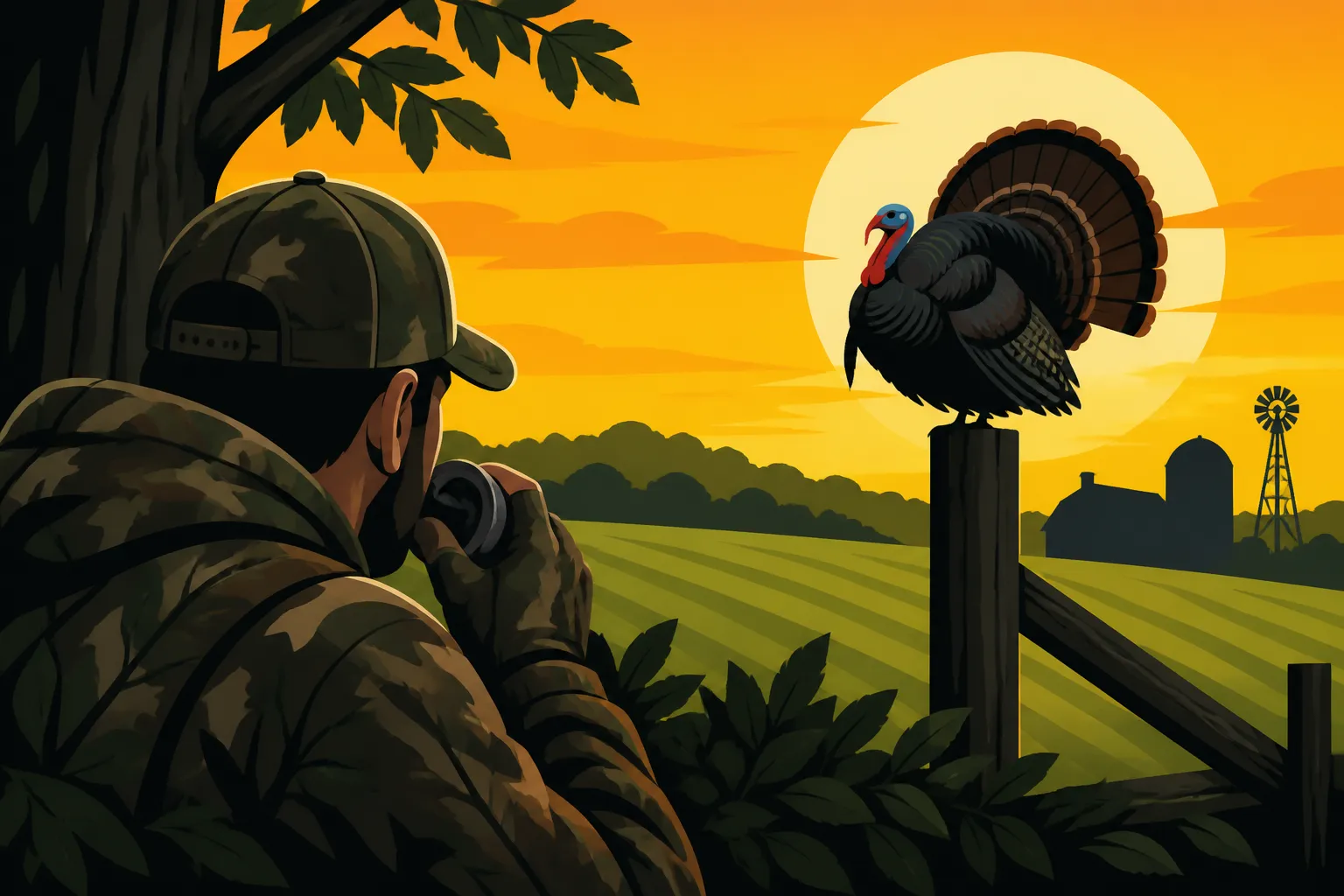
Calling a Gobbler Off a Maryland Farm Roost
There's nothing quite like the sound of a gobbler hammering from the roost as the first hint of daylight paints the eastern sky. It’s an electrifying moment that sets every turkey hunter's heart pounding. But let’s be honest, getting that bird to actually fly down in your direction, much less commit to your calls, can feel like trying to coax a stubborn mule. Those Maryland farm gobblers, especially, have a reputation for being wily, often flying down and heading straight for their hens or a distant field edge, leaving you wondering what went wrong. This guide is all about equipping you with the strategies and insights to transform those frustrating mornings into successful hunts, consistently calling gobblers off their Maryland farm roosts and into shooting range.
Decoding the Maryland Farm Gobbler's Morning Ritual
To consistently call a gobbler off a farm roost, you first need to understand his world and his daily patterns. These aren't the same birds you might find deep in a remote mountain forest; farm gobblers operate on a different set of rules.
Why Roosted Gobblers Are Different on Farmland
Maryland farm turkeys, particularly those residing on agricultural lands, tend to behave differently than their counterparts in more expansive, wilder timber. They often become accustomed to human activity—tractors, vehicles, even everyday chatter—which can make them less prone to outright panic from distant sounds, but incredibly wary of anything that directly threatens them. This familiarity also makes them more prone to being "pressured" birds, especially on properties that see a lot of hunting activity or where they are constantly interacting with agricultural operations.
Unlike forest gobblers that might have vast tracts of timber to descend into, farm birds often roost along wooded edges, creek bottoms, or in small woodlots surrounded by large, open fields. Their fly-down strategy is largely dictated by these surroundings. They're looking for safety, but also immediate access to food sources like waste grain, green fields, or bugs in a pasture, and prime strutting grounds where they can display for hens. This means they often fly down into these open areas or adjacent hedgerows, making them highly visible and prone to spotting anything out of place. They might be less inclined to walk a long distance through thick cover to a call if they can simply fly down and survey their domain.
The Critical Importance of Scouting Roost Trees
You can't call a gobbler off a roost if you don't know where he's roosting. This isn't just about general knowledge of a property; it's about pinpointing the exact tree or cluster of trees. Pre-season scouting is invaluable here, but even a quick afternoon trip the day before a hunt can yield significant intel. Look for tell-tale signs: piles of droppings under prominent trees, discarded feathers, and rub marks on the bark from their legs. These signs indicate consistent roosting spots.
More importantly, listen. Being out there just before dark and listening for fly-up cackles and wing beats can tell you precisely where a gobbler is settling in for the night. This auditory scouting is gold. Once you've located a potential roost, use aerial imagery on an app like GoHunt to analyze the surrounding terrain. Identify all the potential fly-down zones, escape routes, and travel corridors leading from the roost to known feeding or strutting areas. Knowing whether they'll fly into a cut cornfield, a clover plot, or along a creek bottom gives you an immense advantage when planning your morning setup. You’re looking for patterns, for the path of least resistance from their perspective.
Anticipating Their Fly-Down and Morning Travel Routes
A gobbler's fly-down isn't random; it's a calculated move. While wind direction and thermals play a role in their initial descent, they primarily choose a direction that offers both safety and efficiency. Often, they'll fly towards areas where they expect to find hens, or where they know there's a reliable food source or open ground for strutting. For farm birds, those expansive fields are prime real estate for showing off.
Consider the topography: Is there a slight rise they can fly to, giving them a commanding view? Is there a fence line or a drainage ditch they might follow? If you’ve done your scouting, you’ll have observed if they tend to fly into the same corner of a field every morning, or if they follow a particular hedgerow. The path they take from the roost to their morning activities is their travel corridor. If you can anticipate this route, you can set up to intercept them. Remember, these birds are often already familiar with the rhythms of the farm, so their movements can be surprisingly consistent from day to day, assuming no major changes in pressure or weather. It’s a bit of a chess match, and knowing their likely moves puts you several steps ahead.
Setting the Stage for the Morning Fly-Down Encounter
Once you've done your homework and pinpointed that gobbler's bedroom, the real work begins. Your setup is paramount, and every detail, from your approach to your decoy placement, needs to be precise.
The Stealthy Approach and Optimal Blind Placement
This is where many hunts are won or lost. You absolutely must be in position well before the first hint of gray light touches the sky. That means waking up early, planning your route, and moving through the darkness like a ghost. Any unnatural noise – a slamming truck door, crunching leaves underfoot, or even a flashlight beam sweeping the woods – can alert a gobbler and send him flying the other way, or worse, make him completely silent for the morning. Think about quiet entry routes: following a ditch line, walking in the soft dirt of a field edge, or utilizing a logging road that's less noisy than the timber itself.
Your blind placement is critical. You want to be within easy shooting range of where you anticipate the gobbler will fly down, but far enough away from the actual roost tree that you won't spook him as you get into position. This often means 75 to 100 yards, sometimes more, depending on the terrain and available cover. You need good visibility for scanning, but excellent concealment from the sharp eyes of a wary gobbler. Natural cover like thick fence rows, blowdowns, or even a large oak tree (Setting Up Against a Big Oak for Turkeys) can provide an excellent ambush point. If natural cover is sparse, a pop-up ground blind becomes your best friend, offering complete concealment. Position yourself so the gobbler's likely fly-down path and strut zone are directly in front of you, minimizing head turns and awkward movements when he comes into view.
Decoy Strategies Tailored for Farm Birds
Decoys can be incredibly effective, but for pressured farm birds, less is often more. A simple setup can be all it takes. One or two hen decoys, perhaps one standing and one feeding, can project a sense of calm and naturalness. If you’re feeling bold, adding a submissive jake decoy can sometimes draw in an aggressive longbeard who wants to assert dominance. However, be cautious with a full-strut gobbler decoy on public or heavily hunted ground, as it can sometimes spook older, wiser birds, especially if they already have real hens.
Placement is key. Ensure your decoys are visible from the roost, but far enough from your actual hiding spot to draw the gobbler's attention away from your position. This misdirection can give you precious seconds to shoulder your gun or draw your bow. Place them at a realistic distance, mimicking turkeys going about their morning business. Sometimes, having your decoys facing slightly away from the roost can make them appear more natural, as if they're heading to a nearby feeding area. For more detailed insights, consider different approaches for Decoy Placement for Pressured Maryland Gobblers.
The Crucial Opening Calls: Gentle and Inviting
The moment before daylight breaks, when you first hear that distant gobble from the roost, is truly magical. But resist the urge to immediately unleash a barrage of aggressive yelps. The first calls should be soft, subtle, and incredibly inviting. Think sleepy tree yelps, contented clucks, and soft purrs—mimicking a hen just waking up and stretching, still on the limb. You’re simply letting him know there’s a hen nearby, and she sounds perfectly content.
Timing is important. Start calling just as the sky begins to lighten, before they can clearly see the ground below. This allows your calls to intrigue him from the safety of his perch. Gauge his interest; if he gobbles back hard at your soft calls, acknowledge him, but don't overdo it. The goal is to sound natural, not like a desperate hen. Remember, you want to pique his curiosity and make him believe he's flying down to an easy rendezvous, not walking into a trap.
Engaging and Closing the Deal
Once that gobbler flies down, the real cat-and-mouse game begins. This phase requires patience, skill, and the ability to adapt to his reactions.
The Nuance of Soft Calling and Reading the Bird
The moment that gobbler's feet touch the ground, your calling strategy needs to shift. He knows where you are (or, more accurately, where he thinks you are). Aggressive calling now can often be detrimental. Instead, lean into the power of soft calls: subtle clucks, content purrs, and maybe a single, soft yelp every 10 to 15 minutes. The idea is to sound like a contented hen, perhaps feeding casually, waiting for him to come to you. You want to convey a sense of "I'm here, but I'm not going to chase you."
Reading the bird's body language and gobbling frequency is key. Is he strutting and drumming? Is he moving directly towards you, or is he circling? If he’s gobbling frequently and sounding excited, you might offer a slightly more enthusiastic series of yelps, but still keep it natural. If he goes quiet or seems to be moving away, silence can often be your most effective call, making him wonder where the "hen" went. This quiet approach often works best when you understand When Maryland Gobblers Start Strutting and their natural inclination to seek hens.
Tackling the Infamous Hang-Up
Ah, the "hang-up"—the bane of every turkey hunter's existence. It’s when a gobbler comes to a certain point, often just out of range, and absolutely refuses to take those last few steps. They might strut, drum, and gobble their heads off, but they won't commit. This usually happens because of a visual obstacle (a fence, a ditch, a slight rise), suspicion, or because they’re waiting for the "hen" to come to them.
When a gobbler hangs up, your first instinct might be to call louder or more aggressively. Resist that urge. Often, the best strategy is to simply stop calling. Let him wonder. Let the silence make him uneasy. A soft purr or cluck, after several minutes of silence, can sometimes be just enough to make him take those crucial few steps. If he's completely stalled, you might try a very subtle, quick repositioning if you have sufficient cover and he's not looking directly at your position, but this is a high-risk maneuver. Sometimes, if he's henned up, he simply won't break away, and no amount of calling will change his mind. In such cases, understanding that you’ve done everything right but he has other priorities is important.
Adapting Your Strategy as the Morning Unfolds
Turkey hunting isn't always a quick affair. If a gobbler flies down and walks off with real hens, don't immediately pack up. Birds often separate from their hens later in the morning, or they might circle back through the same area. Patience truly is a virtue.
As the morning progresses, especially after 8 or 9 AM, your calling strategy can change. Gobblers that were henned up might now be looking for new company. This is when more aggressive calls—sharp cutting, excited yelps, or even a fly-down cackle (if you didn't use it earlier)—can sometimes entice a satellite gobbler or a longbeard that has lost his morning companions. You might also consider repositioning, moving to a new setup that allows you to intercept him if you’ve observed a consistent travel pattern. Keeping an eye on What Maryland Turkeys Eat in Spring can also clue you into where they might be headed later in the day.
Avoiding Common Pitfalls and Staying Persistent
Even the most seasoned hunters make mistakes, but understanding the common missteps in calling a gobbler off a roost can significantly increase your success rate.
The Peril of Overcalling and the Power of Silence
This is probably the most common mistake in turkey hunting, especially for enthusiastic beginners. It's so tempting to keep hammering away at a gobbler, but too much calling sounds unnatural and can make wary farm birds suspicious. Imagine a real hen calling constantly – it just doesn't happen. Constant, loud calling screams "something's wrong" to an educated gobbler.
The power of silence cannot be overstated. When a gobbler is responding, call just enough to keep his interest, then let him do the work. Let him wonder where you went. The curiosity often drives him to come investigate. If he gobbles, give him a soft answer, and then let him stew for a bit. This dynamic creates an illusion that you are a real hen, contented and possibly moving away, which can often be the final push he needs to commit. Remember, you're trying to replicate nature, not win a calling contest.
Ignoring the Landscape and Hunter Pressure
The landscape plays a huge role in how a gobbler will approach. Farm fields, while offering good visibility for strutting, also provide clear lines of sight for the turkey, making it easy for him to spot you if you move or are poorly concealed. Always use natural contours, fence rows, ditches, and any available cover to your advantage for concealment and to break up your outline. Your GoHunt app can be invaluable for pinpointing these micro-features.
Hunter pressure, especially on public lands or heavily leased private farms, fundamentally changes a gobbler's behavior. Birds that regularly encounter hunters become more wary, more prone to silence, and more likely to hang up or circle wide. If you know you're hunting pressured birds, your approach needs to be even more subtle, your setup more concealed, and your calling even more conservative. This is a stark contrast to hunting a bird on unpressured ground. Understanding Hunting Pressure on Maryland Public Land can give you insights into how to adapt your strategy, even on private ground that sees significant activity.
Patience: The Ultimate Virtue in Turkey Hunting
If there’s one golden rule in turkey hunting, it’s patience. Turkeys operate on their own timeline, not ours. A gobbler might hear your calls from the roost, fly down, and then take an hour to walk 200 yards. He might be meeting real hens, strutting for a bit, or simply taking his sweet time. The biggest mistake you can make after a gobbler flies down is to get impatient and move too soon, or to spook him with excessive calling.
Maintain your position, stay quiet, and remain vigilant. Many a gobbler has appeared silently, seemingly out of nowhere, after a long period of quiet. Don't get discouraged if he flies down and immediately goes the other way; he might be checking out other hens first, only to come looking for you later. The thrill of turkey hunting often comes from the sudden, unexpected appearance of a longbeard after what felt like an eternity of waiting. Your unwavering patience is often what finally seals the deal.
Comparative Calling Strategies for Roosted Gobblers
| Calling Type | Description | Best Use | Timing | Common Mistakes |
|---|---|---|---|---|
| Tree Yelps | Soft, contented, sleepy yelps, often in a short series. | Mimicking a hen waking up on the roost. | Just before dawn, while birds are still on roost. | Too loud or too frequent. |
| Soft Clucks & Purrs | Gentle, subtle sounds of a contented hen, sometimes feeding. | Post-fly-down, to sound natural and draw birds closer. | After fly-down, throughout the morning. | Overdoing it, sounding too aggressive. |
| Assembly Yelps | Louder, more urgent yelps designed to gather scattered birds. | When a gobbler flies down and moves away with other hens. | Mid-morning, after birds have dispersed. | Using too early or when birds are close. |
| Cutting | Sharp, excited, often rapid series of yelps. | To challenge a gobbler or pull him away from real hens. | Mid-morning, when birds seem hung-up or distant. | Using too much; can intimidate shy gobblers. |
| Fly-Down Cackle | Excited series of fast yelps and clucks, mimicking a hen leaving the roost. | To simulate a hen flying down, potentially bringing a gobbler with her. | Just as light breaks, while gobbler is on roost. | Unrealistic sound, using when birds are too close. |
| Gobbles | Imitating a male turkey's gobble. | To challenge a dominant gobbler or locate a silent one. | Sparingly, from concealment, never at close range. | Giving away your position, challenging a superior bird. |
Disclaimer
Hunting involves inherent risks, and safety should always be your top priority. This guide is for informational purposes only and does not supersede local, state, or federal hunting regulations. Always consult the Maryland Department of Natural Resources (DNR) regulations before hunting and consider taking a Maryland Hunter Education Requirements course. Ensure you have all necessary Maryland Hunting Licenses and What They Cost and stamps before heading afield.