Setting Up Against a Big Oak for Turkeys
There's nothing quite like the sound of a spring gobbler hammering a response to your call, but that heart-stopping excitement can quickly turn to frustration if you're caught flat-footed. We've all been there – trying to melt into a flimsy sapling or a patch of sparse brush, feeling completely exposed as that keen-eyed longbeard struts closer. Turkey hunting success hinges on impeccable concealment and the ability to stay motionless, a monumental task when a bird with vision far superior to a human's is scrutinizing every detail. This guide is all about transforming a robust, old oak tree into your ultimate fortress, giving you the upper hand against even the wariest Maryland gobblers.
Why a Big Oak is the Ultimate Turkey Blind
When you're out there chasing gobblers in Maryland's diverse landscapes, from the rolling farmlands of the Eastern Shore to the hardwood ridges of Western Maryland, the choice of your setup location can make or break your hunt. While pop-up blinds have their place, nothing beats the natural advantage and stealth offered by a grand, old oak tree. These majestic sentinels of the forest provide not just cover, but a strategic vantage point that can turn a close encounter into a successful harvest.
Natural Concealment and Back Support
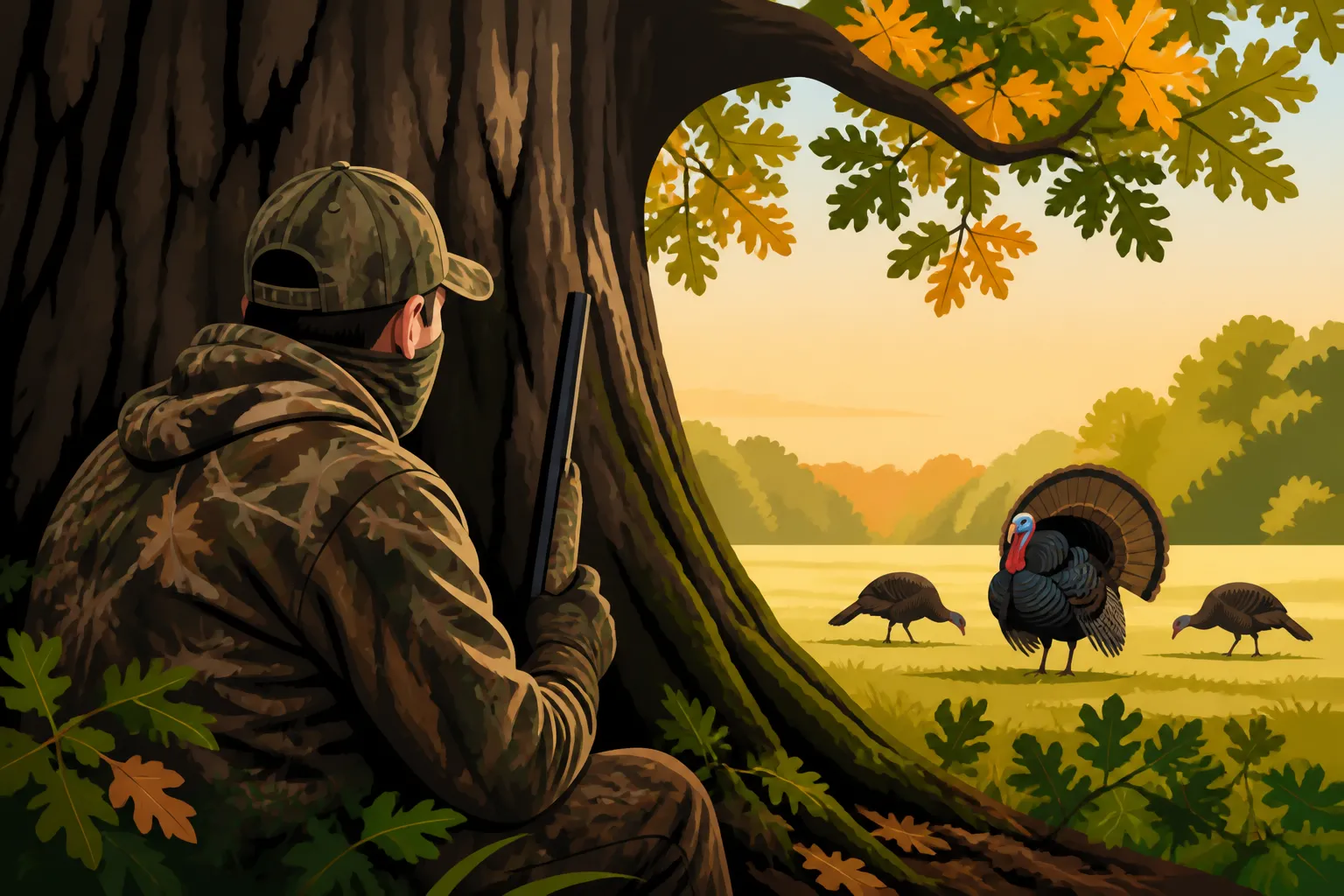
Imagine trying to sit motionless for an hour or more, perched precariously against a flimsy bush, or worse, out in the open. It's a recipe for fidgeting, discomfort, and ultimately, spooking a bird. This is where the big oak truly shines. Its massive trunk provides unparalleled natural concealment, breaking up your human silhouette far more effectively than any manufactured blind could hope to. The gnarled bark and often sprawling base offer a chaotic pattern that camouflages your form seamlessly into the environment. Furthermore, the sheer size of a mature oak provides ample shade, not just for comfort on a warm spring day, but also to obscure your movements as the sun shifts, preventing glinting from your gun or face.
Beyond the visual benefits, a large oak is a hunter's best friend for comfort and stillness. The broad, sturdy trunk offers solid back support, allowing you to settle in for extended periods without aching muscles or the urge to shift. This ability to remain comfortable and motionless is absolutely critical when a gobbler is slowly working his way into range. Every twitch, every slight adjustment, can be picked up by those incredible turkey eyes. A comfortable setup means less unnecessary movement, translating directly into more successful opportunities. It's about blending in so completely that you become just another part of the tree itself, patiently waiting for your moment.
Strategic Positioning for Gobbler Approvals
Big oaks aren't just big for the sake of it; they're often dominant features in the landscape, providing clues to turkey behavior and travel patterns. In many Maryland habitats, oaks are a primary food source, dropping acorns that turkeys eagerly forage for in the fall and often remember into the spring. Even when acorns aren't present, the large, open canopy of a mature oak allows sunlight to penetrate, encouraging lush undergrowth around its base, which can attract insects – another key part of a turkey's spring diet. This means that setting up against a big oak can often place you directly in a gobbler's natural travel corridor or feeding area.
Beyond food, the strategic placement of these trees offers excellent sight lines and acoustics. A commanding oak often stands on a slight rise, at the edge of a field, or along a ridge, giving you an elevated view of the terrain without making you visible from a distance. This advantage allows you to spot incoming gobblers from further away, giving you precious extra seconds to adjust your posture, raise your gun, and prepare for the shot. Additionally, the solid structure of the oak can help project your calls, especially soft yelps and clucks, making them sound more natural and localized to the approaching bird. These aren't just random trees; they are often natural hubs in the turkey world, making them prime real estate for a hunter.
Scouting and Selecting Your Perfect Oak Setup
Finding the perfect big oak isn't just about picking the largest tree in the woods. It requires thoughtful scouting, understanding turkey behavior, and evaluating the specific characteristics of the tree itself. Maryland offers a variety of public lands and private tracts where old-growth oaks stand tall, and knowing how to choose the best one can significantly increase your odds. Before you even step into the woods with your shotgun and calls, you should be putting in the legwork to understand the lay of the land and where the turkeys are likely to be.
Reading the Landscape for Turkey Movement
Turkeys are creatures of habit, and while they can be unpredictable, they generally follow established patterns for feeding, roosting, and strutting. Your first step in selecting a killer oak setup is to understand these patterns in your chosen hunting area. Look for signs of turkey activity: droppings, scratch marks in leaf litter where they've been foraging for insects, and dusting bowls where they've bathed. Listen for gobblers on the roost at dawn or dusk, as this will give you a general idea of where they spend their nights. Pay close attention to terrain features like creek bottoms, subtle ridges, field edges, and logging roads – these are often natural travel corridors that gobblers use to move between different areas.
When scouting, online mapping tools or dedicated hunting apps like GoHunt can be incredibly valuable. They allow you to study aerial photos, identify mature timber stands, pinpoint potential roosting sites near water, and mark likely strut zones in open areas or fields. Use these tools to identify those dominant oak clusters or solitary giants that are strategically located along these predicted travel routes. A big oak sitting on a point overlooking a field, or at the intersection of two faint trails, is a far more effective setup than a similar tree tucked deep in thick, featureless timber where you can't see or hear effectively. Understanding turkey movement, as detailed in guides like Roost Hunting Gobblers on Maryland Farmland, is paramount to picking the right tree in the right place.
Assessing the Oak's Characteristics for Your Setup
Once you've identified potential large oaks in areas with turkey activity, it's time for a closer, on-the-ground inspection. Not all big oaks are created equal when it comes to being a hunting blind. You need to consider several factors:
- Size and Trunk Diameter: Aim for an oak with a trunk wide enough to completely conceal your body from the direction you expect the turkey to approach. A truly massive tree offers the best silhouette breakup.
- Bark Texture and Color: Gnarled, rough bark provides better camouflage than smooth bark. Look for trees whose bark blends well with your camouflage pattern.
- Base Structure: Does the tree have roots flaring out, or a lower limb that creates a natural pocket for you to sit in? These features can enhance concealment and comfort.
- Background Cover: Even the biggest oak is just a silhouette if there's nothing behind you. Ideally, you want some sparse brush, saplings, or even a slight rise immediately behind your chosen tree to further break up your outline. Avoid trees that stand isolated in completely open areas without any background.
- Angles and Obstructions: Once you sit down against the tree, assess your shooting lanes in the likely directions of approach. Are there small branches or saplings that might obstruct your shot? If so, can they be discreetly trimmed before opening day (where legal and on your own property, of course), or do you need to pick a different tree? You want clear lanes for your chosen shotgun range.
- Sun Angle: Consider where the sun will be throughout the morning. You want to avoid having the sun directly in your face or casting a long, dark shadow that outlines you. Positioning the oak so it shields you from the rising sun, or at least casts your shadow away from the expected turkey approach, is a smart move.
A good oak isn't just a place to sit; it's a carefully chosen component of your hunting strategy, vetted for its ability to hide you and facilitate a shot.
The Finer Points of Setting Up for Success
You've found your perfect oak, strategically located and offering excellent concealment. Now, the real artistry begins: actually setting up and executing your hunt. This stage is all about precision, patience, and anticipating the gobbler's every move. Even the best oak can't save a sloppy setup, so pay attention to the details.
Optimizing Your Angle and Decoy Placement
When you settle in against your chosen oak, your primary goal is to be ready for the shot while remaining invisible. This means positioning yourself so that your dominant hand and shoulder are aligned with your most likely shooting lane, allowing for a smooth, minimal-movement gun mount. Your feet should be planted firmly, offering a stable base. Ensure there are no twigs or rustling leaves immediately around you that might betray your presence with an errant crunch.
Decoy placement is critical and goes hand-in-hand with your sitting angle. A common mistake is placing decoys too close to your position or directly in front of you. Turkeys, especially gobblers, have incredibly sharp eyesight. If a bird walks right up to your decoys, he'll likely be looking beyond them for the "hen" that called him in. If you're sitting too close or exposed, you're busted. Instead, aim to place your decoys 15-25 yards out, slightly offset from your position, creating a clear shooting lane between yourself and the decoys. This forces the gobbler to stop and orient himself to the decoy, ideally presenting a broadside or slightly quartering-away shot while his attention is focused elsewhere.
Consider placing a single hen decoy, or a hen and a jake, to appear more natural. If you're in an area with high hunting pressure, as discussed in Decoy Placement for Pressured Maryland Gobblers, sometimes less is more, or even no decoy at all. A gobbler that hangs up at 50 yards is often doing so because he can't see the "hen" he's hearing. Your decoys should be visible to him from a distance, drawing him into your kill zone without creating suspicion. Always position decoys so the gobbler approaches them, and thus you, from an angle that provides the best opportunity for a clean shot.
Minimizing Movement and Sound
Turkeys are masters of detecting the slightest anomalies in their environment. Your oak setup provides the concealment, but you are responsible for the stillness. This requires discipline. Once you're settled, commit to staying as motionless as possible. Use a comfortable turkey cushion to prevent fidgeting. All your essential gear – calls, rangefinder, water, shotgun shells – should be readily accessible with minimal movement.
Before the hunt, practice raising your gun from your sitting position. Identify any clothing that might snag, or any movements that create excessive noise. If you're wearing a vest, ensure nothing will clank or rustle. Breathing deeply and calmly can help maintain focus and stillness. When a gobbler is approaching, fight the urge to peek or track him with your eyes. Instead, use peripheral vision and listen intently. Wait until the bird is behind a tree or a dip in the terrain before making any necessary adjustments to your gun or body. Your goal is to become an extension of that oak, so static and natural that the turkey overlooks you completely. This level of stillness is crucial, especially when you're trying to call in a bird that's been roosted nearby, a tactic explored in Calling a Gobbler Off a Maryland Farm Roost.
Adapting to Different Scenarios
Even with a perfect setup, turkeys rarely read the script. You'll encounter various scenarios, and your ability to adapt from your oak stronghold is key.
- The Hung-Up Gobbler: This is the classic frustration. He's gobbling, he's close, but he just won't come the last 50 yards. From your oak, try subtle, soft calling – purrs and soft yelps, suggesting a content hen. Sometimes, a long period of silence can pique his curiosity. If he's still hung up and you're confident in your cover, a very slow, subtle movement of a decoy (if you have one designed for it) can sometimes break the stalemate.
- Multiple Birds: When multiple gobblers or hens come in, the dynamic changes. Focus on the lead bird, or the one that offers the best shot. If a group of hens comes in first, the gobbler will often follow. Be patient, let the hens mill around, and wait for the gobbler to step into range and present a clear shot. Avoid calling too aggressively to multiple birds, as hens can often lead gobblers away.
- Silent Approach: Not all gobblers announce their arrival with booming calls. Some will come in silently, especially if they've been pressured. This is why vigilance and having clear shooting lanes are so important. Scan your surroundings frequently with minimal head movement.
- Changing Weather: Rain, wind, or sudden temperature drops can affect turkey behavior. From your oak, you're relatively protected from minor weather changes. In windy conditions, turkeys might be harder to hear and will often stick to more sheltered areas. Adapt your calling volume and consider that their approach might be less direct.
The beauty of the big oak setup is its inherent flexibility. You're concealed, comfortable, and stable, giving you the best platform to observe, call, and react to whatever the Maryland wild throws your way.
Gear and Tactics for Your Oak Ambush
To truly maximize the advantage a big oak provides, you need the right gear and a solid understanding of calling tactics. It's not just about hiding; it's about being prepared to seal the deal when the opportunity arises.
Essential Camouflage and Equipment
Your camouflage needs to be top-notch, head-to-toe. Turkeys see color incredibly well, so avoid any bright colors. A complete turkey hunting suit, including gloves, a face mask or head net, and a dark long-sleeved shirt, is non-negotiable. Breakup patterns that mimic the woods and bark are ideal.
Here’s a quick checklist of essential equipment:
- Shotgun: A 12-gauge or 20-gauge shotgun with a turkey choke (extra full or super full) is standard.
- Ammunition: High-density turkey loads designed for tight patterns at typical turkey ranges (30-45 yards). Check the patterning of your gun and choke with your chosen shells before the season.
- Calls: A variety of calls is helpful:
- Box Call: Easy to use, great for loud yelps to locate birds.
- Slate/Pot Call: Versatile, good for soft to medium volume yelps, clucks, and purrs.
- Mouth Diaphragm Call: Hands-free, excellent for realistic soft calls when a bird is close.
- Comfortable Cushion: Absolutely vital for long, motionless sits against that oak trunk.
- Binoculars or Rangefinder: To confirm distance, especially if using a decoy or trying to judge the "three-point rule" in Maryland.
- Water and Snacks: Staying hydrated and fueled helps maintain focus and patience.
- Small Backpack or Vest: To carry all your gear quietly and efficiently.
- Orange Safety Vest/Hat (when moving): Essential for safety when walking in and out of the woods, especially on public land.
Remember, every piece of gear should be as silent as possible. Avoid anything that jingles, clanks, or rustles loudly. Having a solid plan, perhaps even marked on your GoHunt app, before you step into the woods can make all the difference. Knowing where you'll sit, where you'll put your decoys, and what your shooting lanes are will save you precious time and minimize movement during setup.
Calling Strategies from Your Oak Stronghold
From the stable, concealed position of your big oak, you have the ideal platform for various calling strategies. Your goal is to sound like a natural, content hen, drawing the gobbler into your trap.
- Locating Calls (From a Distance): If you're just starting your hunt or trying to locate birds, use louder, more aggressive calls from your oak to get a response. Sharp yelps, cutts, and fly-down cackles can provoke a shock gobble. Once you get a response, go silent or use softer calls to entice him closer.
- Enticing Calls (When He's Gobbling): Once a gobbler is interested and gobbling back, tone down your calling. Use more realistic hen yelps, clucks, and purrs. Mimic a hen that's comfortable and not overly eager. A good strategy is to call, get a response, and then wait. Let him wonder where you went, forcing him to come looking. If he continues to gobble but doesn't move, try a soft "kee-kee run" or a series of clucks and purrs to pique his interest further.
- The Silent Treatment (When He's Close): As the gobbler gets closer (within 100 yards), scale back your calling dramatically, or go silent entirely. Let him come to you. If he hangs up, a very soft cluck or purr, almost imperceptible, can sometimes be enough to coax him the last few yards. Remember, he's looking for a hen, and if he hears her close but can't see her, he's more likely to commit.
Consider the time of year and day. Early in Maryland Spring Turkey Season Dates, gobblers are often more responsive to aggressive calling. Later in the season, particularly When Maryland Gobblers Go Quiet in Mid May, they might be more wary and require softer, more infrequent calls. The key is to listen, observe, and adapt. You’re trying to sound like a hen, not a turkey call salesman.
| Scenario | Recommended Calls | Volume | Notes |
|---|---|---|---|
| Locating a Gobbler | Loud yelps, cutts, fly-down cackle | Loud | Use from a distance, typically when arriving or moving to a new setup. |
| Gobbler Responds | Medium yelps, clucks, purrs | Medium | Once he's interested, reduce volume. Sound like a content, natural hen. |
| Gobbler Approaching (100+ yds) | Soft yelps, soft clucks, occasional purrs | Soft | Call less frequently. Let his curiosity draw him in. |
| Gobbler Hung Up (50-100 yds) | Very soft clucks, purrs, "kee-kee run" (subtle) | Very soft, infrequent | Patience is key. Sometimes silence works best. Avoid overcalling. |
| Gobbler at Decoy Range | Silence, or very soft clucks/purrs if he needs a nudge | Silent/Barely audible | Let him commit to the decoys. Your main job is to be motionless and ready. |
| Multiple Hens/Gobblers | Soft yelps, clucks, purrs (don't overcall) | Medium-soft | Focus on the lead bird. Don't call too aggressively; hens can lead gobblers away. |
The big oak is your ultimate partner in the spring turkey woods, providing a foundation for stealth, comfort, and strategic advantage. Master its use, and you'll find more success bringing those Maryland longbeards into range.
Disclaimer
Please remember that hunting regulations and seasons, including Maryland's Deer Bag Limits and Antler Rule and Maryland Spring Turkey Bag Limit, can change. Always consult the current Maryland Department of Natural Resources (DNR) hunting guide before heading afield to ensure you are up-to-date on all rules, regulations, and licensing requirements. Safety should always be your top priority in the field.