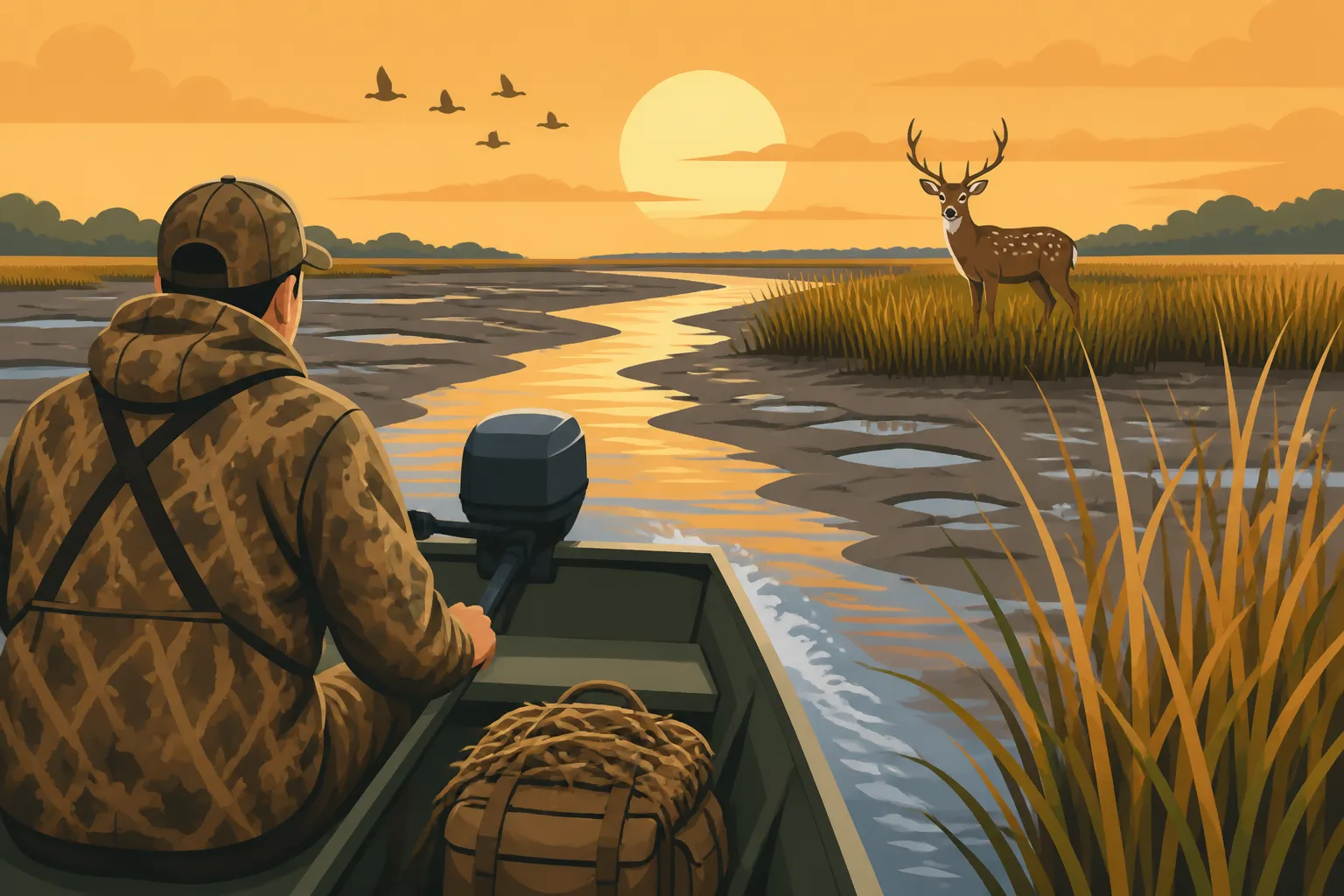
Boating Into a Sika Marsh at Low Tide
Trying to access those prime Sika deer spots in Maryland's tidal marshes can feel like an impossible puzzle, especially when the water drops out and leaves nothing but treacherous mudflats and winding guts. Many hunters get stuck, literally, or miss out on opportunities because they can't effectively navigate these challenging environments. This guide is all about equipping you with the knowledge and strategies to confidently boat into a Sika marsh at low tide, ensuring you can reach those hidden honey holes and increase your chances of a successful hunt.
Why Low Tide Access is Critical for Sika Hunters
The tidal marshes of Maryland's Eastern Shore are truly unique, a wild, unforgiving landscape that Sika deer call home. These compact, hardy deer thrive in the dense phragmites, spartina, and loblolly pine islands that dot the marsh. For hunters, gaining access to these areas, particularly during low tide, isn't just a convenience; it's often the key to unlocking success. Without the ability to get deep into the marsh when the water is down, you're leaving a significant portion of their habitat untouched and many opportunities on the table.
Understanding the Marsh's Dynamic Nature
Maryland's tidal marshes, especially in places like Dorchester and Somerset counties, are incredibly dynamic environments, constantly shaped by the ebb and flow of the Chesapeake Bay. Understanding these changes is fundamental to successful low-tide navigation. The tide can fluctuate by several feet, transforming navigable channels into vast, sticky mudflats in just a few hours. What looked like a clear passage at high tide might become an impassable barrier at low tide, stranding your boat or forcing a long, arduous push through thick muck.
The composition of the marsh bottom itself varies greatly. Some areas might have a relatively firm sand or shell bottom, while others are an endless expanse of soft, silty mud that can easily swallow a boot, or worse, an entire boat. Vegetation, too, plays a critical role. Dense stands of phragmites can conceal hidden ditches, oyster beds, and mud mounds, making visual navigation challenging. Learning to read these subtle cues, like the darker lines indicating deeper channels or the slight ripples where current still flows, is an art form developed over many hunts.
The Strategic Advantage of Low Tide
Hunting a Sika marsh at low tide offers several distinct strategic advantages that can significantly increase your odds. First and foremost, low tide often concentrates deer into more predictable areas. As the water recedes, large sections of the marsh become inaccessible to deer, forcing them onto higher ground, along ditch banks, or into the pine islands. These natural funnels and pinch points become prime locations for ambush, as deer move between exposed feeding areas and dense bedding cover.
Secondly, low tide allows you to access areas that are simply too deep or too flooded at high tide. Mudflats that are covered by several feet of water during high tide become traversable, allowing you to scout for fresh tracks, rub lines, and bedding areas that would otherwise be hidden. This extended reach can lead you to previously undiscovered Sika hotspots, giving you an edge over other hunters who stick to the more obvious high-tide access points. Being able to get your boat close to these hidden havens means less wading and quieter entry, which is crucial when targeting wary Sika. For more insights on how these tidal shifts impact wildlife, consider reading about How Tides Move Marsh Game Around.
Choosing the Right Watercraft for Maryland's Sika Marshes
The success of your low tide Sika marsh hunt hinges significantly on the vessel you choose. Not all boats are created equal when it comes to navigating the notoriously shallow and often muddy waters of places like the Blackwater National Wildlife Refuge or Deal Island WMA. Selecting the right watercraft involves balancing capacity, draft, maneuverability, and propulsion methods, all while keeping in mind the specific challenges of a receding tide.
Jon Boats and Skiffs
For many Maryland marsh hunters, a sturdy jon boat or a shallow-draft skiff is the go-to choice. These boats are designed for stability and can often handle a decent payload of gear and hunters. A flat-bottomed jon boat, typically 14 to 16 feet in length, can draw very little water, especially when lightly loaded. This minimal draft is crucial when pushing over submerged mudflats or traversing narrow, winding guts. Brands like Alumacraft or Lowe often offer robust jon boats that can take a beating.
However, even with their shallow draft, jon boats and skiffs have limitations. Their flat bottom means they can get hung up in very soft mud, and while you can pole them, it’s back-breaking work. They also don't handle choppy open water as well as a V-hull, which can be a concern if your access requires crossing larger bodies of water, such as parts of the Honga River or the open Bay. Choosing the right outboard motor is equally important; a small, lightweight tiller-steer outboard, perhaps 15-25 horsepower, offers good torque for pushing through mud and allows for precise control in tight quarters. Remember, too, to check Maryland's Legal Weapons by County as some areas restrict motor sizes or types.
Kayaks and Canoes
For the ultimate in stealth and shallow-water access, kayaks and canoes are hard to beat. They draw mere inches of water, allowing you to paddle into extremely tight, overgrown areas where even a jon boat would be utterly stuck. This silent approach is invaluable for Sika, which are known for their exceptional hearing and elusive nature. A durable, stable fishing kayak, often designed with a wider beam for stand-up fishing, can also double as an excellent hunting platform. Brands like Old Town or Hobie offer models with ample storage for gear.
The downsides, of course, include limited carrying capacity and the physical exertion required to paddle, especially against current or wind. Transporting a harvested Sika deer back to your vehicle in a kayak or canoe can be an immense challenge, often requiring multiple trips or a carefully planned retrieval strategy. However, for a single hunter focused on deep penetration into the marsh, or for scouting missions where you just need to get in and out quietly, these human-powered vessels excel. For tips on quiet entry and exit, you might find useful advice in Wading Into a Dorchester Marsh Before Daylight.
Airboats and Mud Motors
While less common for the average Sika hunter due to cost and noise, airboats and specialized mud motors offer unparalleled capability in extremely shallow water and thick mud. Airboats, with their propeller mounted above the water, can skim over inches of water and mud, making them ideal for navigating vast, soupy flats. Mud motors, often called "surface drive" or "long tail" motors, are designed with a heavy-duty propeller that operates partially submerged, pushing through mud and vegetation that would clog a traditional outboard. Go-Devil and Gator-Tail are well-known names in the mud motor industry.
However, airboats are incredibly loud and expensive, making them less practical for stealth hunting and often restricted in public hunting areas due to noise pollution. Mud motors, while more accessible, are still louder than traditional outboards and require specific maintenance. They are also heavy and can still get bogged down in the deepest, stickiest mud. For most hunters, the advantages of airboats and mud motors are outweighed by their limitations for a typical Sika hunt, but their utility in certain extreme conditions is undeniable.
Here's a quick comparison of popular watercraft for Sika marsh hunting:
| Watercraft Type | Pros | Cons | Ideal Conditions for Sika Hunting |
|---|---|---|---|
| Jon Boat/Skiff | Shallow draft, stable, good capacity, durable, versatile motor options. | Can get stuck in very soft mud, not as stealthy as canoes/kayaks. | Moderate depth channels, crossing short mudflats, carrying gear. |
| Kayak/Canoe | Extremely shallow draft, silent, highly maneuverable in tight spaces. | Limited capacity, physical exertion, deer retrieval challenging. | Deep marsh penetration, scouting, quiet approach in dense cover. |
| Mud Motor Boat | Excellent for thick mud and vegetation, better than traditional outboard. | Louder than traditional, heavier, still can get stuck in extreme mud. | Long distances over shallow, muddy flats with moderate vegetation. |
| Airboat | Navigates almost any depth of water/mud, very fast. | Extremely loud, expensive, often restricted, not stealthy. | Extensive, very shallow, open mudflats; specialized operations. |
Navigating the Marsh at Low Tide: Techniques and Safety
Once you've chosen your vessel, the real challenge begins: actually navigating the complex Sika marsh at low tide. This isn't like boating on open water; it requires a unique skillset, a keen eye for subtle changes in the landscape, and a strong emphasis on safety. Getting stuck miles from your truck, especially in freezing temperatures or approaching darkness, is a real possibility and a situation no hunter wants to find themselves in.
Reading the Water and Terrain
Successfully boating a Sika marsh at low tide is all about reading the water and the terrain around you. Even when the tide is out, there are often deeper channels and guts that retain enough water to float your boat. These are your highways into the marsh. Look for subtle color changes in the water – darker blues or greens often indicate deeper water, while lighter, muddier browns suggest extreme shallows or exposed mud. Pay attention to the flow of the current; water naturally carves out deeper paths where it flows most strongly.
Vegetation can also be a tell-tale sign. Taller, denser stands of spartina or phragmites often grow on slightly higher ground or along the banks of deeper ditches, while more sparse or submerged vegetation might indicate softer mud. Keep an eye out for exposed oyster beds or shell rakes, which can be sharp and damaging to boat hulls and propellers. Learning to interpret these visual cues comes with experience, but starting with a general idea of the marsh topography from maps will give you a significant advantage. This intimate knowledge is similar to Reading a Marsh Trail for Sika Sign, requiring attention to detail.
Essential Gear for Low Tide Marsh Travel
You can’t just hop in your boat with your hunting gear and expect to make it. Proper preparation involves bringing essential tools specifically for low tide marsh navigation. A long, sturdy push pole (fiberglass or aluminum is best) is absolutely non-negotiable. This is your insurance policy for when your propeller hits bottom or your boat gets bogged down. It allows you to push off the bottom, navigate tight corners, and free your boat from sticky situations. You'll use it more than you think, especially when you are Boating Into a Sika Marsh at Low Tide.
Another critical piece of gear is a reliable anchor, or even two, specifically designed for soft bottoms, like a mushroom anchor or a spud pole that can be driven into the mud. You'll need it for holding position while scouting, setting up, or recovering a deer. Don't forget proper PFDs (personal flotation devices) for everyone aboard, even in shallow water. A waterproof dry bag containing a first-aid kit, extra layers of clothing, emergency food and water, a powerful flashlight, and a fully charged cell phone (with a portable charger) is also vital. Consider bringing a small shovel or a mud anchor that can be used to winch yourself free if truly stuck.
Planning Your Route with Technology
In today's age, technology is an invaluable asset for navigating the complex Sika marsh. Before you even leave the house, spend significant time studying aerial imagery. Satellite maps, like those available on platforms such as GoHunt or Google Earth, are incredibly detailed and will reveal hidden channels, mudflats, and higher ground that are impossible to discern from the ground. Look for darker lines indicating deeper water and lighter areas showing exposed mud. Identify potential entry and exit points, as well as alternative routes in case your primary path becomes unnavigable.
Once you’re in the field, a reliable GPS unit or a smartphone with a robust mapping app is your best friend. Many hunters rely on apps like GoHunt, which allow you to download offline maps, mark waypoints, and track your route. Plot your planned course, marking critical turns, obstacles, and potential hunting spots. Use the GPS to monitor the tides; knowing precisely when the water will start to recede and when it will begin to come back in is paramount. Being able to see your position relative to the surrounding marsh features in real-time can prevent you from getting disoriented or accidentally straying into impassable terrain. This precise planning is crucial for successful Hunting Maryland's Lower Eastern Shore Marshes.
Overcoming Common Low Tide Challenges
Even with the best planning and gear, the Sika marsh at low tide will inevitably throw some curveballs your way. It’s an unforgiving environment, and being prepared to handle unexpected challenges is part of the game. The key to successful low-tide hunting isn't just avoiding problems, but knowing how to effectively deal with them when they arise.
Getting Stuck in the Mud
This is perhaps the most common and frustrating challenge of marsh hunting at low tide. Your boat, despite its shallow draft, can quickly get bogged down in soft, silty mud. Prevention is always better than cure: constantly watch your depth finder or pole ahead, especially in unfamiliar territory. If you feel the prop starting to churn mud, cut your engine immediately to avoid digging a deeper hole.
If you do get stuck, assess the situation calmly. If you have a push pole, try to push the boat free by rocking it side to side and applying steady pressure. If the mud is particularly deep and you’re alone, it can be incredibly strenuous. If you're with a partner, one person might need to get out and push, carefully feeling for firm ground. Waders are a must for this scenario. Sometimes, waiting for the tide to turn and come back in is your only option, but this could mean hours, so always carry emergency supplies and communicate your location. For extremely stuck situations, a mud anchor and a small hand winch can be a lifesaver, allowing you to pull your boat to firmer ground or deeper water.
Dealing with Obstructions
The marsh is full of hidden dangers just beneath the surface, especially at low tide. Sunken logs, discarded crab pots, oyster beds, and old pilings can all damage your prop, lower unit, or even puncture your hull. Always navigate slowly and cautiously in unfamiliar areas. If you know a particular gut or channel has historically had obstructions, consider an alternative route or proceed at a snail's pace, constantly scanning the water ahead.
A spare prop and the tools to change it are highly recommended, as hitting an obstruction is often just a matter of time. Carrying a good quality spotlight or headlamp is essential for early morning or late evening navigation, allowing you to spot potential hazards before you run over them. If you hear or feel something scrape your hull, stop immediately and check for damage. A small repair kit for minor punctures can be invaluable for patching up a leak until you can get back to shore.
Weather and Environmental Factors
The weather in Maryland, particularly along the coast, can change dramatically and quickly. A calm, sunny morning can turn into a windy, foggy, or stormy afternoon, making low-tide navigation even more treacherous. High winds can make poling a light boat nearly impossible, pushing you off course or creating chop that a shallow-draft boat struggles with. Fog can reduce visibility to mere feet, turning a familiar marsh into a disorienting maze.
Always check the marine weather forecast before heading out, paying close attention to wind speed, direction, and any advisories for fog or storms. If the forecast looks questionable, consider postponing your hunt or sticking to areas with easier access. If you get caught in fog, rely heavily on your GPS to navigate back the way you came, or find the nearest safe haven. Remember that cold weather, especially in the late season, amplifies the dangers of getting stuck or capsizing. Hypothermia is a serious risk in the marsh. Dress in layers, wear waterproof outerwear, and always have a means to call for help. Being prepared for these elements is part of being a responsible hunter, especially when considering Maryland's Sika Deer Stamp and Bag Limits and ensuring a safe and successful trip.
Final Thoughts on Sika Marsh Boating
Boating into a Sika marsh at low tide is an adventure, a challenge, and one of the most rewarding ways to experience Maryland hunting. It demands respect for the environment, meticulous planning, and a readiness to adapt. By understanding the marsh's dynamic nature, selecting the right watercraft, mastering navigation techniques, and preparing for the inevitable challenges, you'll open up a whole new world of hunting opportunities. The effort and preparation will pay off when you're quietly slipping into a prime Sika bedding area, just as the sun is breaking, knowing you've earned your spot through grit and intelligent marshcraft. Remember, patience and a good sense of humor are also crucial when dealing with the fickle nature of the tides and the mud. Always prioritize safety, and happy hunting!
Disclaimer
The information provided in this guide is for informational purposes only and does not constitute professional advice. Hunting regulations and conditions can change rapidly. Always consult the official Maryland Department of Natural Resources (DNR) website and local authorities for the most current laws, regulations, and safety guidelines before engaging in any hunting activities. Adherence to all applicable laws and responsible hunting practices is essential.