Hunting an Appalachian Bench Above a Hollow
There’s something truly special, and undeniably challenging, about hunting the rugged Appalachian terrain of Western Maryland. Unlike the flat farmlands of the Eastern Shore, the mountains demand a whole different level of understanding of topography and deer behavior. One of the most overlooked, yet consistently productive, features in this landscape is the humble "bench" situated above a hollow. Many hunters walk right past these subtle shelves on a hillside, missing out on prime opportunities. This guide will walk you through how to identify, scout, and effectively hunt these often-secretive deer highways and bedding areas, turning frustration into success in the steep country.
Decoding the Appalachian Bench and Hollow
Before you can hunt a bench, you need to understand what it is and why deer are drawn to it like a magnet. This isn't just a random bump on the hillside; it's a critical component of a deer's daily life in steep country.
What Exactly is a Mountain Bench?
Imagine you're walking up a steep mountain face, and suddenly, the incline eases for a stretch, forming a relatively flat or gently sloping shelf before the hill steepens again. That, my friend, is a bench. These benches can range from just a few yards wide to quite expansive, sometimes running for hundreds of yards along a contour. They're often formed by different geological layers or erosion patterns. For a deer, especially a wary old buck in Western Maryland's rugged forests like Savage River State Forest or Green Ridge State Forest, these benches offer a welcome reprieve from constantly climbing or descending.
Deer, like us, prefer the path of least resistance. Instead of struggling up or down a steep slope, they'll often travel horizontally along these benches. Think of them as natural highways through otherwise difficult terrain. They provide stable footing, and often, denser vegetation along their edges or on the bench itself, offering both cover and browse. Benches are particularly valuable because they combine travel corridors with potential bedding and feeding areas, making them prime real estate for deer seeking security and sustenance.
The Dynamics of a Hollow and Its Influence
Now, let's talk about the "hollow" below that bench. A hollow is essentially a depression or valley, often with a stream or drain running through its bottom. It creates a natural funnel, drawing air currents and, critically, providing thermal sinks where cooler air settles. When a bench sits above one of these hollows, it creates a powerful combination for deer.
Deer often use the dense cover found within hollows for bedding, especially during the middle of the day. As evening approaches, or during the morning hours, they'll typically move up out of the hollows onto these benches to feed or travel to other areas. The hollow provides seclusion, water sources, and escape routes. A bench directly above it becomes a key transition zone. Understanding this interplay between the bench and the hollow is crucial. Deer might bed down in the thick bottom of the hollow, then ascend to the bench to browse or simply travel more easily around the mountain. Conversely, in the morning, they might be feeding on the bench and then drop down into the hollow for security. This constant ebb and flow makes that bench a highly predictable pinch point.
Scouting for Success on Mountain Terrain
Hunting Appalachian benches isn't something you just stumble into; it requires meticulous scouting. You need to become a detective of the forest floor, understanding the subtle clues deer leave behind and how they interact with the land.
Digital Reconnaissance with Mapping Tools
Before you ever set foot in the woods, your scouting begins with aerial photos and topographic maps. Tools like onX Hunt or GoHunt are absolute game-changers for this. Start by looking for contours on a topo map that indicate a flattening or widening of the contour lines on a steep slope – that's your bench. Then, look for hollows or drainage features immediately below these benches. Pay attention to how these benches connect different parts of the mountain: ridge tops, saddles, or other hollows. Are there any distinct points, inside corners, or areas of thicker cover along the bench? These are often natural funnels.
Use the satellite imagery to identify different timber types. Are there oak flats above the bench? Or perhaps thick mountain laurel or regenerating clear-cuts on the bench itself? Deer will use these features for food and cover. Mark potential access routes to these benches, considering wind direction and stealth. Identify where the terrain might be too steep for easy deer movement and where the benches offer that easier path. This preliminary work will save you countless hours of aimless wandering on the mountain. You're looking for the "lines" deer draw across the landscape. Check out Scouting Maryland Public Land With Aerial Photos for more tips on digital scouting.
Boots-on-the-Ground Verification and Sign Reading
Once you've identified potential benches on your map, it's time for some boots-on-the-ground scouting. This is where you confirm your digital hunches and uncover the real story. Start by hiking into the hollow below your identified bench. Look for water sources, old logging roads, or dense thickets where deer might bed. Then, climb up to the bench itself. What kind of sign are you finding?
Look for well-worn deer trails running along the length of the bench. Are there rubs and scrapes, particularly in the early fall, indicating rutting activity? Check for bedding areas – flattened spots in the leaves or grass, often under thick cover on the edge of the bench. Pay close attention to what deer are eating. Are there acorn shells, browse lines on saplings, or signs of activity around specific food sources like grapevines or soft mast trees? Remember, deer are using these benches for a reason, and that reason is usually food, cover, or efficient travel. Don't just look for fresh sign; try to understand the pattern of movement. When you're Reading Sign in Maryland Mountain Timber, these benches are key places to focus your efforts.
Strategic Stand Placement and Wind Considerations
Hunting a mountain bench effectively isn't just about finding it; it's about positioning yourself correctly, understanding the fickle mountain winds, and managing your scent. This is where many hunts are won or lost.
Placing Your Stand for Archery and Firearms
When it comes to stand placement, whether you're bowhunting or carrying a rifle, you want to be where deer are naturally going to travel, but always downwind or crosswind of their approach. For archery, this often means setting up on a well-used trail that intersects the bench, or on a point where the bench narrows or changes direction, forcing deer into a tighter corridor. Aim for a spot that offers good shot lanes without exposing you too much. Often, a tree on the edge of the bench, overlooking a subtle drop-off into the hollow or a slight rise on the bench itself, can be ideal. You want to be able to see deer coming from both directions along the bench, as well as any deer moving up or down into the hollow.
For firearms, you have a bit more range, so you might position yourself a little further back from the primary travel corridor, giving you a wider field of view. Look for a location that offers clear shots across a good stretch of the bench, or that can cover a natural opening where deer might pause. Always consider your background. Silhouetting yourself against the sky is a quick way to get busted. Use the natural topography and vegetation to break up your outline. Remember that deer will often travel with the wind in their face, scent-checking the terrain ahead, so planning for this is paramount.
Mastering Mountain Winds and Thermals
Ah, mountain winds and thermals – the bane of many a hunter's existence! Unlike flat land, mountain winds are rarely consistent. They're heavily influenced by temperature, sunlight, and the contours of the land itself. Thermals, in particular, play a huge role. In the morning, as the sun warms the air, thermals generally rise, carrying your scent upwards. In the evening, as the air cools, thermals reverse and fall, pulling your scent down into the hollows.
This means you need to adjust your approach based on the time of day. For a morning hunt on a bench above a hollow, you might want to approach from above the bench and set up so your scent is rising and blowing over the hollow, not down into it where deer might be bedding. As the day progresses, and especially in the evening, you'll want to be on the side of the bench where your falling thermals are blowing away from any expected deer movement. A perfect evening setup might be on the bench's edge, allowing your scent to drop into the hollow behind you while you watch the bench and the opposite rise. Wind checkers are your best friend here; constantly monitor the airflow. For an in-depth look at this, read Wind and Thermals in Western Maryland Terrain.
Stealthy Entry and Exit Routes
Even the best stand placement is useless if you spook deer on your way in or out. Planning stealthy entry and exit routes is just as important as choosing your stand site. Avoid walking directly on well-used deer trails. Instead, use natural cover, old logging roads that parallel the bench, or even creek bottoms in the hollow (when the wind is right) to get to your stand undetected.
For morning hunts, try to approach from above the bench, if possible, allowing thermals to carry your scent away from where deer might be. In the evening, approaching from below the bench might be more effective, as falling thermals could work in your favor. Always walk slowly, quietly, and use a headlamp with a red filter in the dark to preserve your night vision and minimize disturbance. Your goal is to be a ghost in the woods, leaving no trace of your presence until it's too late for the deer.
Timing and Tactics for Appalachian Benches
Even with perfect scouting and stand placement, timing is everything. Understanding when and why deer use these benches will dramatically increase your success rate.
Best Times of Day and Seasonal Movement
Just like any deer hunting, first light and last light are often the most productive times on Appalachian benches. Deer are most active during these low-light periods, moving from bedding to feeding areas, or vice-versa. In the morning, deer may be finishing up feeding on the bench or nearby ridge tops before dropping into the hollow for midday bedding. Your best bet is to be in your stand well before first light, waiting for that movement. In the evening, deer will start moving out of their bedding areas in the hollow or dense thickets on the mountain and will often utilize the benches for travel and browsing before heading to more open feeding spots, or staying right on the bench to feed if browse is good.
Seasonal movement also dictates how benches are used. Early in the season, during September archery, deer are often predictable, moving between specific food sources and bedding. As the rut approaches in October and November, bucks will actively cruise benches, scent-checking for does. Benches offer easier travel for cruising bucks than steep hillsides. Later in the season, when food sources become scarce, benches that hold browse or scattered mast trees can become critical feeding areas. Look for Late Season Food Sources for Maryland Deer that might be available on or near these benches.
The Influence of Weather and Rut Activity
Weather plays a huge role in deer movement, especially in the mountains. A sharp cold front following a warm spell can often kick deer movement into high gear. They'll be more likely to be up and moving, feeding heavily to prepare for colder temperatures. Hunting a bench during or immediately after a light rain can also be productive. The rain helps to wash away your scent and dampens the leaves, making it easier for you to move quietly and for deer to move less noisily.
During the rut, typically in early to mid-November in Maryland, benches can become absolute hotspots for buck activity. Bucks use these natural travel corridors to cover ground efficiently while searching for does. Does, too, will often use benches as escape routes or as places to gather. Setting up on a bench during the rut, especially if you've seen historical rub lines or scrape activity, can be incredibly exciting. Consider combining your sit with some light calling – a soft grunt or doe bleat can sometimes bring a curious buck right onto the bench. This is when patience really pays off. For more on this, check out Hunting the Rut in Early to Mid November.
Stand Hunting vs. Still-Hunting on a Bench
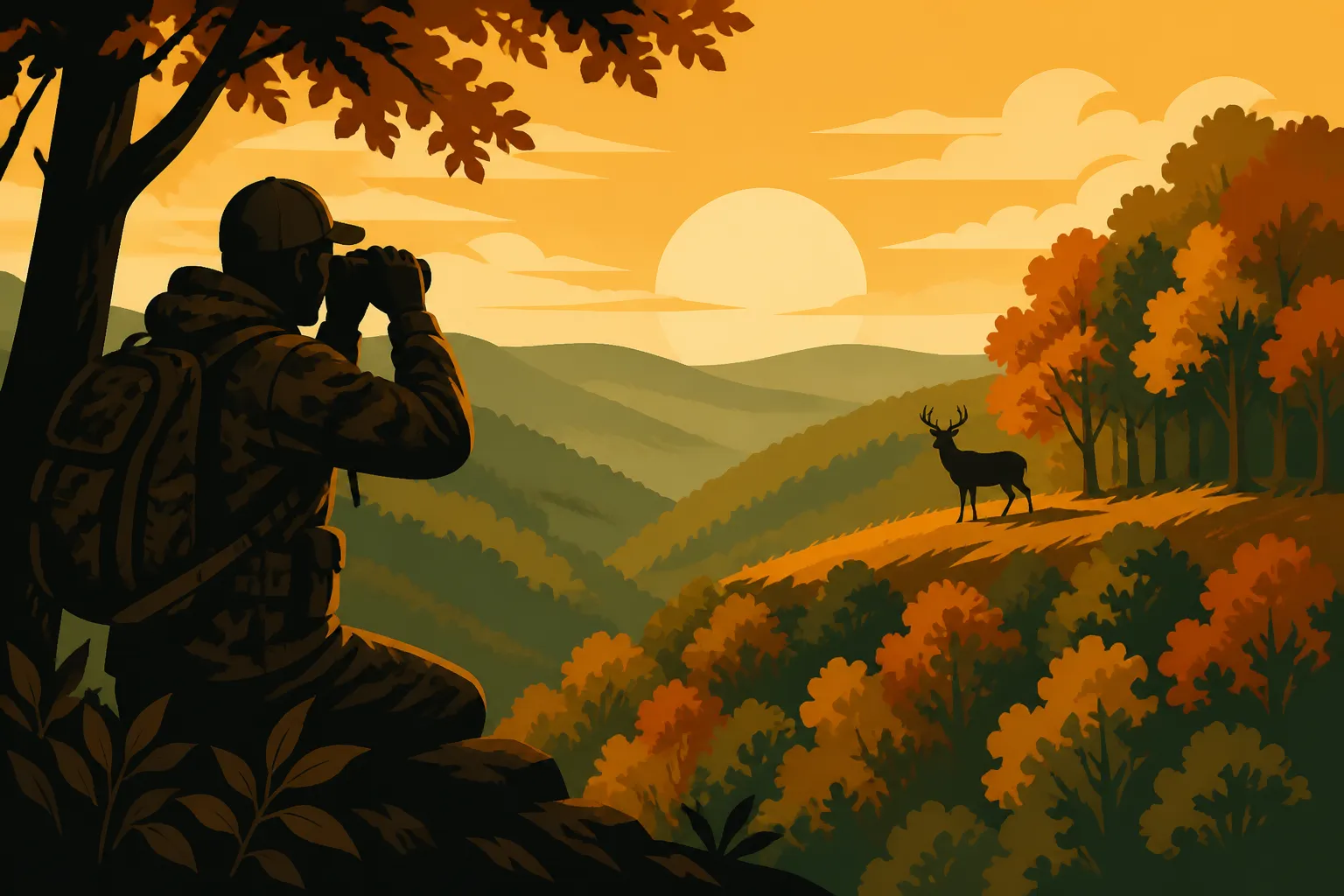
While a fixed stand offers a predictable ambush point, still-hunting can be a powerful tactic on Appalachian benches, especially if you're exploring new territory or if deer are pressured. Still-Hunting Western Maryland Mountain Timber can be an effective way to cover ground. Move incredibly slowly, taking a few steps, then pausing for several minutes to scan for movement. Use binoculars to pick apart every shadow and patch of cover, especially where the bench dips or rises, or where thickets create natural hiding spots.
Still-hunting allows you to adapt to changing conditions and to intercept deer that might be moving slightly off the main trail. It's particularly effective when there's a light breeze that allows you to move quietly without your scent swirling too much. When still-hunting, always work into the wind or crosswind, moving from one vantage point to the next. The goal isn't to walk quickly, but to hunt your way along the bench, ready for a shot at any moment. Whether in a stand or still-hunting, the key is to be present and observant in the moment, trusting your scouting and your understanding of how these mountain features guide deer.
Disclaimer
This article is for general informational purposes only and does not constitute professional advice. Laws, prices and regulations vary by location and change over time. Consult a qualified professional for guidance on your specific situation.