Decoy Placement for Pressured Maryland Gobblers
There's nothing quite as frustrating as working a gobbler hard, pouring your heart into calls, only to watch him hang up at 100 yards, perfectly visible but utterly unapproachable. He might strut and drum, perhaps even gobble, but he simply won't commit to your setup. This scenario is all too common in Maryland, especially after opening week, when turkeys have already encountered hunters, heard every call in the book, and seen countless decoys. This guide is dedicated to dissecting the art of decoy placement specifically for those pressured gobblers, helping you understand how to make your setup believable enough to seal the deal.
Understanding the Pressured Gobbler's Mindset
When you're dealing with a turkey that's been hunted for a week or two, you're not just up against a wild animal; you're up against an animal that's learned. Maryland's diverse landscapes, from the rolling farmlands of the Eastern Shore to the rugged mountains of Western Maryland, all see their share of hunting pressure, influencing how gobblers behave. These birds become wary, associating certain sights and sounds with danger. A perfectly placed call might get a response, but the visual confirmation is where many setups fall apart for savvy longbeards.
The Evolution of Wariness
Imagine a gobbler that's already walked into an ambush, had a close call with a hunter, or simply seen a decoy spread that looked too perfect, too static, or too out of place. Each of these experiences builds a catalog of suspicion in his mind. He's been educated. What worked on opening day—a strutter decoy out in a field—might now send him running the other way. He's looking for subtle cues, signs that something isn't right. A tom that used to commit hard might now circle widely, scrutinizing the scene from a safe distance before deciding to approach, or more often, to simply vanish. This learned wariness means we, as hunters, need to elevate our game, focusing not just on attracting his attention, but on disarming his suspicion.
The Impact of Habitat and Hunter Density
Maryland offers fantastic turkey hunting, but it's also a relatively small state with significant hunter numbers. This means that even in prime turkey habitat, birds are likely to encounter human activity. In areas with high hunter density, like many public lands or smaller private tracts, gobblers become especially sensitive to movement, unusual objects, or anything that seems out of sync with their natural environment. A decoy standing alone in a wide-open field on private land that sees little pressure might be irresistible to a young gobbler, but that same setup on a highly pressured public parcel, like those found within many of Maryland's Wildlife Management Areas, could be a deal-breaker for an older, wiser tom. Understanding the typical routes turkeys take and how they react to pressure in your specific hunting spot is crucial. Platforms like GoHunt can be invaluable for scouting, allowing you to examine aerial photos and topo maps to identify natural travel corridors and potential hang-up spots where a pressured bird might pause.
Decoy Selection and the Art of Realism
When hunting pressured gobblers, your decoy selection needs to be precise, and your goal should be absolute realism. Forget the bright, shiny, plastic-y dekes you might have used successfully in the past. These birds are looking for natural behavior, not a fluorescent beacon.
Less is Often More: The Power of Subtlety
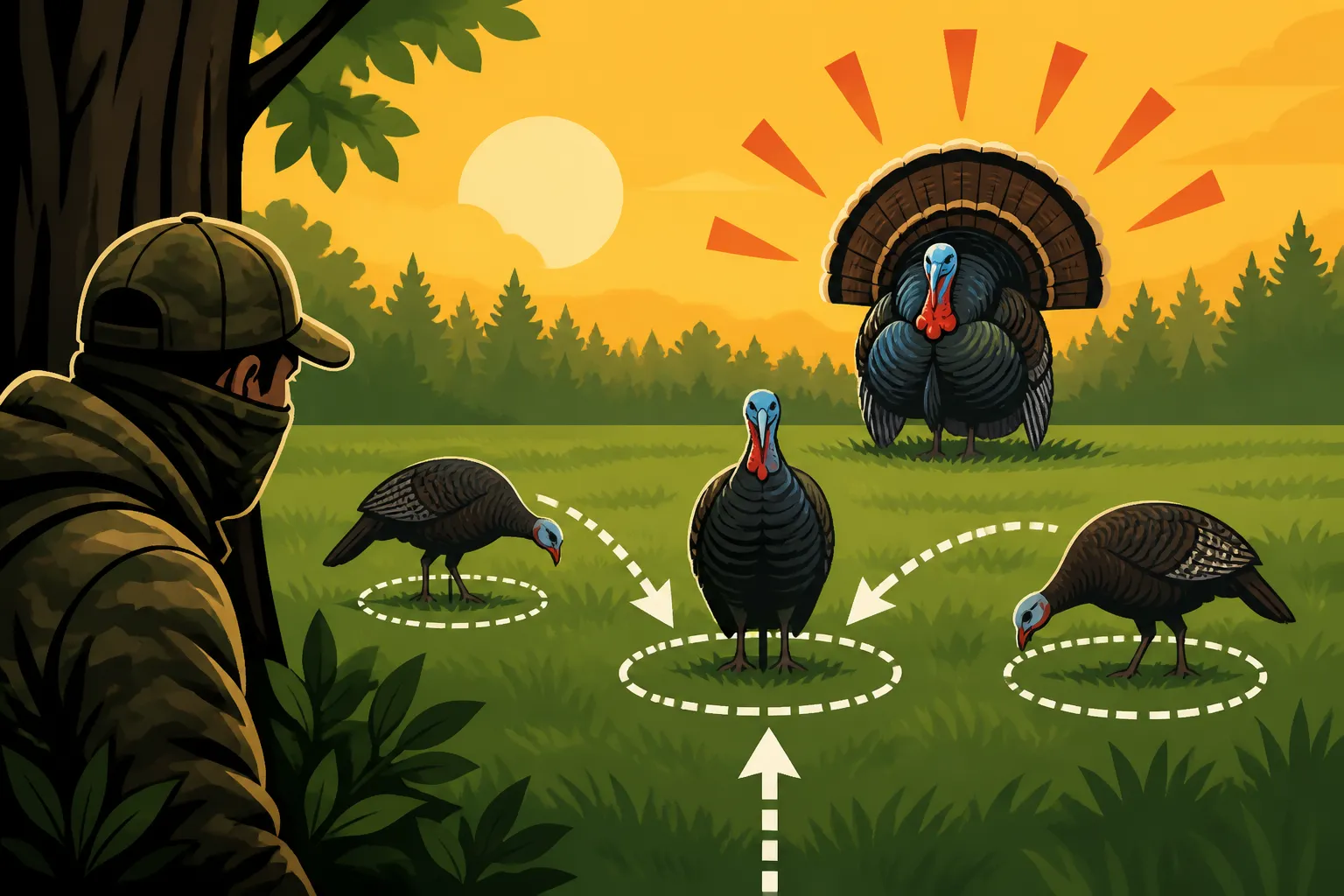
One of the biggest mistakes hunters make with pressured birds is deploying too many decoys. A flock of five hens and a strutter might look impressive, but it can also scream "ambush!" to a gobbler who's already seen that show. For pressured birds, I often find that one or two decoys are far more effective. A single hen, or perhaps a hen and a jake, portrays a much more natural, less threatening scene.
Think about what a gobbler is truly looking for: companionship and breeding opportunities. A lone hen feeding calmly, or a hen subtly receptive to breeding, can be incredibly enticing without raising alarm bells. If you're going with a jake, make sure it's a submissive one. An aggressive strutter jake might challenge a dominant gobbler, but it also forces him to commit to a fight, which a pressured bird might be reluctant to do if he suspects danger. A more passive posture invites him to investigate without feeling threatened.
Table: Decoy Strategies for Pressured Maryland Gobblers
| Decoy Type | Number | Posture | Ideal Scenario | Hunter Strategy |
|---|---|---|---|---|
| Single Hen | 1 | Feeding/Alert | Open field, timber edge, shy gobblers, late season | Minimal calling, focus on natural movement |
| Hen & Submissive Jake | 2 | Feeding/Alert | Field edges, subtle openings, challenging cautious gobblers | Moderate calling, focus on drawing tom to "bully" jake |
| Hen & Receptive Hen | 2 | Feeding/Breeding | Early season, active strutting zones, breeding urgency | Soft calling, creating a believable "scene" |
| Strutter (Full Fan) | 1 (Rare) | Full Strut | Highly aggressive gobblers, very specific blind setups | Very cautious, often paired with a receptive hen |
The Motion Factor
Static decoys can be a dead giveaway. Real turkeys move. They peck, they stretch, they shift. Incorporating subtle motion can dramatically increase realism. This doesn't mean frantic, unnatural flapping. It means gentle, lifelike movement.
You can achieve this in several ways:
- Wind-Activated Decoys: Many modern decoys are designed with subtle movement in mind, often featuring flexible heads or tails that sway with the slightest breeze. This can be enough to catch a gobbler's eye and make the setup appear alive.
- Manual Motion: Using a string from your blind to gently pull a decoy's head or fan, mimicking a preening or feeding motion, can be incredibly effective. This allows you to control the movement and ensure it’s natural.
- Fanning/Reaping Decoys: While highly effective, fanning or reaping requires extreme caution and should only be attempted when you are absolutely certain of your background and that no other hunters are in the area. This involves using a real or artificial turkey fan to crawl and draw birds in, often culminating in a close-range shot. This tactic can work wonders on birds that won't come to traditional setups, but safety must be your absolute priority. When you're dealing with a wary tom that's been roost hunting gobblers on Maryland farmland and has likely seen plenty of hunters, an aggressive fanning tactic might just be the bold move needed to get him to commit.
Strategic Placement for Different Scenarios
Effective decoy placement isn't just about putting a decoy out; it's about staging a scene that feels natural and safe for the incoming gobbler, while also setting you up for a clean shot. This requires careful consideration of the terrain, the bird's likely approach, and your own concealment.
The "Kill Zone" and Decoy Orientation
One of the most critical aspects of decoy placement for pressured birds is establishing your "kill zone." This is the area where you want the gobbler to be when you take your shot, typically 20-30 yards from your position. Your decoys should be positioned within or just beyond this zone, drawing the gobbler past your shooting lanes.
- Facing Away: A common and highly effective tactic is to place your hen decoy(s) facing away from the direction you expect the gobbler to come from. Turkeys, especially toms, often approach other turkeys from behind to display or to challenge a jake. This causes them to walk past your shooting lane, often pausing to strut or investigate, presenting a broadside or slightly quartering-away shot.
- Facing Towards: If you're anticipating an approach where the gobbler will need to see the decoy from a distance, having a hen looking towards his likely path can draw his attention. However, if he hangs up, he'll be facing the decoy, and potentially you, making a shot harder. A good compromise is a hen slightly quartering to the expected approach, allowing her to be seen but still inviting the gobbler to walk past.
- The Jake Setup: If using a submissive jake decoy with a hen, place the jake slightly behind and to the side of the hen, mimicking him attempting to breed or simply following her. Position them so the gobbler is drawn in to confront the jake, again creating a shot opportunity as he moves past. This often leads him to circle the decoys, presenting various shot angles.
Concealment and Visibility
This is a delicate balance. Your decoys need to be visible enough to attract the gobbler's attention, but not so exposed that they look unnatural or out of place. Your own concealment, whether in a blind or against a natural backdrop, is paramount.
- Field Edges and Openings: On farm fields, often the best place to set up is along the edge where timber meets the open ground. This provides good cover for you and allows the decoys to be seen from a distance. Place your decoys 15-20 yards out into the field, leaving room for the gobbler to approach and circle. You might find success near scrape lines along a Maryland field edge, where natural turkey activity is already high.
- Timber and Woods: In more wooded areas, look for natural clearings, logging roads, or subtle benches. Avoid placing decoys in overly dense brush where they can't be seen or where the gobbler can't approach cleanly. A natural setup might be a single hen feeding on the edge of a small opening, perhaps near a big oak where you're set up for turkeys.
- Irregular Terrain: Maryland offers varied topography, especially in Western Maryland. Use slight rises, dips, or vegetation changes to your advantage. A decoy placed on a subtle ridge can appear more prominent, while one in a slight depression can offer a more natural feeding posture. Sometimes, you need to be creative, particularly when reading sign in Maryland mountain timber.
Distance from the Hunter
How far should your decoys be from your position? This depends on your weapon and comfort level, but for pressured birds, slightly closer can be better.
- Shotgun Hunting: For shotguns, 20-25 yards is often ideal. This ensures the gobbler is well within your effective range when he commits. Place decoys slightly to one side of your shooting lane, so the bird moves into an open window as he approaches.
- Bowhunting: Bowhunters often prefer even closer distances, 10-15 yards, due to the limited effective range of archery equipment. This means your concealment needs to be impeccable. Using a ground blind is often the best option for bowhunting, allowing for more consistent draw and shot execution. When bowhunting Maryland's long archery season, precise decoy placement is even more critical.
Adapting to the Situation and Troubleshooting
Even with the best planning, gobblers can be unpredictable, especially those that have been hunted. Being able to adapt on the fly is a hallmark of a successful turkey hunter.
When to Go Decoy-Less
There are times when the best decoy is no decoy at all. If you've been working a particularly wary gobbler that consistently hangs up at the sight of plastic, it might be time to switch tactics. Some gobblers are so pressured that any visual cue of another turkey, even a realistic one, will send them packing. In these situations, your calling becomes paramount, focusing on convincing the bird that a real hen is just over the ridge or around the bend. This is particularly relevant when Maryland gobblers go quiet in mid-May, having heard every call and seen every decoy. You might simply set up at a pinch point, relying on your calling to draw him within range without a visual.
Adjusting Mid-Hunt
You've set up your decoys, called, and a gobbler is responding but holding his ground. What now? Don't be afraid to adjust.
- Angle Adjustment: If he's consistently hanging up to one side, consider if your decoys are drawing him too far in that direction, or if he can't get a good enough view without feeling exposed. A slight repositioning, even just 10-15 yards, might be enough.
- Posture Change: If using a decoy with interchangeable heads or a collapsible fan, consider switching from an alert hen to a feeding hen, or from a strutting jake to a submissive one. This subtle change can sometimes make the difference.
- Add or Remove: If you started with one decoy and he's not committing, adding a second, submissive hen might sometimes entice him. Conversely, if you started with two and he's overly cautious, removing one might calm his nerves.
Using Terrain to Your Advantage
Maryland's varied terrain is your ally. Always look for natural funnels, crests of hills, or low spots that can act as natural visual breaks.
- Ridge Lines: If a gobbler is approaching over a ridge, set your decoys just on the downside, visible only once he crests the hill. This commits him to showing himself to get a full view, giving you precious seconds to prepare for a shot. This strategy can be especially effective when still-hunting western Maryland mountain timber.
- Rolling Hills: Use the undulations of the landscape. Place decoys where they briefly disappear from view as a gobbler approaches, then reappear, creating a more dynamic and realistic visual experience.
- Creek Bottoms and Swales: Turkeys often use these features for travel, especially in timber. Setting decoys near these natural pathways can be highly effective.
Remember, every situation is different. A gobbler in Southern Maryland might react differently to decoys than one in a Western Maryland county due to variations in local pressure and habitat. The key is to observe, learn from each encounter, and be willing to experiment. Using tools like GoHunt to analyze land features and scout areas for potential pinch points or travel corridors can greatly improve your success rate on these challenging birds. Sometimes, simply knowing where to set up on a Maryland grain field edge, regardless of decoy use, is the most crucial part of the hunt.
Disclaimer
Hunting is an inherently dangerous activity. Always prioritize safety, adhere to all local, state, and federal hunting regulations, and ensure you have the proper licenses and permits before heading into the field. This guide provides general information and recommendations; individual results may vary.