Where Buckshot Is Legal for Deer
Hunters in Maryland often find themselves scratching their heads over the intricate web of regulations governing legal weapons for deer, and nowhere is this more true than with buckshot. It's frustrating to sort through county-specific rules, wondering if your preferred ammunition is even permitted in your hunting area, especially when crossing from one region to another. This guide is here to untangle the confusion, providing a clear, detailed breakdown of exactly where buckshot is legal for deer hunting in Maryland, the rationale behind these rules, and practical advice for hunters.
Understanding Maryland's Legal Deer Hunting Ammunition
Maryland's diverse landscapes, from dense suburban woodlots to expansive Eastern Shore marshes, necessitate a variety of hunting tools. For deer, hunters generally use archery equipment, muzzleloaders, or various firearms. When we talk about firearms, the regulations often get granular, specifying not just the type of firearm, but the exact ammunition allowed. This isn't just bureaucratic red tape; it's about public safety and ethical hunting practices tailored to different environments across the state. The rules are designed to ensure safety given population densities and terrain.
Shotguns, in particular, come with their own set of rules regarding ammunition. While shotgun slugs, which are single projectiles, are widely accepted in many areas, buckshot is a different beast entirely. It consists of multiple large pellets, designed for close-range effectiveness on big game. The distinction between these two types of shotgun ammunition is critical, as their flight characteristics and potential for collateral damage vary significantly, leading to distinct legal applications across Maryland's counties.
Many hunters, especially those new to Maryland or accustomed to less restrictive states, often assume that if a shotgun is legal, then all common shotgun ammunition is too. This is a common misconception that can lead to costly fines or even dangerous situations if not understood. Maryland's regulations are carefully crafted, often county by county, to reflect population density, terrain, and the specific challenges of deer management in those areas. Understanding these foundational distinctions is your first step towards a compliant and successful hunt.
Shotgun Slugs Versus Buckshot
Let's clear up the difference right away because it's paramount to understanding the legality. A shotgun slug is a single, heavy projectile designed to be fired from a shotgun, delivering a powerful punch similar to a rifle bullet but typically with a shorter effective range. Slugs are widely considered a safe and effective option for deer hunting in areas where bullet travel might be a concern, as they tend to lose energy faster and don't ricochet as easily as smaller projectiles. You'll find that in many counties across Maryland, slugs are the go-to for shotgun deer hunters. You can learn more about Maryland's Legal Weapons by County for a complete overview.
Buckshot, on the other hand, is a shell loaded with multiple large lead pellets, ranging in size from #4 buck to 000 buck, designed to create a spread pattern. The idea is to increase the chances of hitting a vital area on a moving target at closer ranges. While effective, the individual pellets in a buckshot load can travel considerable distances, albeit with diminishing energy. This broad spread and potential for longer-range pellet travel is precisely why its use is heavily scrutinized and restricted in many areas, particularly those with higher population densities or smaller private land parcels.
The choice between slugs and buckshot isn't just about legality; it's about ethical hunting and target acquisition. With slugs, you're aiming for precision, much like a rifle shot. With buckshot, while it offers a wider pattern, you still need to be aware of your maximum effective range to ensure a clean kill. Understanding this fundamental difference between the two types of ammunition will help you grasp the reasoning behind Maryland's regulations and make informed decisions in the field regarding your ammunition selection.
Maryland Counties Where Buckshot is Legal for Deer
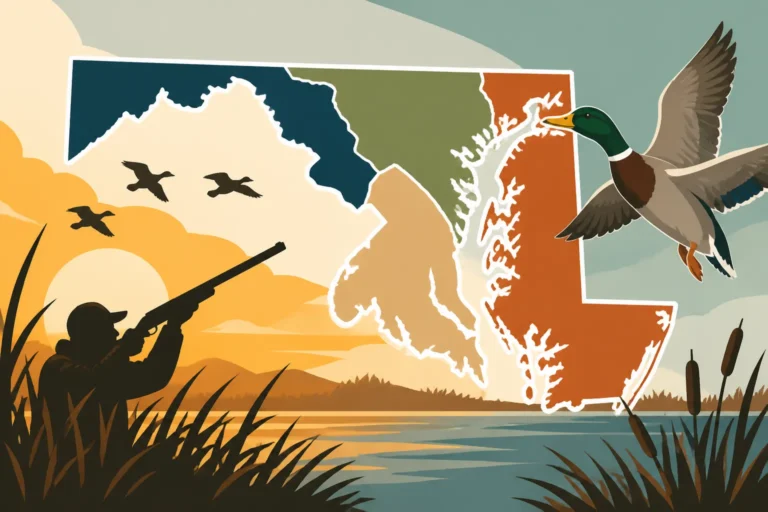
If you're planning to use buckshot for deer hunting in Maryland, your options are primarily concentrated on the Eastern Shore and in some Southern Maryland counties. This is largely due to the more rural, agricultural, and marshy landscapes found in these regions, where population density is generally lower, and the risk of stray pellets impacting unintended targets is reduced. For generations, hunters in these areas have relied on buckshot for close-quarters deer hunting, particularly in thick cover or marsh environments where shots are often snap-shots at shorter distances.
Specifically, Maryland regulations permit the use of buckshot for deer hunting in the following counties: Calvert, Caroline, Charles, Dorchester, St. Mary’s, Somerset, Talbot, Wicomico, and Worcester. In these counties, hunters can utilize buckshot during the designated firearms seasons. It's worth noting that these regulations are subject to change, so always double-check the most current Maryland DNR hunting guide before you head out. A reliable app like GoHunt can also be extremely helpful for quickly verifying county-specific regulations while you're planning your hunt or even in the field, ensuring you're always compliant with current rules.
In many of these counties, buckshot is a preferred choice for hunting elusive Sika deer in the dense Phragmites marshes, where shots are often taken at extremely close range. The spreading pattern of buckshot can be advantageous in these situations, increasing the chances of hitting a small, fast-moving target in thick cover. However, even within these permissive counties, hunters must always adhere to general safety rules, including knowing their target and what lies beyond it, and respecting minimum setback distances from dwellings and roads.
Counties Where Buckshot is Prohibited for Deer
Conversely, the vast majority of Maryland counties prohibit the use of buckshot for deer hunting. These restrictions are in place primarily for safety reasons, as these counties tend to be more densely populated, have smaller private land parcels, or are closer to urban and suburban developments. The longer travel distance of individual buckshot pellets, even if their energy diminishes, presents an unacceptable risk in areas where residential properties, roads, and other non-hunting zones are in close proximity to hunting lands. This is a significant point of confusion for hunters who might be used to using buckshot in other states or more rural settings.
Counties where buckshot is not permitted for deer hunting include: Allegany, Anne Arundel, Baltimore (County and City), Carroll, Cecil, Frederick, Garrett, Harford, Howard, Kent, Montgomery, Prince George's, Queen Anne's, and Washington. In these areas, if you're using a shotgun for deer, you are legally required to use shotgun slugs. The switch to slugs ensures that hunters are relying on a single, controlled projectile, thereby minimizing the risk of stray shot traveling beyond the intended target area. This is a crucial distinction that every Maryland deer hunter needs to commit to memory.
Navigating these rules can feel like a maze, especially if you hunt in multiple counties. Imagine hunting deer behind a Maryland housing development in Anne Arundel County, where slugs are mandated, then traveling to Dorchester County to hunt Sika deer where buckshot is allowed. This stark contrast underscores the need for meticulous preparation and understanding of local ordinances. Always consult the official Maryland DNR hunting regulations for the current season, and consider using digital mapping tools like GoHunt to visualize county boundaries and verify regulations on the fly, preventing accidental violations.
Maryland Buckshot Legality by County
To make things a bit clearer, here's a quick reference table showing buckshot legality for deer hunting by county in Maryland. Remember, this applies to firearms season, and specific rules or local ordinances might have additional nuances, so always verify with current DNR guides.
| County | Buckshot Legal for Deer | Ammunition Note |
|---|---|---|
| Allegany | No | Shotgun Slugs Only |
| Anne Arundel | No | Shotgun Slugs Only |
| Baltimore Co. | No | Shotgun Slugs Only |
| Baltimore City | No | Shotgun Slugs Only |
| Calvert | Yes | Buckshot (and Slugs) Permitted |
| Caroline | Yes | Buckshot (and Slugs) Permitted |
| Carroll | No | Shotgun Slugs Only |
| Cecil | No | Shotgun Slugs Only |
| Charles | Yes | Buckshot (and Slugs) Permitted |
| Dorchester | Yes | Buckshot (and Slugs) Permitted |
| Frederick | No | Shotgun Slugs Only |
| Garrett | No | Shotgun Slugs Only |
| Harford | No | Shotgun Slugs Only |
| Howard | No | Shotgun Slugs Only |
| Kent | No | Shotgun Slugs Only |
| Montgomery | No | Shotgun Slugs Only |
| Prince George's | No | Shotgun Slugs Only |
| Queen Anne's | No | Shotgun Slugs Only |
| St. Mary’s | Yes | Buckshot (and Slugs) Permitted |
| Somerset | Yes | Buckshot (and Slugs) Permitted |
| Talbot | Yes | Buckshot (and Slugs) Permitted |
| Washington | No | Shotgun Slugs Only |
| Wicomico | Yes | Buckshot (and Slugs) Permitted |
| Worcester | Yes | Buckshot (and Slugs) Permitted |
The Rationale Behind Buckshot Restrictions
The frustrations of navigating complex hunting regulations are valid, but it helps to understand the "why" behind these rules. Maryland's buckshot restrictions aren't arbitrary; they are the result of careful consideration of public safety, ethical hunting, and the unique geography of the state. It's a balance act between providing hunting opportunities and ensuring the well-being of all residents, whether they hunt or not.
Public Safety in Densely Populated Areas
The primary driver behind Maryland's buckshot restrictions is undoubtedly public safety. Unlike a rifle bullet or a shotgun slug, which maintain a relatively predictable trajectory and rapidly lose velocity, individual pellets from a buckshot load can scatter. While their effective killing range is shorter than a rifle, the individual pellets can still travel considerable distances with enough energy to cause serious injury or damage, even outside their effective hunting range. In a state like Maryland, which has a mix of rural, suburban, and urban landscapes, this becomes a critical concern.
Many of the prohibited counties are part of the bustling "corridor" between Baltimore and Washington D.C., or contain significant population centers where residential properties, roads, and recreational areas often abut or intertwine with hunting lands. Imagine the risk if hunters were using buckshot just a few hundred yards from a suburban neighborhood or a busy highway. The regulations prohibiting buckshot in these areas are a direct response to the need to mitigate these risks and protect non-hunters and property owners from potential harm caused by stray pellets.
This isn't about diminishing a hunter's choice but ensuring responsible and safe hunting practices given the unique geography and population distribution of Maryland. The Maryland Department of Natural Resources (DNR) works tirelessly to balance hunting opportunities with public safety, and these buckshot rules are a prime example of that careful consideration. It’s a frustrating reality for some hunters, but a necessary one to ensure hunting remains a safe and accepted activity across the state.
Ethical Considerations and Effective Range
Beyond public safety, ethical hunting practices also play a significant role in the regulation of buckshot. A clean, humane kill is paramount to responsible hunting. While buckshot can be devastating at very close ranges, its effectiveness drops off sharply beyond a certain distance. The spread pattern means that at longer ranges, fewer pellets will strike the target, and those that do may lack sufficient energy to quickly dispatch an animal. This increases the risk of wounding deer, leading to prolonged suffering and difficult recovery efforts.
The intent of the regulations, in part, is to ensure that hunters are using ammunition that provides the highest probability of a clean, ethical kill within the typical hunting conditions of a given area. In counties where fields are open, or woods allow for longer shots, a slug offers better precision and retained energy. Where buckshot is permitted, such as in the dense marshes of Dorchester County, the expectation is that shots will be taken at very close quarters, typically within 30-40 yards, where its pattern can be highly effective.
This emphasis on ethical hunting underlines the importance of hunters knowing their equipment and its limitations. It's not enough to simply know if buckshot is legal; you must also understand its effective range for a humane kill. Regardless of the ammunition chosen, hunters are responsible for ensuring their shot is true and lethal, avoiding unnecessary suffering for the game animal. Don't forget to review Maryland Shooting Hours and Legal Light to ensure you're hunting only during appropriate times, regardless of your chosen ammunition.
Navigating Buckshot Rules Across Maryland's Regions
Understanding Maryland's buckshot rules also means understanding how they fit into the broader deer management strategies and regional classifications of the state. It's not always a standalone regulation but part of a larger framework designed for specific geographical and population contexts.
Region A and Region B Implications
Maryland divides its deer management into two distinct regions: Region A (Western Maryland's mountainous counties) and Region B (the rest of the state). This regional division primarily influences bag limits and antler restrictions, but it also indirectly ties into weapon regulations. In essence, all of Region A (Allegany, Garrett, Washington counties) falls under the "buckshot prohibited" category, where only shotgun slugs are legal for deer hunting. This aligns with the more open, mountainous terrain where longer sightlines might occur, making precision a greater concern.
Region B, covering the vast majority of the state, is where you find the mix of buckshot-legal and buckshot-prohibited counties. So, while Region B generally has more liberal antlerless deer bag limits, it doesn't uniformly allow buckshot. The county-specific rules still apply. For instance, a hunter in Kent County (Region B) must use slugs, while a hunter in Dorchester County (also Region B) can use buckshot. Understanding these nuances is critical, especially if you hunt in multiple parts of the state or across county lines. You can learn more about Hunting Maryland's Two Deer Management Regions to get a broader picture of these distinctions.
It's a testament to Maryland's diverse landscape and population distribution that even within a single deer management region, weapon rules can vary so significantly. This isn't just about deer numbers; it's about tailoring regulations to local conditions, ensuring both effective deer management and public safety. Always consult the official Maryland DNR hunting guide for the current season, as specific details on Maryland's Deer Bag Limits and Antler Rule can also influence your overall hunting strategy and the type of ammunition you choose.
Suburban and Special Management Hunts
Many areas within Maryland's more populated counties host special suburban deer management hunts, often designed to reduce deer populations in residential or park areas where traditional hunting might be restricted. These hunts often have their own specific weapon requirements, and buckshot is almost universally not permitted in these sensitive areas. Instead, archers and shotgun hunters using slugs are typically the only options. The goal here is precision and minimal disturbance, making buckshot an unsuitable choice. You can find more detailed information on Hunting Maryland's Suburban Deer Management Hunts.
These special hunts might take place in areas like county parks or designated green spaces, often near housing developments or busy roads. The emphasis is heavily on safety and controlled conditions. Even in counties where buckshot might be legal in more rural sections, its use would be strictly prohibited in a managed hunt within a developed area. The dense human population and smaller huntable parcels dictate an even more conservative approach to ammunition choice, focusing on single-projectile methods.
If you're considering participating in one of these suburban hunts, always check the specific regulations for that hunt directly with the managing agency, whether it's the Maryland DNR, a county park service, or a private land manager. Do not assume the general county rules apply. These hunts are designed with extremely strict parameters to ensure public safety and community acceptance, and weapon choices are always at the top of that list. This is also where resources like GoHunt can provide overlays for specific public lands or managed areas, helping you understand permitted activities.
Practical Tips for Buckshot Hunters in Maryland
For those hunting in the counties where buckshot is legally permitted, there are several practical steps you should take to ensure a safe, ethical, and successful hunt. These considerations go beyond simply knowing the rules; they involve understanding your equipment and its performance.
Choosing the Right Load and Patterning Your Shotgun
For those hunting in the counties where buckshot is legal, selecting the right load and thoroughly patterning your shotgun are non-negotiable steps. Buckshot comes in various pellet sizes, like #4 buck, #1 buck, and 00 buck. Generally, larger pellets (like 00 buck) carry more energy and penetrate deeper, making them suitable for larger deer, while smaller pellets offer a denser pattern. The key is to find a load that performs best out of your specific shotgun barrel. Different chokes (full, modified, improved cylinder) will also dramatically affect your pattern, so don't just grab a box of shells and head to the woods.
Patterning involves shooting several different buckshot loads at varying distances (e.g., 20, 30, 40 yards) at a large paper target to see how tightly and consistently the pellets group. You're looking for a pattern that places a sufficient number of pellets (typically 3-5 or more) into a vital area (like a 10-inch circle) to ensure a clean kill. If your pattern is too open at, say, 35 yards, then that is your effective maximum range, regardless of what the box says. This diligent practice is an ethical imperative for any hunter.
This preparation is critical for success and ethical hunting. You wouldn't take a rifle into the field without sighting it in, and the same principle applies, perhaps even more so, to shotguns loaded with buckshot. Knowing your effective range down to the yard prevents taking questionable shots that might wound an animal. So, get to the range, test different loads and chokes, and understand your setup's capabilities and limitations. Remember to check Maryland Hunting Licenses and What They Cost and ensure you have all necessary stamps before purchasing ammunition and heading to the range.
Maximizing Safety and Ethical Range Awareness
Even in counties where buckshot is legal, safety remains paramount. The same rules of knowing your target and what's beyond it apply, but with buckshot, you must be acutely aware of the potential for pellets to spread and travel. While individual pellets might not be lethal at extreme distances, they can still cause injury or property damage far beyond your effective killing range. Always consider your backdrop and ensure that any shot taken is safe. This means being extra vigilant when hunting near property lines, roads, or other structures.
Understanding your ethical range is equally important. Just because a few pellets might hit a target at 50 yards doesn't mean it's an ethical shot with buckshot. For most setups, the reliable ethical range for deer with buckshot is generally considered to be 30-40 yards, perhaps 50 yards with an exceptionally tight-patterning gun and optimal conditions. Pushing beyond this range dramatically increases the risk of merely wounding the animal. Use tools like a rangefinder to confirm distances before taking a shot, especially when you're targeting deer in dense cover.
For those utilizing buckshot on Maryland's Eastern Shore for Sika deer or Whitetails in thick areas, getting close is part of the challenge and reward. This is where scouting and knowing the land really pay off. Use mapping applications like GoHunt to mark deer trails, bedding areas, and potential shot lanes that keep your shots within that ethical buckshot range. By combining good woodsmanship with a thorough understanding of your ammunition's capabilities, you can have a safe, successful, and ethical hunt. Also, always be mindful of Maryland Blaze Orange Requirements to ensure you're visible to other hunters, especially in dense cover where buckshot is commonly used. Even for new hunters, Maryland Apprentice and Mentored Hunting programs emphasize these safety protocols.
Disclaimer
Please remember that hunting regulations can change. While every effort has been made to provide accurate and up-to-date information, it is the individual hunter's responsibility to consult the most current Maryland Department of Natural Resources (DNR) hunting guide before heading afield. This guide is for informational purposes only and does not constitute legal advice.