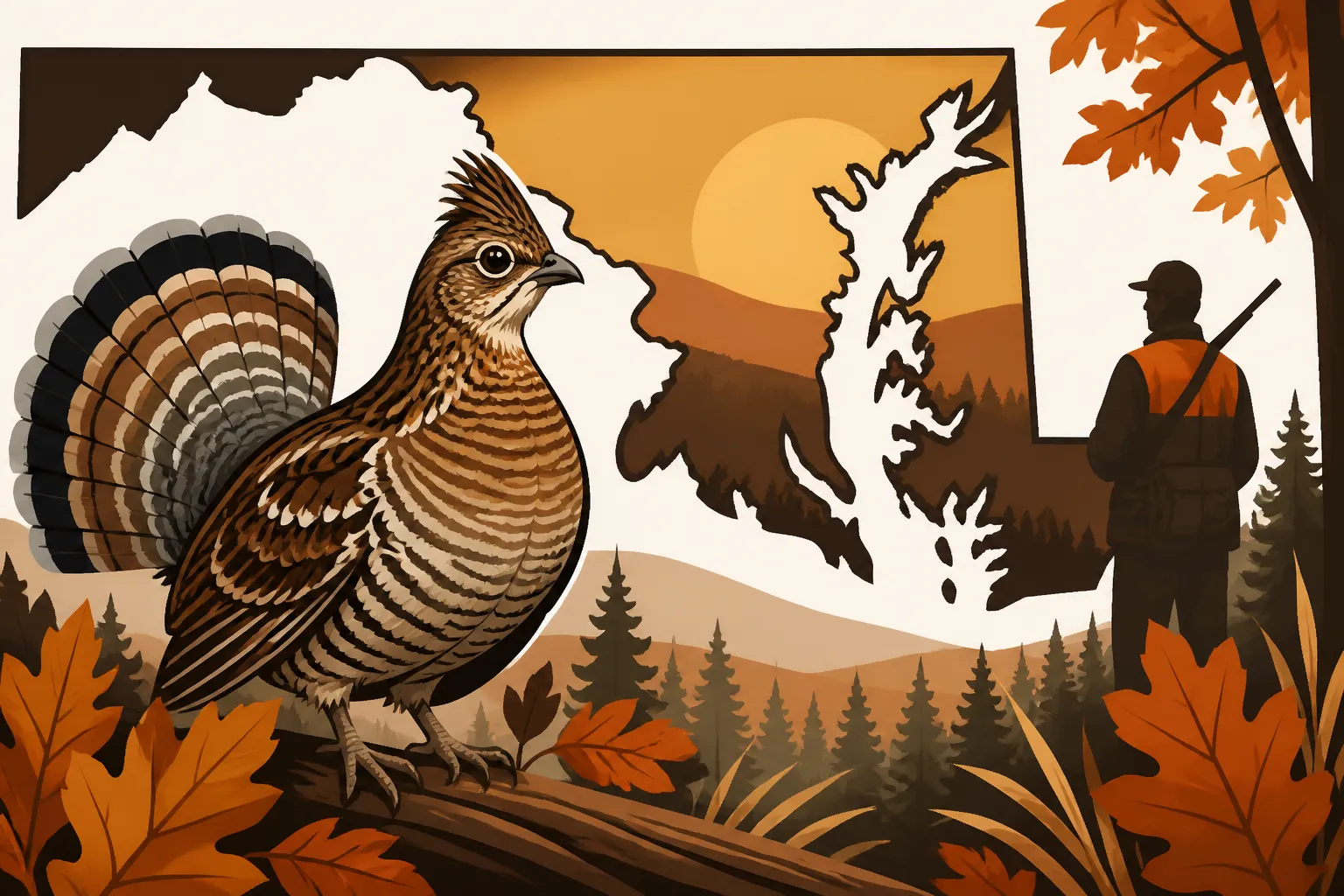
Where Maryland Grouse Still Hold On
It’s a tough pill to swallow for many seasoned Maryland hunters, but the drumming of a ruffed grouse has become an increasingly rare sound in our woods. If you're like me, you remember a time when these explosive game birds were a more common sight, but finding them now feels like searching for a needle in a haystack. This guide is dedicated to helping you understand why these magnificent birds have declined, and more importantly, where you might still be able to find a flush or two in Maryland's remaining grouse coverts.
The Vanishing Drummer: Why Grouse Are So Elusive Now
For many of us who grew up in the woods, the memory of a ruffed grouse thundering out of a thicket, scattering leaves and sending adrenaline coursing through our veins, is etched into our minds. It was a common occurrence, a hallmark of fall hunting. But today, if you hear that distinctive drumming or experience that heart-stopping flush, consider yourself lucky. The truth is, ruffed grouse populations in Maryland have been on a steady decline for decades, making them one of the most challenging small game species to pursue. It's a frustrating reality for those of us who cherish the tradition of grouse hunting.
Habitat Loss and Fragmentation: The Primary Culprit
The single biggest factor in the decline of ruffed grouse across Maryland, and much of their eastern range, is the disappearance of suitable habitat. Grouse aren't birds of mature, open timber. They thrive in what we call early successional habitat—young forests that are regenerating after logging, wildfires, or other disturbances. Think dense thickets of saplings, greenbrier, mountain laurel, and rhododendron, often mixed with some scattered older trees. This tangled mess provides critical cover from predators like hawks and coyotes, and it offers a consistent food source of buds, catkins, and berries.
Unfortunately, much of Maryland's forestland has aged past this ideal stage. As timbering practices have changed and suburban development has crept deeper into rural areas, those patchwork landscapes of varying forest ages have become less common. Clear-cutting, which used to create prime grouse habitat, is often replaced by selective logging or simply no logging at all in many areas. The result is a more uniform, mature forest canopy that lacks the dense understory grouse need to survive and reproduce. Where you once had a mosaic of young growth, now you often find continuous tracts of mature hardwoods, beautiful for hiking, but less than ideal for a bird that needs to hide and forage in dense cover.
Increased Predation and Environmental Pressures
While habitat is king, it's not the only factor. A lack of ideal cover makes grouse more vulnerable to predators. A grouse trying to evade a hawk in open, mature woods has far less chance than one diving into a dense thicket of greenbrier. Increased populations of generalist predators like raccoons, opossums, and coyotes, which can thrive in more fragmented landscapes, also contribute to the pressure.
Beyond predators, subtle environmental shifts can play a role. Changing climate patterns, even minor ones, can affect insect populations that young grouse chicks rely on, or alter the timing of budding plants that provide winter sustenance. While these aren't as dramatic as clear-cut habitat loss, they add another layer of challenge for an already struggling species. It's a complex web of factors, but at the heart of it, the grouse needs its specific type of messy, brushy home, and we just don't have as much of it as we used to.
Pinpointing the Last Strongholds: Where to Focus Your Search
Given the challenges, finding ruffed grouse in Maryland today requires a very focused approach. You can't just wander into any patch of woods and expect to kick one up. You need to know where to look, and critically, what specific features make a particular spot more likely to hold these elusive birds. The good news is, there are still pockets, albeit shrinking ones, where grouse continue to hold on.
Western Maryland's Higher Elevations
Without a doubt, the mountainous terrain of Western Maryland offers the best, and arguably only, consistent chance of finding ruffed grouse. Specifically, Garrett and Allegany counties are where you should concentrate your efforts. This region offers the right combination of elevation, forest type, and historical logging activity that creates the microclimates and habitat diversity grouse need. Think of the deep hollows, rugged ridges, and colder temperatures that define this area – it’s a world away from the Eastern Shore.
Within these counties, focus on areas of higher elevation, particularly where you find a mix of mature timber and regenerating clear-cuts from the last 10-25 years. These regenerating areas are key. Look for dense thickets of mountain laurel, rhododendron, greenbrier, and young saplings, often mixed with hemlock or other conifers that provide thermal cover in winter. Stream bottoms and steep, north-facing slopes can also be productive, as they tend to hold moisture and support dense undergrowth that persists even through drier periods. Using a mapping tool like GoHunt can be incredibly helpful here, allowing you to overlay topo maps with satellite imagery to identify these specific habitat types before you even lace up your boots. You're looking for areas that look almost impenetrable on a map – the thicker, the better for grouse. Still-Hunting Western Maryland Mountain Timber is a great strategy for these areas.
Public Land Opportunities: State Forests and WMAs
Maryland's state forests and some Wildlife Management Areas (WMAs) in the western part of the state are your best bet for public land grouse hunting. These larger tracts of land often have more varied timber management plans, which occasionally create the crucial early successional habitat grouse need.
- Savage River State Forest: This vast forest in Garrett County is a prime example. Its rugged terrain, elevation changes, and ongoing timber management, while not always specifically for grouse, can create pockets of ideal habitat. Look for old logging roads leading into regenerating clear-cuts or areas where significant storm damage has occurred, leading to dense new growth. You'll need to work hard and cover a lot of ground, but the potential is there.
- Green Ridge State Forest: Located primarily in Allegany County, Green Ridge also offers expansive public hunting opportunities. Similar to Savage River, focus on areas with recent timbering activity or natural disturbances. The key is finding that dense, almost impenetrable cover. Sometimes, areas that were heavily logged decades ago are now maturing into a secondary growth that, while perhaps not perfect young forest, still offers more cover than completely mature stands.
- Other WMAs: Smaller WMAs in Garrett and Allegany counties might also hold a few birds, but generally, the larger state forests offer the most extensive search areas. Always check the specific WMA regulations for Maryland Public Land Hunting Permits and any special access rules before you go.
It’s crucial to understand that even within these areas, grouse densities are low. You'll likely walk many miles for a single flush, but for the dedicated hunter, that single flush is often worth all the effort. It’s a game of patience and perseverance, relying heavily on your ability to read the cover and understand what a grouse needs to survive in its shrinking world.
| Habitat Characteristic | Ideal Grouse Cover in Maryland | Less Ideal (but Common) Cover |
|---|---|---|
| Forest Age | Young, regenerating forest (5-20 years old), recent clear-cuts, old fields converting to timber | Mature, open hardwoods (50+ years old), planted pines without understory |
| Understory Density | Dense thickets of mountain laurel, rhododendron, greenbrier, blackberry, young saplings | Sparse understory, open forest floor, dense canopy shades out ground growth |
| Food Sources | Aspen buds, birch catkins, wintergreen, partridgeberry, ferns, insects in summer | Primarily acorns (mast crops), limited diversity for year-round foraging |
| Water Access | Nearby small streams, seepages, moist draws, springs; dense cover along banks | Dry ridge tops, distant water sources, large open water bodies (lakes) |
| Slope/Aspect | Varied topography, benches, steep north-facing slopes for thermal cover | Flat, uniform terrain; exposed south-facing slopes in winter |
| Disturbance | Recent logging, storm blowdowns, managed burns, abandoned orchards or farms | Undisturbed, homogeneous forest stands, manicured woodlots |
Tactics for Hunting Maryland's Remaining Grouse
Hunting ruffed grouse in Maryland is not for the faint of heart. It demands physical stamina, sharp observational skills, and a healthy dose of humility. You'll work hard for every opportunity, but the reward of a wild grouse flush is unparalleled.
Understanding Grouse Behavior and Preferred Cover
The first step to successfully hunting Maryland grouse is deeply understanding their habits. They are masters of camouflage and cover. When you walk through what looks like an impenetrable tangle, remember that to a grouse, it's home, sanctuary, and dinner table all rolled into one. They won't be out in the open, casually strolling along. They'll be buried deep in the thickest, nastiest stuff you can imagine.
When scouting, whether in person or using detailed aerial photos and mapping apps like GoHunt, look for those very specific cover elements:
- Young, regenerating timber: This is paramount. Locate areas that have been clear-cut within the last two decades and are now a dense mix of saplings, briars, and low-growing shrubs.
- Mountain laurel and rhododendron thickets: These evergreen plants provide excellent year-round cover. Grouse will dive into these dense patches for protection from weather and predators.
- Conifer stands mixed with hardwoods: Pockets of hemlock, spruce, or white pine mixed within a hardwood forest offer thermal cover in winter and protection from raptors.
- Edges and transitions: While grouse love thick cover, they often forage along the edges where different cover types meet, or along old logging roads and skid trails within that cover. This is where you might get your shot as they move between feeding and loafing areas.
Your ability to read the habitat and anticipate where a grouse might be holding is crucial. Think like a grouse: "Where would I go to hide from a hawk? Where can I find buds to eat without being exposed?" This often means pushing through incredibly dense, difficult terrain. For effective pre-season scouting, checking out Scouting Maryland Public Land With Aerial Photos can save you a lot of boot leather.
Still-Hunting and Working with a Dog
Given the dense cover and the low density of birds, slow, deliberate hunting methods are almost always more effective than fast-paced busting through the woods.
-
Still-Hunting: This involves moving very slowly, pausing frequently, and using your eyes and ears. Take a few steps, then stop for a minute or two, scanning the cover in front of you. Grouse often hold tight, relying on their camouflage, and will only flush when you're almost on top of them. These pauses can sometimes make a nervous bird flush early, giving you a slightly better chance at a shot. Listen intently for any movement, the rustle of leaves, or the soft "putt" of a nervous grouse. When you find a promising patch of cover, circle around it, working the edges, before making a final push through the thickest part. Patience is your greatest ally here. Reading Sign in Maryland Mountain Timber can also help you identify areas where other small game might be active, indirectly leading you to grouse cover.
-
Hunting with a Dog: For many, the true art of grouse hunting lies in working with a well-trained bird dog. A good grouse dog, typically a setter or pointer, works close, scents birds, and goes on point, holding the bird until you arrive. This allows you to walk into the flush, mentally prepared, and often provides a slightly longer shot window as the bird breaks cover. However, finding a dog specifically trained for Maryland's tight, rugged grouse cover is a commitment. The dog needs to be tough, fearless of briars, and accustomed to working out of sight for short periods. Without a dog, expect to walk past many birds you never knew were there. If you're considering hunting Small Game Species in Maryland with a dog, it's worth the investment in training for grouse.
Remember, shooting opportunities will be fleeting. Grouse are incredibly fast and agile, weaving through trees and disappearing almost as soon as they flush. Practice your swing shooting and be ready to shoulder your shotgun quickly. A light, fast-handling shotgun with open chokes (improved cylinder or skeet) is often preferred for these close, fast shots.
The Future of Grouse Hunting in Maryland
While the current state of ruffed grouse hunting in Maryland might feel a bit bleak, there's still hope for these magnificent birds, primarily through continued habitat focus and dedicated conservation efforts. It’s important for us, as hunters, to understand and support these initiatives.
Conservation Efforts and Habitat Management
The key to any grouse recovery lies squarely in habitat. Without the right mix of early successional forest, grouse simply cannot thrive. Maryland's Department of Natural Resources (DNR) and other conservation groups are aware of the challenges facing various native wildlife, including grouse. Efforts to manage state forests and WMAs sometimes include timbering practices designed to create diverse age classes of forest, which can inadvertently benefit grouse. These managed cuts or controlled burns, while sometimes controversial with the general public, are vital for species that depend on young growth.
It's a delicate balance. Mature forests offer aesthetic beauty and habitat for other species, but specific, targeted management is needed for species like grouse. Supporting organizations that advocate for sound, science-based forest management and participating in public comment periods for forest plans can make a difference. Every acre of new, quality early successional habitat is a step in the right direction for the ruffed grouse.
Hunter Responsibility and Advocacy
As grouse hunters, we have a unique role to play. We are often the first to notice changes in wildlife populations and habitats.
- Reporting Sightings: If you encounter a grouse, even if you don't get a shot, consider reporting your sighting to the Maryland DNR. Data, even anecdotal, helps wildlife biologists track populations and identify potential strongholds.
- Ethical Hunting: With such low populations, ethical hunting practices are more important than ever. Don't overharvest, respect bag limits, and ensure clean kills. Each bird is precious.
- Advocacy: Become an advocate for habitat. Support conservation groups like the Ruffed Grouse Society, even if their primary work is outside Maryland. The principles of creating and maintaining early successional habitat are universal for grouse. Talk to landowners about the benefits of timber management that creates young forests. Consider exploring Hunting Maryland's Western Mountain Forests not just as a hunt, but as an opportunity to observe and learn more about these critical habitats.
Hunting Maryland's ruffed grouse today is an act of dedication, a testament to the enduring appeal of this challenging bird. It’s a hunt steeped in tradition and an intimate connection with the wildest parts of our state. While the flushes may be few and far between, the satisfaction of hearing that heart-stopping burst of wings, even if no shot is fired, is a reminder of the wild beauty that still clings to our western mountains. We may not see a return to the grouse numbers of yesteryear, but with continued effort and passion, we can help ensure that the drumming of the ruffed grouse continues to echo through Maryland's timber for generations to come.
Disclaimer
This article is for general informational purposes only and does not constitute professional advice. Laws, prices and regulations vary by location and change over time. Consult a qualified professional for guidance on your specific situation.