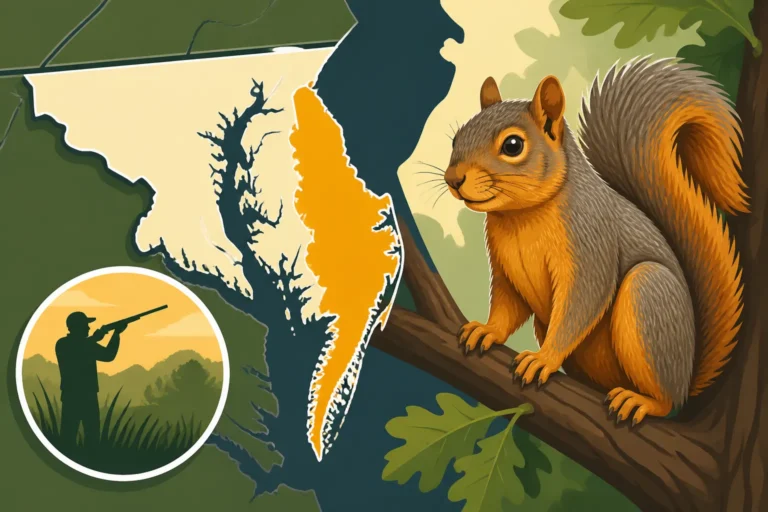
Fox Squirrels in Western Maryland
It can be tough to distinguish between the various squirrel species scampering through Maryland’s hardwoods, especially when you're out hunting and need to make a quick, legal identification. Many hunters might not realize the unique characteristics and habitat preferences of the fox squirrel, particularly in the rugged, forested landscapes of Western Maryland. This guide will help you understand where to find these elusive critters, how to tell them apart from their more common gray cousins, and what strategies can lead to a successful hunt in the beautiful mountains and ridges of our state.
The Unique World of Fox Squirrels in Western Maryland
When we talk about fox squirrels in Maryland, we're primarily looking at the westernmost counties—Garrett and Allegany, with some scattered populations in western Washington County. These aren't your typical backyard gray squirrels that you see everywhere from suburban Baltimore to the Eastern Shore. Fox squirrels are generally larger, often with a more reddish or yellowish-gray coat, and a notably bushier, darker tail. They carry themselves with a certain gravitas, moving a bit slower, almost more deliberately, than the frenetic gray squirrel.
Preferred Habitats and Range
Unlike gray squirrels, which thrive in dense, unbroken hardwood forests, fox squirrels tend to prefer more open, mature woodlands with a diverse mix of trees, including oaks, hickories, and pines. You'll often find them along forest edges, in smaller woodlots, or adjacent to agricultural fields where they can forage for nuts, seeds, and even agricultural crops. They appreciate a more "park-like" setting, if you will, with fewer trees per acre but larger, older growth that provides excellent denning cavities and abundant food sources. In Western Maryland, this often means the higher elevations, the mixed oak-pine stands that border old farmsteads, or the edges of large timber tracts. Think about the big, old oak flats you might find within Savage River State Forest or Green Ridge State Forest – those are prime fox squirrel hangouts. They're less common in the deep, continuous canopy where gray squirrels dominate.
The reasons for this preference are pretty straightforward. Fox squirrels spend more time on the ground foraging than gray squirrels. They need that open understory to see predators and to bury their caches of nuts. They also rely heavily on den trees, those magnificent old giants with hollows and broken limbs, which are more prevalent in mature, less disturbed woodlands. If you’re scouting an area and notice fewer but larger trees, with clear sightlines and plenty of mast on the forest floor, you might be in good fox squirrel territory. They’re a true indicator of healthy, mature forest ecosystems in our western counties.
Diet and Behavior
Fox squirrels are largely diurnal, meaning they are most active during the day, particularly in the early morning and late afternoon. Their diet is incredibly varied, reflecting their adaptable nature. While acorns, hickory nuts, and walnuts are staples, they'll also consume seeds from pines, berries, buds, fungi, and even insects when other food sources are scarce. During the late summer and fall, you'll see them intensely focused on harvesting and burying nuts, a critical behavior for their winter survival. This makes understanding mast crop cycles incredibly important for hunters. A good year for acorns means a healthier, more abundant squirrel population.
Their behavior is also a bit different from gray squirrels. Fox squirrels are often less frantic, more prone to "freezing" when alarmed rather than immediately bolting up a tree and chattering incessantly. They might flatten themselves against a limb or hide on the far side of a tree trunk, relying on their camouflage to avoid detection. When they do run, it can be a surprisingly fast, powerful dash up to the safety of a high branch or den tree. They're also less social than gray squirrels, often seen alone or in smaller family groups. This makes them a bit more challenging to hunt, as you won't typically find large concentrations like you might with grays. You'll need to be more patient and observant, slowly still-hunting through their preferred habitat, scanning the branches and tree trunks for that tell-tale reddish flash or the slight twitch of a bushy tail.
Identifying Maryland's Fox Squirrels
Correct identification is absolutely crucial when you're in the field, not just for confirming you're hunting the right species, but also because Maryland has a protected species of fox squirrel. Knowing the difference ensures you stay within the law and contribute to responsible hunting practices.
Distinguishing Features from Gray Squirrels
The most noticeable difference between a fox squirrel and a gray squirrel is size. Fox squirrels are significantly larger, often weighing up to two pounds or more, compared to the gray squirrel's typical one to one-and-a-half pounds. Imagine comparing a large house cat to a smaller, sleek one – that's roughly the scale difference you're looking at.
Beyond size, look at the coloration. While both can have some variation, Western Maryland fox squirrels typically exhibit a grizzled yellowish-brown to reddish-gray coat on their backs, with lighter, often orange or rusty-colored undersides. Their most distinctive feature is often their tail: a thick, bushy tail that is usually edged in a rusty orange or reddish color, rather than the more white-fringed tail of a gray squirrel. Gray squirrels, as their name suggests, are predominantly gray with white bellies and tails. Sometimes, gray squirrels can have a reddish wash on their flanks, especially in the fall, which can confuse new hunters, but their overall grayness and tail characteristics usually give them away.
When you see them in the field, observe their movements. Fox squirrels tend to be a bit more deliberate, sometimes even appearing sluggish, compared to the lightning-fast, acrobatic movements of gray squirrels. They often move with a bounding gait on the ground, and when they climb, it's often a bit more heavy-footed. Keep an eye out for these subtle differences, perhaps using your binoculars to get a clearer look before raising your rifle.
Here’s a quick comparison to help you:
| Feature | Western Maryland Fox Squirrel | Gray Squirrel (Eastern Gray Squirrel) |
|---|---|---|
| Size | Larger (1.5-2.5+ lbs, up to 30 inches long including tail) | Smaller (1-1.5 lbs, up to 20 inches long including tail) |
| Color | Grizzled yellowish-brown to reddish-gray back; orange/rusty belly | Predominantly gray back; white belly |
| Tail | Bushy, often rusty-orange or reddish-fringed | Bushy, typically white-fringed |
| Movement | More deliberate, slower; sometimes freezes | Faster, more agile; often chatters and barks |
| Habitat | Open, mature woodlands, forest edges, smaller woodlots | Dense, continuous hardwood forests, urban areas |
| Range (MD) | Primarily Western MD (Garrett, Allegany, W. Washington) | Statewide |
The Protected Delmarva Fox Squirrel – A Critical Difference
This is perhaps the most important distinction to make. Maryland is also home to The Protected Delmarva Fox Squirrel, found almost exclusively on the Eastern Shore, notably in counties like Dorchester, Caroline, and Talbot. This particular subspecies of fox squirrel (Sciurus niger cinereus) looks quite different from its Western Maryland cousin. Delmarva fox squirrels are larger than gray squirrels, but often appear a much paler, silvery-gray, almost washed-out color, with a white belly and a distinctively broad, bushy tail that can also be silvery-gray with a white tip. They also have a white nose and sometimes white ear tips. They lack the reddish or yellowish tones of the Western Maryland fox squirrel.
It is critical to understand that the Delmarva fox squirrel is a federally and state-protected species, and it is illegal to hunt them. They are a conservation success story, having been delisted federally, but they remain protected by the state of Maryland. Therefore, if you are hunting on the Eastern Shore, you must know How to Identify a Delmarva Fox Squirrel and ensure you are only targeting gray squirrels. Conversely, in Western Maryland, while you can hunt the Western fox squirrel, you still need to be confident in your identification to avoid any potential confusion, particularly if you encounter an unusually pale specimen. Always err on the side of caution. If you have any doubt, let it walk. Your best bet is to rely on a combination of size, color, and habitat to make a positive ID.
Strategies for Hunting Fox Squirrels in Western Maryland
Hunting fox squirrels can be a rewarding experience, offering a different pace than deer hunting and a chance to hone your stalking and observation skills. Success often hinges on understanding their patterns and choosing the right approach.
Prime Season and Conditions
Maryland's squirrel season typically kicks off in September, offering a fantastic opportunity to get out in the woods before the deer firearms season starts to dominate. The early part of the season, specifically September and October, can be excellent for fox squirrels. The leaves are still on the trees, providing plenty of cover, but the squirrels are actively foraging for the fall mast crop. This is when they are most predictable, often found on the ground or in the lower canopy, gathering acorns and hickory nuts. Look for areas with a good abundance of fallen nuts. Squirrel Hunting Maryland's September Opener can be warm, so plan for comfortable clothing and be mindful of hydration.
As the season progresses into late fall and winter, after the leaves have dropped, visibility increases, but squirrels become more reliant on den trees and less active during harsh weather. Crisp, calm days after a cold front can be ideal, as squirrels will often emerge to feed. Overcast days can also be productive, as the reduced light can make squirrels feel safer and less prone to hiding from aerial predators. Avoid very windy days, as squirrels often hunker down, and the constant movement of branches makes spotting them incredibly difficult. When considering the weather, also think about how it affects their food sources. A light snow can sometimes make it easier to spot their tracks leading to buried caches or feeding areas.
Effective Hunting Methods
There are a few primary methods that prove effective for fox squirrels, each with its own rhythm and requirements.
- Still-Hunting: This is my personal favorite and often the most productive for fox squirrels due to their preference for more open woods. It involves moving slowly and deliberately through the woods, pausing frequently to scan the trees and ground. Think of it like a slow, methodical walk, stopping every few steps to listen and look. Take five steps, stop for a minute or two, listen for rustling leaves or falling nut fragments, and meticulously search the branches, trunks, and forest floor. Pay close attention to gnawed nut shells at the base of trees or on stumps, which indicate recent feeding activity. This method requires patience and keen observation, but it allows you to cover ground while being ready for a shot at any moment. Focus on those mature oak and hickory stands, and the edges where timber meets fields.
- Stands/Blinds: While often associated with deer hunting, sitting quietly in a well-placed ground blind or treestand can also be effective for squirrels, especially if you've identified a heavily used feeding area. This is a great strategy if you have limited mobility or prefer a more stationary hunt. Set up near a cluster of mature nut-bearing trees or along a known travel corridor between a woodlot and a field. Get there before daylight and wait for the squirrels to become active. The key here is absolute stillness and silence. A small pair of binoculars can be invaluable for scanning the canopy without excessive movement.
- Dog Hunting: If you have a good squirrel dog, this can be an incredibly fun and active way to hunt fox squirrels. The dog will locate squirrels by scent and sight, barking "treed" when it finds one. This method is particularly effective in areas with dense undergrowth where spotting squirrels visually can be difficult. The dog does the hard work of finding and pointing out the squirrel, leaving you to make the shot. It's a great way to introduce new hunters, especially youth, to the sport, and it adds an exciting dynamic to the hunt. Just make sure your dog is well-trained and respects other wildlife.
No matter the method, wearing appropriate camouflage that blends with the Western Maryland woods is important. Given their keen eyesight, breaking up your outline is critical.
Gear and Tactics for Success
When targeting fox squirrels, your equipment choice can make a real difference.
- Firearms: A .22 caliber rimfire rifle is the classic choice for squirrel hunting. It's accurate, quiet, and provides more than enough power for fox squirrels. Headshots are preferred for quick, humane kills and to preserve the meat. Many hunters also use a small gauge shotgun, like a .410 or 20 gauge, especially in dense cover or when hunting with dogs. Make sure you check Maryland's Legal Weapons by County before you head out, as regulations can vary. For those who enjoy a challenge, a small air rifle in .177 or .22 caliber can also be a quiet and effective tool, provided it has sufficient power and accuracy.
- Optics: A good pair of binoculars (8x or 10x magnification) is indispensable. They allow you to thoroughly scan tree limbs and trunks for squirrels without excessive head movement that might spook them. A scope on your rifle, typically a variable power between 3-9x, will greatly aid in precise shot placement.
- Calling: While not as common for fox squirrels as for other game, sometimes a gentle squirrel call, mimicking a distress bark or chatter, can sometimes get a hidden squirrel to reveal itself. It's less about luring them in and more about getting a response. Don't overdo it.
- Patience and Stealth: Fox squirrels are wary. Move slowly, quietly, and deliberately. Every rustle of leaves, every snapped twig, can alert them to your presence. Wear soft clothing that won't make noise when you move. Use the terrain and tree trunks for cover as you advance. When still-hunting, use the natural rhythm of the woods. After you hear a squirrel, it often takes a minute or two for them to settle down and become visible again. Be patient.
- Utilize Apps and Maps: Tools like GoHunt or other mapping apps can be incredibly useful for scouting good fox squirrel habitat. Use the satellite imagery to identify areas of mature, open timber, especially those bordering agricultural fields or clearings. You can pinpoint old logging roads, ridgetop benches, and creek bottoms that might concentrate activity. Even if you've been hunting the same spot for years, a quick glance at a GoHunt map can reveal overlooked pockets of habitat. This can help you plan your entry and exit routes, identify potential den trees, and find areas that might hold fewer Hunting Pressure on Maryland Public Land.
Remember, safety first. Always identify your target positively and ensure a safe backdrop before taking a shot.
Conservation and the Future of Western Maryland's Fox Squirrels
While not as heavily managed as deer or bears, fox squirrels play a vital role in their ecosystem, and responsible hunting practices contribute to their continued health.
Regulatory Considerations
Maryland's fox squirrel populations in the western counties are generally stable, and hunting regulations reflect this. There are usually generous bag limits and a long season, running from early fall well into winter. However, it's essential to consult the current Maryland Guide to Hunting and Trapping, available online from the Maryland Department of Natural Resources (DNR), for the precise season dates, bag limits, and any specific county regulations that might apply. These regulations can change year to year, so don't rely on last season's memory!
As mentioned earlier, the critical regulatory aspect is the absolute prohibition against harvesting the protected Delmarva fox squirrel. While geographically separated, understanding the difference is a mark of a responsible hunter. If you're hunting in Western Maryland, you don't typically have to worry about the Delmarva subspecies, but knowing the "why" behind the strict rules for their Eastern Shore cousins underlines the importance of accurate species identification across the board. Always carry your Maryland Hunting Licenses and What They Cost and any required stamps, and be ready to register your harvest if necessary, though small game like squirrels often have simpler reporting requirements than big game.
Habitat Management Efforts
The health of Western Maryland's fox squirrel population is directly tied to the health and management of its forests. As fox squirrels prefer mature, open woodlands, forest management practices that maintain or create this type of habitat are beneficial. This can include selective timber harvests that open up the canopy, prescribed burns that reduce underbrush and encourage mast-producing trees, or maintaining buffer zones around agricultural fields. Landowners and land managers who promote a diverse age structure in their forests, with plenty of old-growth trees for dens and a mix of mast-producing species, are doing a great service for these squirrels.
Conservation organizations and state agencies, like the Maryland DNR, often work on habitat improvement projects in various Maryland's Wildlife Management Areas and Maryland's State Forests Open to Hunters. While not always specifically aimed at fox squirrels, many of these efforts benefit a wide range of small game and forest-dwelling species. Hunters themselves can contribute by advocating for sound forest management, participating in habitat improvement days, or simply by being ethical stewards of the land. By understanding the specific needs of fox squirrels – their reliance on mature trees, diverse food sources, and relatively open understories – we can all play a part in ensuring they continue to thrive in the beautiful mountains of Western Maryland for generations of hunters to come.
Disclaimer
This article is for general informational purposes only and does not constitute professional advice. Laws, prices and regulations vary by location and change over time. Consult a qualified professional for guidance on your specific situation.