Crow Numbers and Where They Roost
Finding a reliable estimate for Maryland's crow population can feel like a game of whack-a-mole; they're everywhere, then they're gone, then suddenly there are thousands. For hunters, or even just curious nature enthusiasts, understanding the sheer numbers of these intelligent birds and, crucially, where they choose to gather for the night can be a real head-scratcher. This guide aims to shed some light on the fascinating world of crow populations and their unique roosting habits across Maryland, helping you understand their patterns whether you're observing them or planning a hunt.
Understanding Maryland's Crow Population Dynamics
Crows are incredibly adaptable birds, thriving in a variety of habitats across Maryland, from the bustling suburbs of Montgomery County to the quiet farmlands of the Eastern Shore. But unlike deer or turkey, whose populations are often meticulously tracked by the Department of Natural Resources (DNR), crows present a much more elusive target for accurate population counts. Their intelligence, migratory tendencies, and tendency to form massive, transient flocks make pinning down a precise number nearly impossible.
The Elusive Nature of Crow Census Data
When you think about wildlife management, you often picture biologists counting deer from helicopters or conducting spring gobbler surveys. For crows, that kind of precise census data simply doesn't exist in the same way. Crows aren't a threatened species, nor are they typically managed with strict bag limits or specific season structures in the same vein as game birds. Instead, they are largely treated as an agricultural pest or a nuisance species in some areas, which means the focus isn't on conservation-based population tracking but rather on local control if numbers become problematic. This leads to a lack of statewide, real-time population figures that hunters might be accustomed to for other species.
What we do know comes from anecdotal observations, localized studies, and migratory bird counts that encompass a much broader region. For example, large winter roosts can number in the tens of thousands, sometimes even hundreds of thousands, giving the impression of an overwhelming population. However, these massive congregations often include crows that have migrated into Maryland from northern states, temporarily swelling our local numbers. When spring arrives, these birds disperse, either heading back north or spreading out into smaller family groups for breeding, making the true "resident" population much harder to isolate. It's a constantly shifting puzzle, and what you see in your backyard in January might be very different from what's there in June.
Factors Influencing Local Crow Numbers
Crow populations in any given area of Maryland are a direct reflection of a few key factors: food availability, suitable habitat, and to a lesser extent, predator pressure. These smart birds are opportunists, and they'll gravitate towards areas where life is easy and resources are plentiful.
Think about the agricultural heartland of the Eastern Shore. Miles of cornfields, soybean fields, and other crops provide an endless buffet for crows, especially after harvest when spilled grain is abundant. These areas, particularly in counties like Kent or Queen Anne's, will naturally support higher crow densities because the food source is so consistent. Similarly, suburban and urban areas, often overlooked by hunters, offer a wealth of food in the form of discarded human food, dumpster diving opportunities, and even roadkill. Crows are masters of adapting to human environments, and our waste often becomes their feast. This is why you might see huge numbers of crows congregating near landfills, fast-food restaurants, or even college campuses where food is readily available.
Habitat also plays a crucial role. Crows need dense cover for safety, especially at night when they gather in huge roosts. Large woodlots, mature pine plantations, and bottomland hardwoods offer the kind of protective canopy and dense branches that make crows feel secure. A healthy balance of food sources and secure roosting cover is what draws crows to an area and helps their numbers flourish. While tools like GoHunt might not give you specific crow population data, they can be invaluable for identifying large timber blocks, agricultural fields, and other prime habitats that are likely to attract these birds. By understanding these habitat preferences, you can make an educated guess about where you might encounter larger numbers of crows.
Where Do Maryland Crows Roost?
The sheer spectacle of a massive crow roost is something every Maryland outdoors enthusiast should witness at least once. Thousands, sometimes tens of thousands, of crows descending on a single patch of woods as dusk settles, filling the sky and the trees with their raucous calls, is an unforgettable experience. These roosts aren't random; crows choose their nightly gathering spots with purpose, prioritizing safety, warmth, and proximity to their daytime feeding grounds.
The Characteristics of a Preferred Roost Site
Crows are highly social birds, and their roosting behavior is a prime example of "safety in numbers." When they select a roost, they're looking for several key features that contribute to their collective well-being. First and foremost is dense cover. This usually means a stand of mature trees, often evergreens like pines or cedars, that offer thick foliage even in winter. The density provides insulation against cold winds and offers concealment from nocturnal predators like great horned owls, raccoons, and even bobcats. The more branches and needles between a crow and a potential threat, the better.
Tall trees are also a common preference, allowing them a higher vantage point and a quick escape if disturbed. Imagine a crow flying into a lower branch versus one sailing down from the top of a towering white pine; the higher bird has a much better view and more options. Furthermore, roosts are often located near water sources, such as a creek, river, or pond. While not strictly for drinking at night, the thermal properties of water can sometimes create slightly warmer microclimates, and it provides a convenient place for a pre-roost drink or a morning splash. They also like to have an open flyway, a clear path to approach and depart the roost without obstacles, which is why you'll often see them funneling over fields or clearings before dropping into the trees.
Finally, access to food is a huge factor. While they won't roost in their feeding grounds, they want their roost to be within a reasonable flying distance. This minimizes the energy expenditure for their daily commute. If you find a massive winter crow roost, you can bet there are extensive agricultural fields, a large town with dumpsters, or a substantial livestock operation within a few miles radius. They are efficient and smart, and their roosts reflect this strategic thinking.
Common Roosting Locations Across Maryland
Maryland offers a diverse landscape, and crows utilize different parts of it depending on the season and local conditions. While every roost is unique, certain types of locations consistently attract large numbers of crows.
In urban and suburban areas, large mature woodlots within or adjacent to developed areas are prime candidates. Think of county parks with old-growth trees, large campuses (like the University of Maryland, College Park, or Towson University), or even cemeteries with dense stands of evergreens. These locations often have less direct human disturbance at night compared to commercial areas, yet are still close to the abundant food sources found in populated zones. The ambient light and warmth from urban centers can also be a subtle draw. I've seen thousands of crows pack into a wood line right behind a shopping center in Anne Arundel County, completely oblivious to the traffic just a hundred yards away. They use the cover of darkness to disappear into the canopy after a day of foraging on leftover fries and discarded sandwiches.
In rural areas, which are often more appealing for hunting, large blocks of timber are the usual suspects. Pine plantations, especially those with dense, mature stands, are crow magnets. The thick needles offer unparalleled cover and thermal protection. Bottomland hardwoods along major rivers like the Potomac or the Susquehanna can also host impressive roosts, particularly if there's a strong component of mature oaks or other mast-producing trees nearby. Old growth forests in central and western Maryland, perhaps along the edges of state forests like Green Ridge or Savage River, might also hold significant crow congregations, especially if they're near agricultural valleys. Hunting Green Ridge Ridgetop Bench might have you pass by such areas, even if you're focused on deer. The key is finding that undisturbed, dense canopy within easy flight of reliable food.
The sheer numbers in these roosts can be astounding. Imagine standing at dusk, listening to the cacophony, and watching wave after wave of crows pour into the trees until the branches literally sag under their weight. It's a testament to their social structure and collective intelligence. These are often the same birds that will disperse for miles in all directions at dawn, making them a challenging but rewarding target for hunters. Using a detailed mapping application can reveal these large patches of dense timber that might go unnoticed from the road, helping you narrow down potential roosting sites.
The Seasonal Migration of Crow Roosts
Crows in Maryland, like many birds, exhibit distinct seasonal behaviors, and their roosting patterns are heavily influenced by the changing temperatures and food availability. Understanding this annual rhythm is key to locating them, whether for observation or for hunting, particularly for those interested in Small Game and Predator Hunting in Maryland.
Winter Roosts: The Grand Spectacle
Winter is the time of the grand spectacle, when crow roosts reach their peak in terms of size and density. As temperatures drop and food sources become scarcer across the northern states, many crows migrate southward, and Maryland becomes a significant wintering ground for these birds, joining our resident population. This influx, combined with the resident crows' natural inclination to band together for warmth and safety, leads to the formation of massive communal roosts.
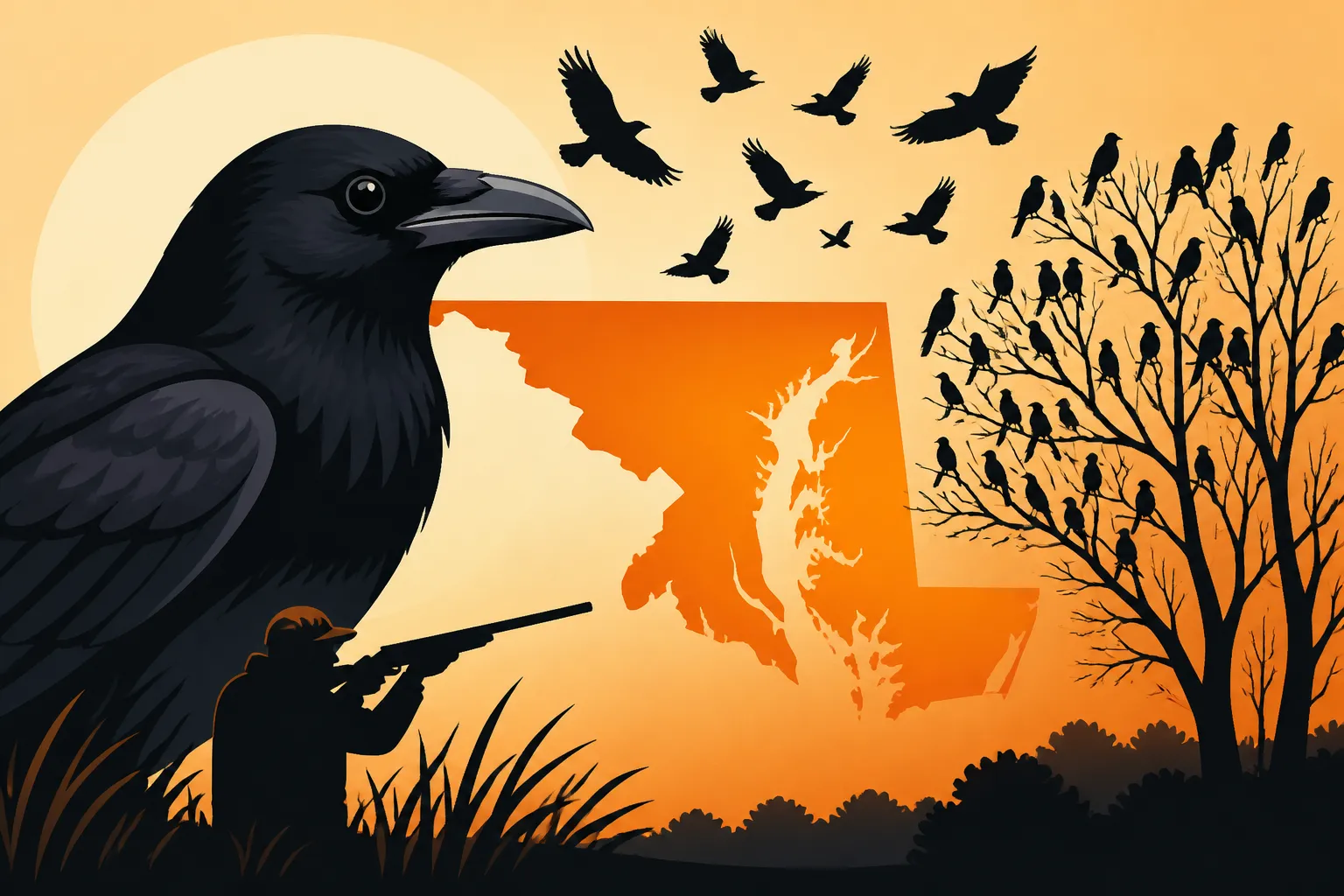
These winter roosts can host tens of thousands, sometimes hundreds of thousands, of birds. The scale is truly astonishing. They'll typically pick a very specific, sheltered location – often a large, dense stand of evergreen trees like pines or cedars, or a mature block of bottomland hardwoods that offers protection from the biting winds. The collective body heat of so many birds helps to keep the core of the roost slightly warmer than the surrounding air, a vital survival strategy on bitter cold nights. During the day, these huge congregations will disperse, sometimes flying 20 or more miles in various directions to feed on agricultural fields, landfills, or any other reliable food source. As evening approaches, they'll begin their journey back, often gathering at pre-roosting sites (staging areas) before making the final flight into the main roost. This daily commute is a sight to behold and offers prime opportunities for hunters looking to intercept them.
Summer Dispersal: Family Matters
Once the longer days and warmer temperatures of spring arrive, the dynamics of crow populations shift dramatically. The massive winter roosts begin to break up as crows transition from survival mode to breeding mode. This usually happens around late February to early April, depending on the specific location and the arrival of consistent spring weather.
Crows will disperse into much smaller units, typically breeding pairs and their offspring from the previous year. They establish territories for nesting and raising their young, often building their bulky nests in tall trees in suburban backyards, farm woodlots, or patches of timber. During this time, you won't see the huge, concentrated flocks that characterize winter. Instead, you'll observe individual pairs or small family groups, often much more wary and focused on their immediate territory. Their vocalizations change too, shifting from the excited chatter of a large roost to more territorial caws and alarm calls. For hunters, this means that summer crow hunting typically involves targeting smaller groups or individuals, often requiring different tactics than the mass shoot opportunities afforded by winter roosts. This dispersal is a vital part of their life cycle, ensuring successful reproduction and spreading the population across the landscape before they regroup again as the next winter approaches.
Here's a quick comparison of crow roost characteristics across seasons:
| Feature | Winter Roosts | Summer Roosts (Nesting) |
|---|---|---|
| Size | Very Large (thousands to hundreds of thousands) | Small (pairs or family groups) |
| Density | Highly concentrated, birds packed together | Dispersed, individual nests within territories |
| Location | Dense evergreens, bottomland hardwoods, urban parks | Scattered, often in suburban or farm woodlots |
| Primary Purpose | Warmth, safety from predators, communal information sharing | Nesting, raising young, territorial defense |
| Duration | November to March/April | April to August/September |
| Food Foraging | Long daily flights to widespread sources | Shorter flights within established territories |
Scouting for Crow Roosts and Hunting Considerations
Whether you're looking to observe these intelligent birds or pursue them as a hunting challenge, understanding how to locate active roosts and approach them effectively is crucial. Crow hunting can be incredibly exciting, offering fast-paced action and a chance to hone your calling and decoying skills. It's also a great way to put some meat in the freezer, as crow is perfectly edible for those adventurous enough to try.
Tips for Locating Active Crow Roosts
Finding an active crow roost isn't always as simple as driving around, but it's certainly doable with a bit of patience and strategic observation. The best time to scout is in the late afternoon or early evening, starting about an hour or two before sunset. This is when crows begin their daily journey back to their communal sleeping grounds.
Begin by driving or walking through areas you suspect might hold crows – think large agricultural fields, areas near landfills, or expansive woodlots that offer dense cover. Listen intently. Crows are incredibly vocal, and as they gather, their caws become more frequent and excited. You'll often hear them before you see them. Pay attention to flight patterns; crows will often fly in long, steady streams, all heading in the same general direction towards the roost. If you see a dozen crows fly over, then another dozen a few minutes later, and then fifty more, all on the same vector, you're probably on the right track.
Follow these flight paths until you pinpoint the general area. As you get closer, you might notice "staging areas" – fields or trees where hundreds or thousands of crows will congregate and mill around for a while before making the final plunge into the actual roost as darkness falls. These staging areas are often quite noisy and are an excellent indicator that a major roost is nearby. Binoculars can be useful for scanning distant tree lines. And remember, crows are smart; they'll often pick a spot that's not easily accessible by vehicle, forcing you to use your feet. Using a mapping tool like GoHunt can help you pinpoint those dense timber blocks or identify potential access routes without disturbing the birds. This kind of pre-scouting is invaluable, especially when looking at Hunting Maryland's Western Mountain Forests or even Hunting a Suburban Woodlot in Montgomery County where specific access points can be tricky.
Hunting Near Roosts: Tactics and Ethics
Hunting crows, particularly near a winter roost, can be an exhilarating experience. However, it requires careful planning, respect for the birds, and adherence to legal regulations, especially concerning Maryland Shooting Hours and Legal Light. Most crow hunting isn't about shooting into an active roost, which would be both unethical and likely ineffective as they'd simply disperse. Instead, it's about intercepting them as they fly to or from the roost, or luring them into range with calls and decoys during their daytime feeding activities.
One common tactic is to set up along a major flight path leading into or out of a known roost. Position yourself well concealed in a blind or natural cover before dawn or in the late afternoon. As the crows fly overhead in large numbers, you can use distress calls or aggressive caws to draw them closer. A good set of crow decoys, especially those featuring an owl or hawk decoy to simulate an attack, can be incredibly effective at drawing in curious or agitated crows. They'll often circle to investigate, offering prime shooting opportunities. Remember that crows have excellent eyesight, so camouflage and minimal movement are paramount.
Another approach, especially if you're not targeting the main migration, is to hunt them during their daytime feeding. If you've located a field where crows are actively feeding, you can set up a decoy spread and call them in. This often works well for smaller groups that have dispersed from the main roost. Always be mindful of local ordinances, especially if hunting near populated areas, and ensure you have permission if you're on private land. Knocking on Doors in Maryland Farm Country can sometimes open up excellent crow hunting opportunities on agricultural ground. Regardless of your chosen method, crow hunting offers a unique challenge that tests your fieldcraft and calling abilities, and can be a fantastic way to enjoy the outdoors during less popular hunting seasons.
Disclaimer
This article is for general informational purposes only and does not constitute professional advice. Laws, prices and regulations vary by location and change over time. Consult a qualified professional for guidance on your specific situation.