Trapping Muskrat in a Dorchester Marsh
Trapping muskrats in the sprawling, intricate marshes of Dorchester County can feel like trying to solve a puzzle where the pieces are constantly shifting with the tides and the seasons. Many folks, especially those new to the game or those returning after a hiatus, find themselves scratching their heads, wondering where to even begin with identifying prime spots, what traps to use, or how to navigate the ever-changing regulations and market values of pelts. This guide aims to pull back the curtain on successful muskrat trapping in Dorchester, offering a deep dive into the environment, techniques, and responsible practices that will help you fill your stretcher boards.
Understanding the Dorchester Marsh Environment for Muskrats
The vast tidal marshes of Dorchester County are a truly special place, a mosaic of water, mud, and resilient vegetation that provides a perfect, albeit challenging, home for muskrats. If you want to consistently catch 'rats here, you first have to become intimately familiar with their watery world.
Unique Characteristics of Dorchester Marshes
Dorchester County’s marshes, particularly those bordering the Blackwater National Wildlife Refuge and extending towards the Honga River and beyond, are defined by their dynamic interaction with the Chesapeake Bay's tides. This constant ebb and flow dictates everything from the salinity levels of the water to the types of plants that thrive, and by extension, where muskrats make their homes.
You'll find a spectrum of conditions here, from predominantly freshwater impoundments and upper tidal creeks to increasingly brackish and even saline areas closer to the Bay. This gradient in salinity is crucial. Muskrats prefer areas with lower salinity, often thriving where freshwater inflows dilute the Bay's saltier embrace. Dominant vegetation plays a massive role in where muskrats set up shop. In the fresher sections, you'll see dense stands of cattails, three-square rush, and other emergent aquatic plants. As you move towards more brackish zones, the ubiquitous Phragmites australis (common reed) becomes more prevalent, alongside saltmarsh cordgrass. While muskrats will use Phragmites for cover and some structural components of their lodges, they prefer to eat the tender roots and stems of cattails and three-square rush. Therefore, identifying these preferred food sources is often the first step in locating productive trapping grounds.
The constant tidal influence means that water levels can fluctuate by several feet over a six-hour period. This has profound implications for muskrat activity and trap placement. What might be a deep muskrat run at high tide could be a muddy, exposed ditch at low tide. Understanding Reading Tide Charts Before a Marsh Hunt is absolutely non-negotiable for success here. This movement of water also influences scent dispersal and the accessibility of food sources for the muskrats, impacting their daily routines.
Identifying Prime Muskrat Habitat and Sign
Finding where muskrats are actively living and feeding is a skill honed by observation. You're looking for subtle clues that, once you know what to look for, become obvious indicators of a healthy muskrat population.
The most undeniable sign of muskrat activity is their "push-ups." These are dome-shaped structures, often made of mud and vegetation, pushed up from beneath the water surface. They serve as feeding stations, resting spots, and often as breathers under the ice. They're typically 1-2 feet in diameter and rise 6-12 inches above the water. A fresh push-up will look damp and have fresh vegetation incorporated. These are absolute goldmines for trap placement. Similarly, you'll find muskrat lodges, which are larger versions of push-ups, used for nesting and shelter, often found in slightly deeper water or on small hummocks. These can be 3-4 feet in diameter and rise higher out of the water.
Look for "runs" – distinct trails muskrats create through the dense marsh vegetation, often just beneath the surface of the water or along shallow ditch banks. These are highways for muskrats moving between feeding areas and their lodges. They'll be 6-8 inches wide, smooth at the bottom, and often have clipped vegetation along the edges. Fresh runs are easy to spot by their clean, often muddy appearance. You'll also encounter "feeding platforms," which are simply flattened areas of vegetation or small piles of clippings where muskrats sit and eat. Keep an eye out for "cuttings" – fresh pieces of cattail, rush, or other aquatic plants, often with chew marks, left floating in the water or piled on a feeding platform. Their scat, small, dark, cylindrical pellets, might be found on these platforms or along runs.
When you're out there, whether you're Wading Into a Dorchester Marsh Before Daylight or checking your lines later in the day, use your eyes and ears. Listen for the subtle rustle in the reeds or the splash of a 'rat diving. Use binoculars to scan areas you can't easily reach. A good pair of hip boots or chest waders (we'll talk more about those later!) is essential for exploring these areas safely and effectively. Pay attention to changes in tide and how it affects water depth in these runs and around push-ups.
The Life Cycle and Behavior of Muskrats
Understanding the basic biology and behavior of muskrats will make you a much more effective trapper. These semi-aquatic rodents are remarkably well-adapted to their marshy environment.
Muskrats are primarily herbivorous, with their diet consisting mainly of the roots, stems, and leaves of aquatic vegetation like cattails, three-square rush, and various sedges. They'll also eat agricultural crops if marshes border farm fields. Occasionally, they'll consume small amounts of animal matter, such as mussels, crayfish, or even small fish, especially if plant food is scarce. This dietary preference is key; finding their favored food plants is often synonymous with finding muskrats.
They are prolific breeders, capable of having multiple litters per year, especially in areas with abundant food and mild weather. Litters typically contain 4-8 kits. This high reproductive rate allows muskrat populations to rebound quickly, which is why sustainable trapping doesn't typically harm their overall numbers and can even help maintain healthy marsh ecosystems by preventing overpopulation and overgrazing of vegetation.
Muskrats are generally crepuscular and nocturnal, meaning they are most active at dawn, dusk, and throughout the night. This isn't to say you won't see them during the day, especially on overcast days or in undisturbed areas, but their peak activity aligns with lower light conditions. They are territorial, particularly during breeding season, and will defend their lodges and prime feeding areas from other muskrats. While they aren't necessarily solitary, they tend to live in family groups or loose colonies rather than large, dense aggregations.
Their underwater capabilities are impressive; they can hold their breath for several minutes, allowing them to travel extensively submerged, avoiding predators and cold. This habit informs many trapping techniques, as water sets are often the most productive. Knowing that they use specific runs and push-ups repeatedly for feeding and travel makes these choke points ideal for trap placement.
Essential Gear and Techniques for Trapping Muskrats
Trapping muskrats in Dorchester's unique environment requires not just knowledge of the animal and its habitat, but also the right tools and a solid understanding of how to use them effectively and safely.
Selecting the Right Traps for Marsh Conditions
The choice of trap is critical for efficiency, humane capture, and compliance with Maryland regulations. You'll primarily be choosing between body-grip (Conibear-style) traps and foothold traps.
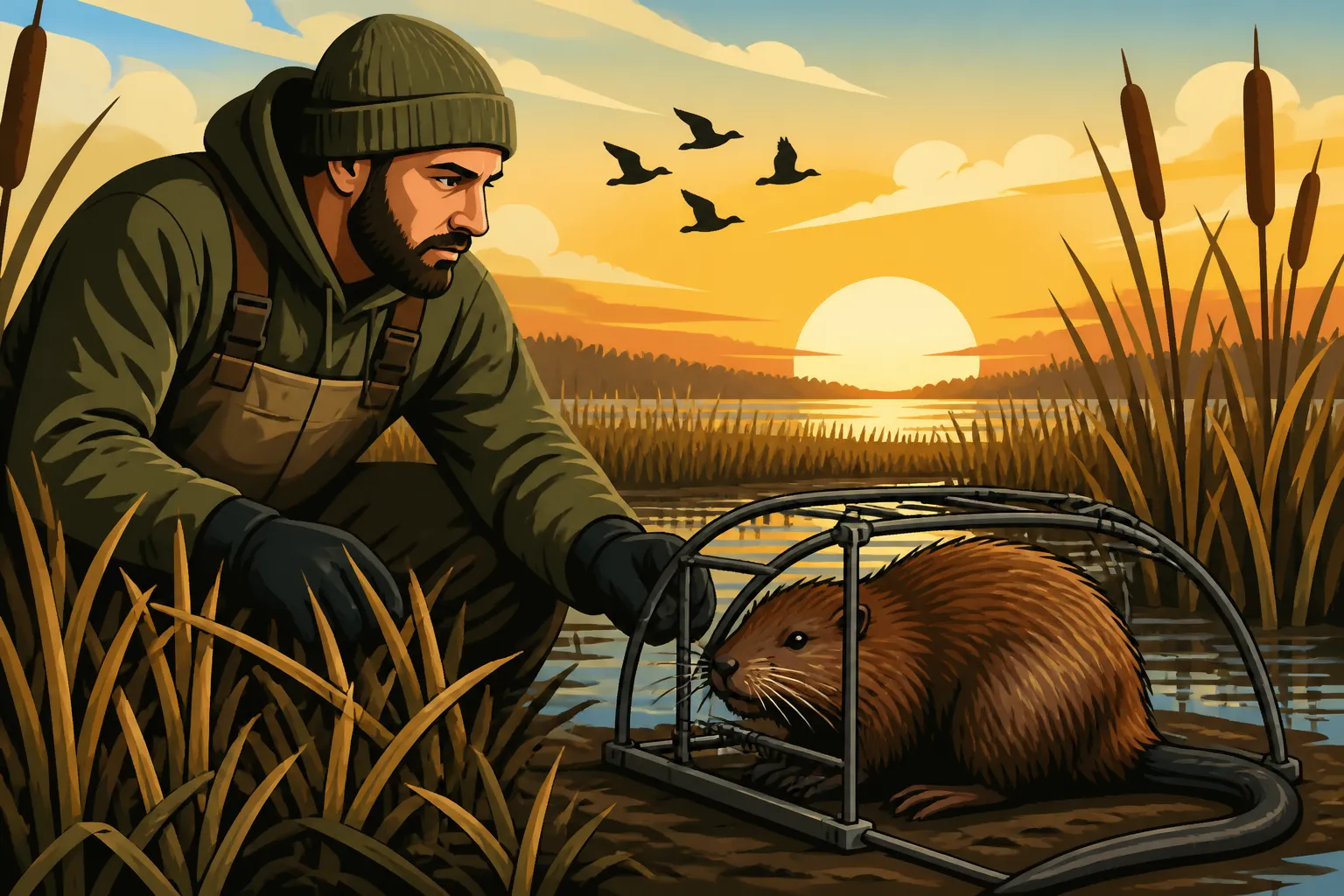
For muskrats, the Conibear 110 (or similar smaller body-grip traps like a Victor 1.5, although 110s are standard) is arguably the most popular and efficient. These traps are designed to deliver a quick, humane kill when the animal enters the trap. They are especially effective in water sets, such as in muskrat runs, at the entrance to push-ups or lodges, or in narrow channels. The beauty of the 110 is its compact size and powerful spring, making it easy to conceal and deadly when triggered. In Maryland, these traps are widely legal for muskrats in most contexts, but always double-check the latest regulations regarding specific trap sizes and where they can be deployed, especially near public roads or dwellings.
Foothold traps, such as the #1 or #1.5 coil-spring or long-spring traps, are also effective. These traps are designed to hold an animal by the foot until the trapper arrives. For muskrats, a smaller jaw spread is preferred to avoid injury. When using foothold traps for muskrats in water, it's absolutely crucial to set them as a "drowning set." This means the trap is placed in water deep enough (at least 18-24 inches) with a heavy anchor or slide wire that pulls the trapped animal into deep water quickly after capture, preventing it from surfacing and ensuring a humane dispatch. This is particularly important for muskrats, which are relatively small and can easily chew off a foot or escape if not drowned quickly. These can be good for bank sets, but the drowning set is paramount for ethical trapping.
It’s worth noting that trap restrictions can change, and some areas, like certain public lands or suburban zones, might have tighter rules. Always refer to the Maryland Department of Natural Resources (DNR) regulations booklet or website to ensure your chosen traps and methods are legal in your specific trapping location. When trapping on private land, you'll also want to confirm any landowner preferences or restrictions.
Strategic Trap Placement and Setting
Effective trap placement is an art and a science, combining your understanding of muskrat behavior with a meticulous approach to setting.
Water Sets: These are your bread and butter for muskrat trapping.
- Run Sets: Identify active muskrat runs. These are often clear trails just below the water's surface. Place a Conibear 110 directly in the run, ensuring the trap is submerged and perpendicular to the direction of travel. Anchor the trap securely with stakes or wire to prevent it from being moved or lost by currents or other animals. For a foothold trap, place it in the center of the run, and ensure it's a drowning set by using a slide wire that plunges into deep water.
- Push-Up Sets: Muskrats frequently enter their push-ups from below. Locate the underwater entrance to a push-up and set a Conibear 110 directly in front of or inside this opening. This is a highly effective, almost guaranteed catch if the push-up is active. You can also place foothold traps on top of the push-up as a "dry set" if allowed, but water sets are generally more reliable for muskrats.
- Lodge Entrance Sets: Similar to push-ups, muskrats have specific entry and exit points for their larger lodges. Locate these underwater entrances and set your Conibear 110s there.
Bank Sets: While primarily aquatic, muskrats do venture onto banks.
- Feeding Stations: If you find a well-used feeding platform on a bank or a partially submerged log, place a foothold trap (always a drowning set if possible) near it.
- Slide Sets: Muskrats often have specific "slides" where they enter and exit the water from a bank. Set a Conibear 110 at the top of the slide, or a foothold trap submerged at the bottom of the slide, again, with a drowning set in mind.
General Setting Tips:
- Safety First: Always use a safety gripper or setting tool when setting body-grip traps. They are powerful and can cause serious injury.
- Concealment: While not always strictly necessary for muskrats, trying to blend your trap into the environment with natural vegetation can sometimes improve success and prevent other animals from investigating.
- Anchoring: Always secure your traps firmly. Muskrats, while small, can pull a trap free, and currents or predators can move or steal your catch. Use heavy gauge wire, stakes, or even small rebar for anchors.
- Trap Checks: Maryland law requires traps to be checked frequently, usually every 24 hours. This ensures humane treatment of captured animals and allows for efficient removal of your catch.
Baits, Lures, and Scents for Muskrats
While muskrats are primarily vegetarians, and well-placed blind sets in active runs often yield the best results, baits and lures can certainly enhance your success, especially in areas with less obvious traffic.
Natural Baits:
- Vegetation: The most natural and often effective bait is simply the muskrat's preferred food source. Fresh cuttings of cattail roots, sections of three-square rush, or even apples and carrots can be highly attractive. Place these either directly in the trap jaws (for Conibears) or suspended slightly above a foothold trap. The visual appeal and the fresh scent can draw them in.
- Fish/Meat: While rare, some trappers will use small pieces of fish or clam meat, especially during very cold weather when vegetation is scarce. However, this dramatically increases the chance of catching non-target species like raccoons or mink. If you're targeting purely muskrats, stick to vegetation.
Commercial Lures and Scents:
- Muskrat Gland Lure: These lures are formulated from the muskrat's own glands and are designed to exploit their territorial instincts and curiosity. A small dab placed near a trap set can be highly effective, especially during the fall and early winter.
- Sweet Lures: Muskrats have a sweet tooth! Anise oil, vanilla extract, or commercial sweet-smelling lures (often fruit-based) can be very appealing. These are typically applied to a small piece of wood or vegetation near the trap.
- Castor: While more commonly associated with beaver, muskrat castor is also sometimes used in lures to evoke territorial responses.
Visual Attractants:
- Bright Objects: Muskrats are naturally curious. Sometimes, a small, shiny piece of tin or aluminum foil hanging above a trap or strategically placed can attract their attention, especially in murky water where visibility is low.
- Mud Trails: Disturbing the mud bottom to create a fresh "mud trail" leading to your trap can mimic fresh muskrat activity and draw them in to investigate. This works particularly well in shallow water runs.
Remember, less is often more with lures. You want to pique their interest, not overwhelm them. A small amount placed strategically is usually sufficient. Rotate lures if one isn't working, or combine natural baits with a subtle commercial scent. When using tools like GoHunt to mark your trap locations, you can also log which baits or lures you used at each spot and track their effectiveness over time. This data-driven approach can significantly refine your strategy season after season.
Navigating Regulations and Ethical Trapping Practices in Maryland
Trapping is a regulated activity in Maryland, designed to ensure sustainability, humane treatment of animals, and public safety. Being a responsible trapper means knowing and adhering to all the rules, and beyond that, embracing ethical practices.
Maryland Trapping Regulations Specific to Muskrats
Before you even think about setting a single trap, you must understand Maryland's trapping regulations. These are put in place by the Maryland Department of Natural Resources (DNR) and are updated annually. Ignoring them can lead to fines, confiscation of gear, and loss of trapping privileges.
First and foremost, you'll need a Maryland hunting license, and crucially, a separate Maryland Trapping License Requirements endorsement. This isn't just a formality; it ensures you've either passed a trapper education course or met other specific criteria demonstrating a basic understanding of responsible trapping. Junior trappers will have different requirements, often involving an apprentice license or mentorship.
Season Dates: Muskrat trapping season dates are specific and vary annually, but generally run through the fall and winter, often opening in November and closing in March. It’s essential to consult the current Maryland DNR Furbearer and Trapping Guide for the precise dates for the year you plan to trap. Trapping Maryland Furbearers Through Winter is a common strategy as muskrat fur is prime during the colder months.
Legal Trap Types and Sizes: While we've discussed Conibear 110s and smaller foothold traps (#1 or #1.5) as standard, the regulations specify maximum jaw spreads for footholds and opening dimensions for body-grips. Ensure your traps comply. Body-grip traps are usually restricted in size for land sets, but for primarily aquatic muskrats, the 110 is generally permissible in water.
Setback Requirements: There are strict rules about how close you can set traps to occupied dwellings, public roads, and other specific areas. These "setback" distances are designed for public safety and to avoid non-target captures. Always be aware of your surroundings and local ordinances, especially if trapping near the edges of marshland that abuts residential or developed areas.
Trap Identification: All traps must be tagged with your name and DNR ID number. This is a non-negotiable requirement and helps identify trap owners if a trap is found or a question arises.
Trap Check Frequency: As mentioned, Maryland law requires traps to be checked at least once every 24 hours. This is paramount for animal welfare.
Always carry a physical or digital copy of the current regulations when you are trapping. Laws can change, and ignorance is no excuse.
Best Practices for Ethical and Humane Trapping
Ethical trapping goes beyond just following the law; it embodies a commitment to the humane treatment of animals and responsible stewardship of wildlife resources.
Humane Dispatch: For any furbearer you trap, a quick, humane dispatch is a moral imperative. For muskrats captured in drowning sets, this is often automatic. For any live-caught animal in a foothold trap, dispatch methods should be swift and effective, typically a blow to the head with a blunt object or a precisely placed shot with a small-caliber firearm (where legal and safe). If you're unsure, seek guidance from experienced trappers or trapper education courses.
Avoiding Non-Target Catches: While difficult to eliminate entirely, good trappers strive to minimize non-target catches. This means understanding the habits of other species in your area. For muskrats, using vegetation-based baits rather than meat baits will reduce the chances of catching raccoons, mink, or opossums. Proper trap size and specific water sets also make it less likely to catch larger animals. If you do catch a non-target species that is unharmed and not a nuisance, the ethical practice is to release it immediately and unharmed. Always carry release tools like a catchpole or heavy gloves.
Minimizing Suffering: The 24-hour trap check rule is designed to minimize the time an animal spends in a trap. However, going above and beyond, especially in very cold weather or areas with high predator activity, by checking traps more frequently (e.g., morning and evening) is an even better ethical practice. Quick checks prevent exposure, stress, and potential injury from other animals.
Respect for Landowners and the Public: If you're trapping on private land, maintain a good relationship with the landowner. Leave gates as you found them, avoid disturbing livestock, and be respectful of their property. If trapping on public land, be mindful of other users like hikers, birdwatchers, or hunters. Avoid setting traps in high-traffic areas unless specifically designated for trapping, and always ensure your traps are clearly marked. The broader public perception of trapping is heavily influenced by the conduct of individual trappers.
Handling and Processing Your Catch
Once you’ve successfully trapped a muskrat, the work isn't over. Proper handling and processing of the pelt are crucial, even if fur prices are low, as it reflects respect for the animal and your craft.
Field Dressing: As soon as possible after dispatch, the muskrat should be field-dressed if you plan to save the meat. This involves a quick incision to remove the entrails, which helps the carcass cool down and preserves the meat. Many trappers in Maryland do indeed consume muskrat meat, considering it a flavorful game meat similar to rabbit, especially the hindquarters.
Skinning: Skinning a muskrat is a relatively straightforward process once you get the hang of it. You'll typically skin them "cased," meaning the pelt is pulled off like a sock, leaving the fur on the outside and only a small opening at the rear. Make an incision from one hind foot, up the inside of the leg, to the base of the tail, and then a similar incision up the other leg to meet the first. Then, carefully work the hide off the carcass, peeling it away from the body, over the head, and down to the nose. You'll need a sharp knife and some patience.
Fleshing: After skinning, the pelt needs to be "fleshed." This involves carefully scraping away any remaining fat, meat, and membrane from the underside of the hide. This is critical for preventing spoilage, allowing the pelt to dry properly, and achieving a higher quality fur. A fleshing beam and a dull fleshing knife are the ideal tools. Take your time to get it clean, but don't cut into the leather.
Stretching and Drying: Once fleshed, the pelt is stretched fur-side-in over a wire or wooden stretcher. Muskrat stretchers are typically narrow at the head and wider at the base. Secure the pelt to the board, stretching it taut but not over-stretched, ensuring symmetry. Allow it to dry in a cool, well-ventilated area, away from direct sunlight or heat. Proper drying prevents rot and locks in the quality. It can take several days to a week for a muskrat pelt to dry completely.
Storage: Once fully dry, pelts should be removed from the stretchers and stored in a cool, dry, dark place where they are protected from insects like moths and dermestid beetles. Hanging them in mesh bags or sealed containers with mothballs or cedar chips is a common practice. Even if you're not selling the fur for high prices, a well-prepared pelt is a source of pride and a testament to your skills. Plus, you never know when fur prices might rebound, making your well-handled pelts valuable commodities. The Muskrats of the Chesapeake Marshes are an important resource, and utilizing them fully, from meat to fur, demonstrates comprehensive respect for the harvest.
Seasonal Considerations and Advanced Strategies for Dorchester Marshes
Dorchester's marshes are ever-changing, and the most successful muskrat trappers are those who can adapt their strategies to the season, the weather, and the dynamic environment.
Trapping Muskrats in Different Weather and Tidal Conditions
The weather and the tides are perhaps the biggest variables you’ll face when trapping muskrats in Dorchester. They dictate muskrat movement, trap effectiveness, and even your own ability to access certain areas.
Cold Weather and Ice: As temperatures drop and ice forms, muskrat behavior shifts significantly. They tend to stay closer to their lodges and push-ups, relying on these structures for shelter and access to underwater food. Trapping under the ice can be highly productive because muskrats are forced to use specific runs and holes in the ice. You’ll need specialized tools like an ice spud or axe to cut openings for your traps. Under-ice sets, often using Conibear 110s at air holes or lodge entrances, are very effective. However, safety is paramount when working on ice; always check thickness and go with a partner. Extremely cold snaps can also make muskrats less active overall, but they still need to feed.
Rain and Runoff: Heavy rains can raise water levels, sometimes temporarily flooding runs and making trap placement difficult. It can also introduce fresh scent into the marsh, which might either increase or decrease muskrat activity depending on its intensity. On the flip side, steady light rain can mask your scent and encourage muskrat movement. The key is to check your traps promptly after significant rainfall to adjust for changed water levels and ensure traps are still functioning.
Tidal Fluctuations: We've touched on this, but it cannot be overstated: the tides are everything in a Dorchester marsh. Reading Tide Charts Before a Marsh Hunt isn't just a suggestion; it's a necessity. High tide might submerge your bank sets, while low tide might expose your water sets, rendering them ineffective or even illegal if they're no longer in water. Most trappers prefer to set and check traps during lower tides when runs and push-ups are more clearly defined and accessible. However, knowing when high tide peaks can inform where muskrats will be pushed to and where their runs might be most active. For instance, at extreme high tides, muskrats may retreat to higher ground or the densest cover, making certain marsh islands productive.
Combining Trapping with Habitat Observation
Truly effective trapping is a continuous learning process. It’s not just about setting traps; it’s about constantly observing, learning, and adapting.
Scouting and Reconnaissance: Your work begins long before opening day. Spend time in the marsh when conditions are mild, identifying potential runs, push-ups, and feeding areas. Look for old sign from previous seasons. As the season progresses, continuously scout your existing lines and adjacent areas. Muskrat populations can fluctuate, and their activity patterns might shift based on food availability or disturbance. What was a hot spot last week might be barren this week, and vice-versa.
Using Technology for Mapping: Tools like GoHunt or other mapping applications can be incredibly valuable here. They allow you to precisely mark every trap location, log the date it was set, the type of trap, any bait or lure used, and the results. Over time, you build a detailed map of your trap line, identifying historically productive spots and less effective ones. This data-driven approach allows you to refine your strategy, focus your efforts, and become more efficient. You can also use aerial imagery to identify subtle changes in vegetation or water flow that might indicate new muskrat habitat or changes in old ones. This is especially useful for exploring new areas without physically wading through every section of the marsh.
Adapting to Changes: If you consistently aren't catching anything in a particular spot, don't be afraid to pull your traps and move them. Muskrat trapping requires flexibility. Perhaps a predator has moved into the area, or a food source has been depleted. The marsh is a dynamic ecosystem, and your trapping strategy needs to be dynamic too. Pay attention to signs of other furbearers like Mink Along Maryland Creeks and Marsh Edges, as their presence might indicate a healthy marsh or a competitor for resources.
Long-Term Marsh Management and Conservation
Muskrat trapping isn't just about harvesting fur; it's an integral part of marsh ecology and management, particularly in a delicate ecosystem like the Chesapeake Bay.
Role in Marsh Health: Muskrats are often considered "ecosystem engineers" in marsh environments. Their feeding habits, particularly their consumption of roots and rhizomes, can create "eat-outs" – areas where vegetation is thinned or removed. While excessive eat-outs can sometimes be detrimental, a healthy level of muskrat activity helps to create open water areas, maintain diverse vegetation patterns, and create edge habitats that benefit many other species, including waterfowl. Sustainable trapping helps to keep muskrat populations in balance, preventing them from overgrazing and damaging the marsh infrastructure, which is especially critical in an era where Why Chesapeake Marshes Are Sinking is a growing concern.
Monitoring Population Trends: Trappers, by their very nature, are intimately familiar with local wildlife populations. Your observations of muskrat numbers, activity, and health can provide valuable data to state wildlife agencies. Reporting unusually low numbers or signs of disease can contribute to broader conservation efforts.
Impact of Environmental Changes: The marshes of Dorchester County, and indeed the entire Chesapeake Bay region, are under constant threat from sea-level rise, salinity intrusion, and habitat loss. How Sea Level Rise Affects Sika Habitat also impacts muskrats and other marsh-dwelling species. As a trapper, you're on the front lines, witnessing these changes firsthand. Responsible trapping practices ensure that we are not adding further stress to these vulnerable populations but rather, through sustainable harvest, participating in the health of the marsh. By keeping muskrat populations at a healthy level, trappers contribute to the resilience of these crucial wetlands, ensuring they remain vibrant habitats for generations to come.
| Trap Type | Description | Pros | Cons | Ideal Use |
|---|---|---|---|---|
| Conibear 110 | Body-grip trap designed for quick, humane dispatch. | Highly effective, often results in quick kills. Compact and easy to conceal. | Powerful springs require care in setting. Can catch non-targets if set improperly. | Muskrat runs, lodge/push-up entrances, narrow channels. |
| #1 Coil-spring | Foothold trap, compact and fast-acting spring mechanism. | Strong, fast action. Good for smaller furbearers. | Requires a drowning set for humane muskrat capture. | Water sets with drowning devices, bank sets (with care). |
| #1 Long-spring | Foothold trap, traditional design with two long springs. | Durable and reliable. | Heavier and bulkier than coil-springs. Requires a drowning set. | Water sets with drowning devices, bank sets (with care). |
Disclaimer
Trapping regulations and best practices can change. Always consult the most current Maryland Department of Natural Resources Furbearer and Trapping Guide and local ordinances before setting traps. This guide is for informational purposes only and does not supersede official regulations. It is the trapper's responsibility to ensure full compliance with all applicable laws.