Telling a Fox Squirrel From a Protected Delmarva Squirrel
For many of us who love chasing small game in Maryland, the thought of squirrel season brings back fond memories of crisp fall mornings and agile quarry darting through the trees. But here in Maryland, there’s a unique challenge that can give even seasoned hunters pause: telling the difference between a huntable fox squirrel and its protected cousin, the Delmarva Fox Squirrel. It's a real head-scratcher that can lead to a lot of anxiety if you're not absolutely sure, and this guide is here to clear up that confusion, ensuring you can enjoy your hunt ethically and legally.
The Critical Need for Accurate Squirrel Identification in Maryland
Let's be honest, few things are as frustrating as being out in the field, spotting what looks like a perfect target, and then having to second-guess yourself for fear of making a mistake. In Maryland, this isn't just about good sportsmanship; it's about adherence to vital conservation efforts and staying on the right side of the law. The legal and ethical implications surrounding squirrel identification here are incredibly important, and understanding them is the first step toward becoming a more responsible and confident hunter.
Why the Confusion Exists
The main reason for this widespread confusion is pretty straightforward: both species are often referred to broadly as "fox squirrels." This common name doesn't really help differentiate them. Visually, there are similarities in their general shape and size, and their habitats can, in some areas, overlap. Historically, the Delmarva Fox Squirrel faced significant population declines due to habitat loss and fragmentation, leading to its listing as an endangered species. Thanks to decades of dedicated conservation and reintroduction efforts by groups like the Maryland Department of Natural Resources (DNR) and the U.S. Fish and Wildlife Service, their numbers have rebounded enough for them to be delisted from the federal endangered species list, though they remain a protected species in Maryland. This success story means they're spreading, and hunters are more likely to encounter them, which further complicates things if you don't know exactly what to look for.
Legal Ramifications of Misidentification
Mistaken identity when it comes to the Delmarva Fox Squirrel isn't just a minor oopsie; it carries significant legal weight. Because the Delmarva Fox Squirrel is a state-protected species, taking one, even accidentally, can result in hefty fines, loss of hunting privileges, and potentially more serious charges. It's a stark reminder that hunting isn't just about bagging game; it's about respecting wildlife regulations and contributing to conservation. Imagine the sinking feeling of realizing you've made a mistake – it’s something every hunter wants to avoid. That added stress can certainly detract from the enjoyment of a day afield, making accurate identification absolutely paramount.
Key Distinguishing Features of the Delmarva Fox Squirrel
Alright, let's get down to brass tacks. When you're out there, you need to know exactly what visual cues to look for to tell a Delmarva Fox Squirrel apart from its huntable relatives. These squirrels are truly distinct once you know what to focus on, and recognizing these features is your best defense against making a costly error.
Coloration and Fur Patterns
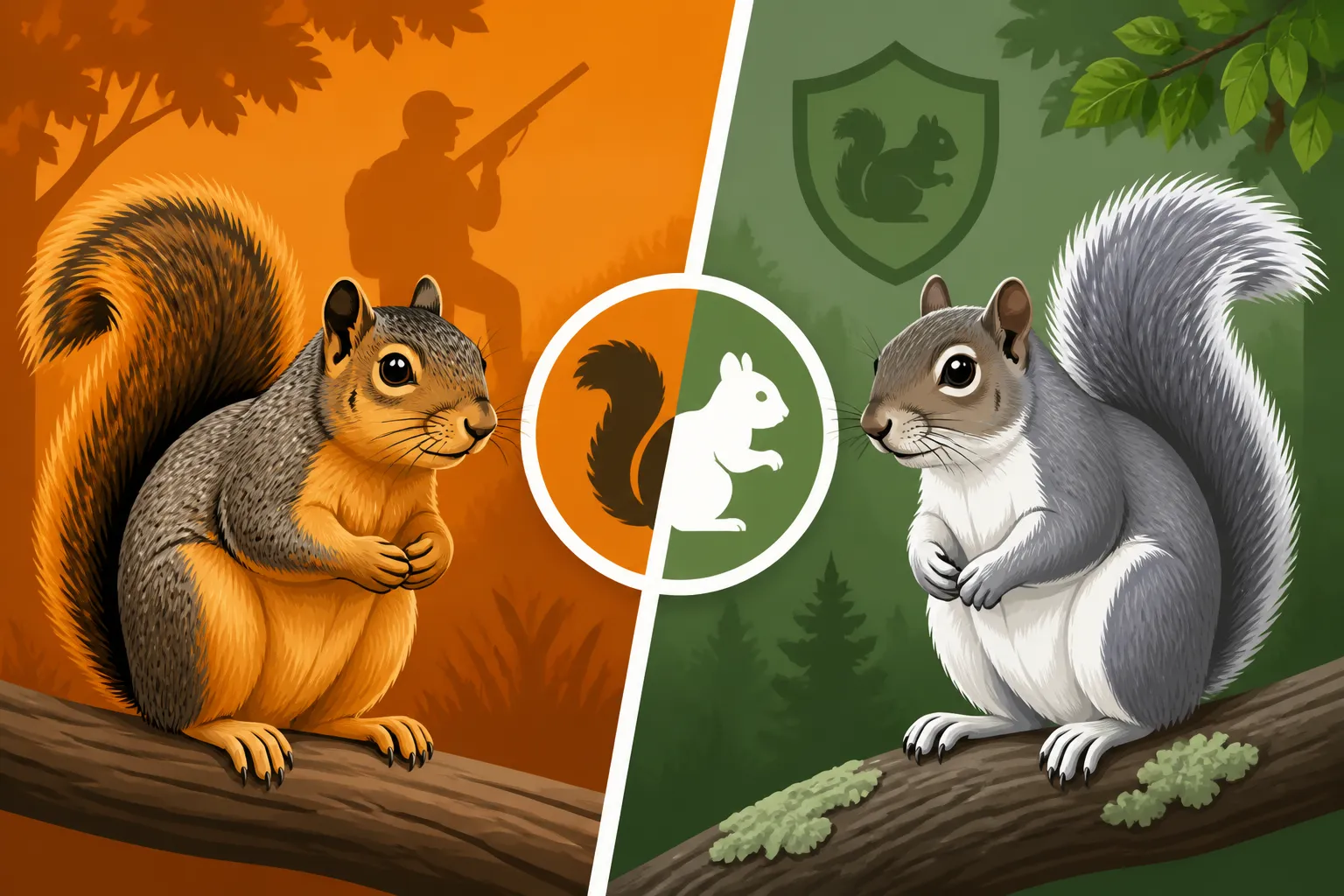
The Delmarva Fox Squirrel (scientific name Sciurus niger cinereus) typically sports a striking and relatively uniform silver-gray coat across its back, often appearing with a "salt and pepper" grizzled look. What really sets them apart, though, are their underparts and facial markings. They almost always have a pristine white belly, which can extend up their sides, contrasting sharply with their darker back. Many Delmarvas also feature a distinct white nose and white ear tips. This combination of a silvery-gray back, white belly, and white facial accents is their signature look. Their tail is usually very full and bushy, often with a darker, almost black tip, adding to their robust appearance. It’s a clean, classic look that, once seen, is hard to forget.
Size and Build
When it comes to the overall package, Delmarva Fox Squirrels are generally the heavyweights of the squirrel world. They are notably larger and more robust than the more common Eastern Gray Squirrel, and typically a good bit larger and chunkier than their Eastern Fox Squirrel cousins. Think of them as the sumo wrestlers of the squirrel kingdom. An adult Delmarva Fox Squirrel can measure up to 30 inches from nose to tail tip and weigh upwards of two or three pounds, sometimes even more. This considerable size gives them a slower, more deliberate gait, especially when they’re moving on the ground. They don't typically exhibit the frantic, darting movements you might associate with smaller squirrels. When you see one, it often seems to lumber rather than scamper.
Behavioral Traits and Habitat Preferences
Beyond their looks, the Delmarva Fox Squirrel also has some behavioral quirks and habitat preferences that can help you distinguish them. They are generally less arboreal (tree-dwelling) than other squirrel species and spend a significant amount of their time foraging on the ground. They prefer mature, open woodlands with large, widely spaced trees and an open understory – what many folks might describe as "park-like" habitat. These are typically older forests where the canopy is high, allowing sunlight to penetrate and encouraging a diverse ground cover of acorns, nuts, and seeds, which form a major part of their diet. You'll often find them meticulously searching for food on the forest floor, rather than leaping wildly through the branches. If you're scouting potential squirrel grounds, using tools like GoHunt to analyze aerial imagery can help identify these specific habitat types. Look for areas with mature timber, a relatively open forest floor, and close proximity to agricultural fields or other food sources. Recognizing these specific habitat characteristics can be a huge aid in identifying potential Delmarva areas even before you step foot on the ground. You can also gain an edge by knowing Where Delmarva Fox Squirrels Still Live or How Far Sika Deer Have Spread From Dorchester, as these areas might coincide with Delmarva Fox Squirrel habitat.
Identifying the Huntable Eastern Fox Squirrel
Now that we’ve covered the protected Delmarva, let's turn our attention to the more common, and huntable, Eastern Fox Squirrel. While they share the "fox squirrel" moniker, they have distinct characteristics that, once learned, make differentiation much easier. This is the squirrel you're generally targeting when you go Squirrel Hunting Maryland Hardwood Ridges or participate in Squirrel Hunting Maryland's September Opener.
Typical Eastern Fox Squirrel Appearance
The Eastern Fox Squirrel (Sciurus niger) displays a much wider range of coloration than its Delmarva cousin. Their coats can vary significantly, from grizzled grayish-brown to a vibrant reddish-orange, and even yellowish-tan, often with a mix of these shades across their body. Unlike the stark white belly of the Delmarva, the Eastern Fox Squirrel typically has underparts that are rusty orange, yellowish-brown, or a dull cream color. You won't usually see that distinctive white nose or white ear tips that are characteristic of the Delmarva. Their tails are also full and bushy, but often match their body color, perhaps with a slightly lighter fringe, and generally lack the dark tip seen on Delmarvas. If you're seeing a squirrel that's more "earthy" in its color palette, without those bright white accents, you're likely looking at an Eastern Fox Squirrel.
Size and Agility Differences
While still a robust squirrel, the Eastern Fox Squirrel is generally smaller and more slender than the Delmarva. They are typically larger than a Gray Squirrel but smaller than a Delmarva, creating a kind of "middle child" in terms of size. Eastern Fox Squirrels are incredibly agile and quick, both on the ground and in the trees. You'll observe them scurrying rapidly across the forest floor, dashing up tree trunks, and leaping between branches with impressive speed and confidence. They are energetic and constantly on the move, a stark contrast to the more deliberate, almost ponderous movements of the Delmarva. This difference in their overall build and particularly their level of activity can be a significant identifier in the field.
Preferred Habitats and Range in Maryland
One of the most helpful ways to identify Eastern Fox Squirrels is by understanding where they thrive. These squirrels are far less picky about their environment than Delmarvas and are found across a much broader range of habitats throughout Maryland. You'll encounter them in mixed deciduous and pine forests, especially where these woods border agricultural fields. They also do quite well in suburban areas, urban parks, and even along creek bottoms. Essentially, if there are trees and food, an Eastern Fox Squirrel can probably make a living there. They are particularly common in Western Maryland, where you might find them when Hunting a Green Ridge Ridgetop Bench or searching for Fox Squirrels in Western Maryland. Their widespread distribution means that outside of the specific Delmarva recovery zones, any fox squirrel you encounter is almost certainly an Eastern Fox Squirrel. This broad habitat preference makes them a staple for hunters across much of the state, making them one of Maryland's Three Huntable Squirrel Species.
Overlapping Zones and Making the Right Call in the Field
Even with all the distinguishing features, there will inevitably be situations where you're just not 100% sure. Maryland's diverse landscape means that in some areas, the ranges of these two species can indeed come quite close, or even subtly overlap, making clear identification crucial. This is where careful scouting, good judgment, and sometimes, simply exercising restraint become your most valuable hunting tools.
Mapping Maryland's Delmarva Fox Squirrel Recovery Areas
Knowing where the Delmarva Fox Squirrels are actively managed and found is arguably the single most important piece of information for any Maryland squirrel hunter. Their presence is primarily concentrated on the Eastern Shore, particularly in Dorchester, Talbot, Caroline, and parts of Kent, Queen Anne's, Wicomico, and Somerset counties. However, within these counties, they specifically prefer fragmented, mature woodlands rather than vast, unbroken forests or marshes. The Maryland Department of Natural Resources (DNR) actively monitors these populations and provides maps and information on their website indicating known recovery areas. Before you head out, it's absolutely essential to consult these resources. Consider using a robust mapping application like GoHunt, which can layer property boundaries, public land information, and often show different habitat types. While GoHunt might not have a "Delmarva Fox Squirrel habitat layer," you can use its aerial and topographical views to identify those open, mature forest stands that are characteristic of Delmarva habitat within their known range. This kind of pre-hunt scouting, along with familiarizing yourself with Scouting Maryland Public Land With Aerial Photos, can prevent a lot of headaches in the field.
Field Identification Best Practices
When you're actually in the woods and a squirrel presents itself, taking a shot should always be the result of a confident, positive identification. Here are some best practices to ensure you make the right call:
- Use Binoculars: Always carry a good pair of binoculars. A clear, magnified view can reveal those subtle but critical coloration details, like a white nose or ear tips, that might be missed with the naked eye.
- Observe Behavior: Watch how the squirrel moves. Is it slow and deliberate, or quick and darting? Is it spending more time on the ground or constantly in the trees? These behavioral cues, as discussed earlier, are strong indicators.
- "When in Doubt, Don't Shoot": This golden rule of ethical hunting is paramount here. If you can't be 100% sure that it's an Eastern Fox Squirrel, simply let it walk (or climb). There will always be another opportunity, and the consequences of a mistake are not worth the risk.
- Wait for a Clear View: Sometimes a squirrel might be partially obscured, or the light might be tricky. Be patient. Wait for the animal to move into a clear, well-lit position where you can observe all its key features without obstruction.
- Consider the Habitat: Even within a general range, if you're in a heavily forested, dense, or marshy area, it's less likely to be a Delmarva. If you're in a very open, park-like mature woods, especially on the Eastern Shore, extra caution is warranted.
Leveraging Tools and Local Knowledge
Beyond your eyes and patience, there are other resources at your disposal. Again, digital mapping tools like GoHunt can be invaluable. By looking at aerial photos, you can get a better sense of the specific habitat types in the area you plan to hunt. If you notice large tracts of open, mature forest, especially within the established Delmarva recovery areas, you'll know to be extra vigilant. For instance, when you're considering hunting a Chesapeake farm woodlot point or thinking about Hunting a Maryland Farm Lease Your First Season, a quick look at the satellite view can reveal the type of tree canopy and understory, giving you clues about which squirrel species might reside there.
Don't underestimate the power of local knowledge either. Talk to Maryland DNR wildlife biologists in the counties you plan to hunt. They are a wealth of information and can often provide hyper-local insights into squirrel populations and specific areas where Delmarva Fox Squirrels are known to be present. Additionally, connecting with experienced local hunters can also offer valuable on-the-ground perspectives. Taking a few scouting trips before the season opens, purely for observation and without a weapon, can also significantly boost your confidence in identification. Remember, part of being a well-rounded hunter, as taught in any Maryland Hunter Education Requirements course, is knowing your target and respecting the species that are off-limits. You should also be aware of Maryland's Legal Weapons by County for squirrel hunting.
| Feature | Delmarva Fox Squirrel | Eastern Fox Squirrel |
|---|---|---|
| Back Coloration | Typically silver-gray, "salt and pepper" grizzled | Reddish-brown, yellowish-orange, or grizzled gray |
| Belly Coloration | Pristine white, often extending up sides | Rusty orange, yellowish-brown, or dull cream |
| Facial Markings | Distinct white nose and often white ear tips | Generally lacks white nose/ear tips |
| Tail Appearance | Very full, bushy, often with a distinct dark/black tip | Full, bushy, often matching body color or lighter fringe |
| Size/Build | Larger, chunkier, more robust (up to 30", 2-3+ lbs) | Smaller, more slender (typically 20-25", 1-2 lbs) |
| Movement | Slower, more deliberate, especially on ground | Agile, quick, darting (both in trees and on ground) |
| Preferred Habitat | Mature, open woodlands with large trees & open understory | Mixed forests, field edges, suburban, parks |
| Legal Status | State Protected Species (no hunting) | Huntable Species (check local regulations) |
| Primary Range | Primarily Eastern Shore (specific recovery areas) | Widespread across Maryland |
Disclaimer
Please remember that hunting regulations and protected species lists can change. Always consult the most current Maryland Department of Natural Resources (DNR) hunting guide and website before heading afield. This guide provides general information and best practices, but it is the individual hunter's responsibility to know and follow all applicable laws.