How Sika Deer Spread Across Delmarva
It's a question many Maryland hunters have pondered, especially those of us who remember when Sika deer were just a whispered rumor or a rare sighting: How did these fascinating, vocal deer spread so effectively across the Delmarva Peninsula? For years, their presence was localized, almost a secret, but today, they've become an undeniable and thriving part of our ecosystem, challenging hunters with their unique behavior and adaptability. This guide will delve into the remarkable journey of the Sika deer, tracing their origins in Maryland and exploring the environmental and biological factors that allowed them to colonize vast stretches of our Eastern Shore, forever changing the landscape for hunters and wildlife enthusiasts alike.
The Initial Introduction and Containment
The story of Sika deer in Maryland is not one of natural migration, but rather a classic example of an introduced species that found a new home. Their journey to our state began more than a century ago, far from their native East Asian forests, brought here through human intention, albeit with unintended long-term consequences.
The First Arrivals in the Early 20th Century
The initial introduction of Sika deer (specifically the Japanese Sika subspecies, Cervus nippon nippon) to Maryland dates back to the early 1900s. Around 1916-1918, a wealthy landowner, Clement Henry from Hooper's Island in Dorchester County, imported several pairs of these exotic deer directly from Japan. His intention was not to establish a wild population, but rather to create a private hunting park on his expansive estate, offering a unique game animal for sport and display. These deer were initially kept within a fenced enclosure, a common practice for exotic game at the time.
This early period of containment was critical. For a number of years, the Sika remained largely confined to this private property, their small numbers sustained within a relatively controlled environment. They were a novelty, a curio, existing outside the native wildlife landscape of Maryland. However, as anyone who has ever tried to contain determined wildlife knows, even the most robust fences can only hold for so long against the forces of nature and the innate drive of animals to expand their territory.
Early Management and Estate Releases
Beyond Clement Henry's initial release, other private individuals and estates across the Mid-Atlantic region also experimented with importing and releasing Sika deer, sometimes for similar private park purposes or even as ornamental additions to large properties. While many of these smaller, isolated populations likely fizzled out due to limited numbers, insufficient habitat, or lack of proper management, the Dorchester County population proved to be exceptionally resilient.
The early "management," if you could call it that, was primarily focused on maintaining the captive herd within the boundaries of the estate. There wasn't a grand plan for their integration into the wider Maryland ecosystem, nor was there the extensive ecological understanding we have today regarding the potential impacts of non-native species. These were the early days of wildlife conservation in America, and the concept of invasive species was far from widely recognized. The Sika deer were simply another interesting animal to be acquired and enjoyed, much like any other exotic livestock or garden specimen. Little did anyone realize that these relatively small, spotted deer would soon become a defining feature of the Chesapeake Bay's unique hunting culture. For those interested in understanding the origin of this unique population, the post on Maryland's Sika Deer, an Imported Herd offers a deeper dive into their genetic background and initial colonization.
Escaping the Confines and Early Dispersal
The meticulous fences of private estates, no matter how well-intended, were ultimately no match for the Sika deer's resilience and the unforgiving power of nature along the Chesapeake Bay. This escape marked the true beginning of their wild journey across Delmarva.
Breaching Barriers: From Enclosures to the Wild
The transition of Sika deer from captive animals to a free-ranging, self-sustaining population wasn't a single, dramatic event, but rather a series of breaches and escapes over several years. The most commonly cited reasons for their initial breakout from Clement Henry's Hooper's Island enclosure revolve around severe weather events, particularly powerful hurricanes and nor'easters that are common along the mid-Atlantic coast. High tides and storm surges would have severely damaged or completely inundated fences, allowing deer to swim or walk away into the surrounding marshlands.
Imagine a powerful storm ripping through the marsh. Fences, even sturdy ones, would have been battered by waves, debris, and the sheer force of the water. Sika deer, being naturally adept swimmers and resilient creatures, would have easily navigated the flooded landscape. Once outside the confines, the vast, interconnected marsh and forest ecosystems of Dorchester County provided immediate refuge and abundant food sources. It was a perfect storm, so to speak, for their liberation. Some reports also suggest that deliberate releases or accidental escapes from damaged transport vehicles might have contributed to their dispersal, but the overwhelming consensus points to natural disasters as the primary catalyst for their initial freedom.
The Initial Foothold in Dorchester County
Once free, the Sika deer found themselves in an environment that was, surprisingly, incredibly well-suited to their needs. The extensive tidal marshes, pine forests, and agricultural lands of Dorchester County offered an ideal combination of dense cover, diverse forage, and isolation. This was crucial for a small, newly freed population to establish itself without immediate, overwhelming pressure from humans or competition. The marsh provided a sanctuary, a complex labyrinth of phragmites, spartina, and scattered pine islands where a small deer could easily hide and thrive.
Dorchester County quickly became the epicenter of the wild Sika population. The deer adapted remarkably well, taking advantage of the abundant food resources like various marsh grasses, aquatic vegetation, agricultural crops (corn, soybeans), and the browse available in the loblolly pine forests. Their relatively small size, compared to native whitetails, allowed them to navigate the dense, often swampy terrain with ease. This initial foothold was critical; it provided the numerical and genetic foundation from which all subsequent expansion would stem. Hunters exploring this unique habitat today can still find clear evidence of their presence. For instance, the article on Wading Into a Dorchester Marsh Before Daylight gives a good picture of the challenging, yet rewarding, environment where Sika thrive.
Early Observations and Hunter Encounters
For many years after their escape, the Sika deer remained something of a local secret, primarily known to residents and a handful of intrepid hunters in Dorchester County. Early sightings were often confused with small whitetail fawns or even considered local folklore. However, as their numbers slowly began to grow, so did the frequency of encounters. Hunters, accustomed to whitetails, started noticing these distinctively smaller deer with unique spotting (especially as fawns) and, most notably, their incredibly piercing whistle during the rut, which stands in stark contrast to a whitetail's grunt.
These early hunter encounters were vital for documenting their spread and acknowledging their establishment as a wild species. Hunters, being keen observers of the natural world, were often the first to report unusual deer sightings to wildlife authorities. The Maryland Department of Natural Resources (DNR) eventually recognized the establishment of a wild Sika population and began monitoring their numbers and range. For those fascinated by their distinct vocalizations, learning Why Sika Deer Whistle Instead of Grunting provides insight into one of their most unique characteristics. This period marked a shift from Sika deer being an exotic curiosity to a recognized, albeit still geographically limited, game species in Maryland.
Factors Fueling the Sika Expansion
The Sika deer's spread across Delmarva wasn't just a matter of escaping a fence; it was propelled by a remarkable suite of biological and environmental advantages that allowed them to flourish and expand their range dramatically.
Adaptability to Maryland's Diverse Habitats
One of the most significant factors contributing to the Sika's successful expansion is their incredible adaptability. While they are often associated with the tidal marshes of Dorchester County, these deer have proven capable of thriving in a wide range of habitats found across the Delmarva Peninsula. They move seamlessly between dense stands of loblolly pine, mature hardwood forests, agricultural fields, and the thick, impenetrable cover of phragmites-choked marshes. This versatility means that as they ventured out from their initial stronghold, they could colonize almost any suitable piece of ground they encountered.
In the marshes, they exploit a variety of aquatic vegetation and marsh grasses. In pine and hardwood forests, they browse on young shoots, acorns, and other understory plants. They are also opportunistic feeders, readily utilizing agricultural crops like corn and soybeans, which are abundant on the Eastern Shore. This diverse diet and ability to exploit different types of cover provide them with year-round resources and protection, minimizing the impact of seasonal food scarcities. Hunters often observe Sika on the fringes of these different habitat types, utilizing thick cover near food sources, a behavior you can better understand by reading about Hunting Sika Deer in Maryland's Loblolly Pine Edges. Tools like GoHunt can be incredibly useful for mapping out these diverse habitat types and identifying potential Sika hotspots on public or private land.
High Reproductive Rates and Survival
Another critical factor in the Sika's rapid population growth and dispersal is their impressive reproductive biology. Compared to many other deer species, Sika are known for their high fecundity and early breeding age. Does can often breed in their first year, and twinning is not uncommon, especially in prime habitats with abundant food. This means that a relatively small initial population can grow exponentially in a short period, producing a steady stream of new individuals ready to disperse and establish new territories.
Their survival rates, particularly for fawns, also tend to be quite good in the Delmarva environment. The dense cover of the marshes and pine thickets provides excellent concealment from predators. While coyotes are present, the sheer density of cover and the Sika's inherent wariness help protect young deer. This combination of early breeding, high birth rates, and good fawn survival translates into a robust population that can quickly rebound from hunting pressure or other environmental stressors, constantly pushing the boundaries of its established range.
Lack of Natural Predators and Disease Resistance
In their native range, Sika deer face a variety of natural predators, including wolves and bears. In Maryland, however, their primary natural predator is the coyote, which, while capable of preying on fawns, generally does not exert the same level of population control as larger predators. This relative lack of intense predation pressure allows a higher percentage of Sika deer to reach maturity and reproduce, further contributing to population growth.
Furthermore, Sika deer have demonstrated a remarkable resilience to diseases that can sometimes impact native whitetail deer populations. While they are not immune to all ailments, their ability to navigate and thrive in the often-challenging, damp marsh environment, combined with what appears to be a robust immune system, has likely played a role in their sustained population health. Their interactions with whitetails, for example, are complex. While they may share some diseases, Sika seem to hold their own, allowing them to coexist and even expand their range into areas also occupied by whitetails. Understanding these dynamics is crucial for land managers and hunters. For instance, insight into Hunting Maryland Whitetails on the Same Ground as Sika can shed light on these shared habitats.
The Modern Sika Stronghold and Ongoing Spread
Today, the Sika deer are no longer a localized curiosity but a firmly established and highly sought-after game animal, with a clear stronghold and a continuing, albeit slower, expansion into new territories.
The Core Range: Dorchester and Surrounding Counties
The undisputed heart of Maryland's Sika deer population remains Dorchester County. This vast expanse of tidal marsh, interspersed with agricultural fields and loblolly pine islands, provided the perfect crucible for their initial colonization and subsequent population boom. Within Dorchester, areas like the Blackwater National Wildlife Refuge and the extensive state-owned lands, such as Fishing Bay Wildlife Management Area, are legendary among Sika hunters. These areas offer ideal habitat—a mix of dense cover for bedding and security, abundant forage, and water access—that allows Sika to thrive.
From this core, the Sika population has naturally expanded into adjacent counties. Wicomico County, with its similar mix of marsh and timber, has a significant Sika presence, particularly in its western portions. Somerset County to the south has also seen increasing numbers, as have parts of Caroline and Talbot counties to the north. While the highest concentrations are still found in Dorchester, hunters regularly encounter Sika deer further afield, indicating a continuous, if sometimes subtle, spread. This expansion has been a boon for hunters, creating new opportunities. Programs like Maryland's Sika deer stamp reflect the importance of this unique herd to the state's hunting heritage. Learn more about the specific requirements for hunting these animals in Maryland's Sika Deer Stamp and Bag Limits.
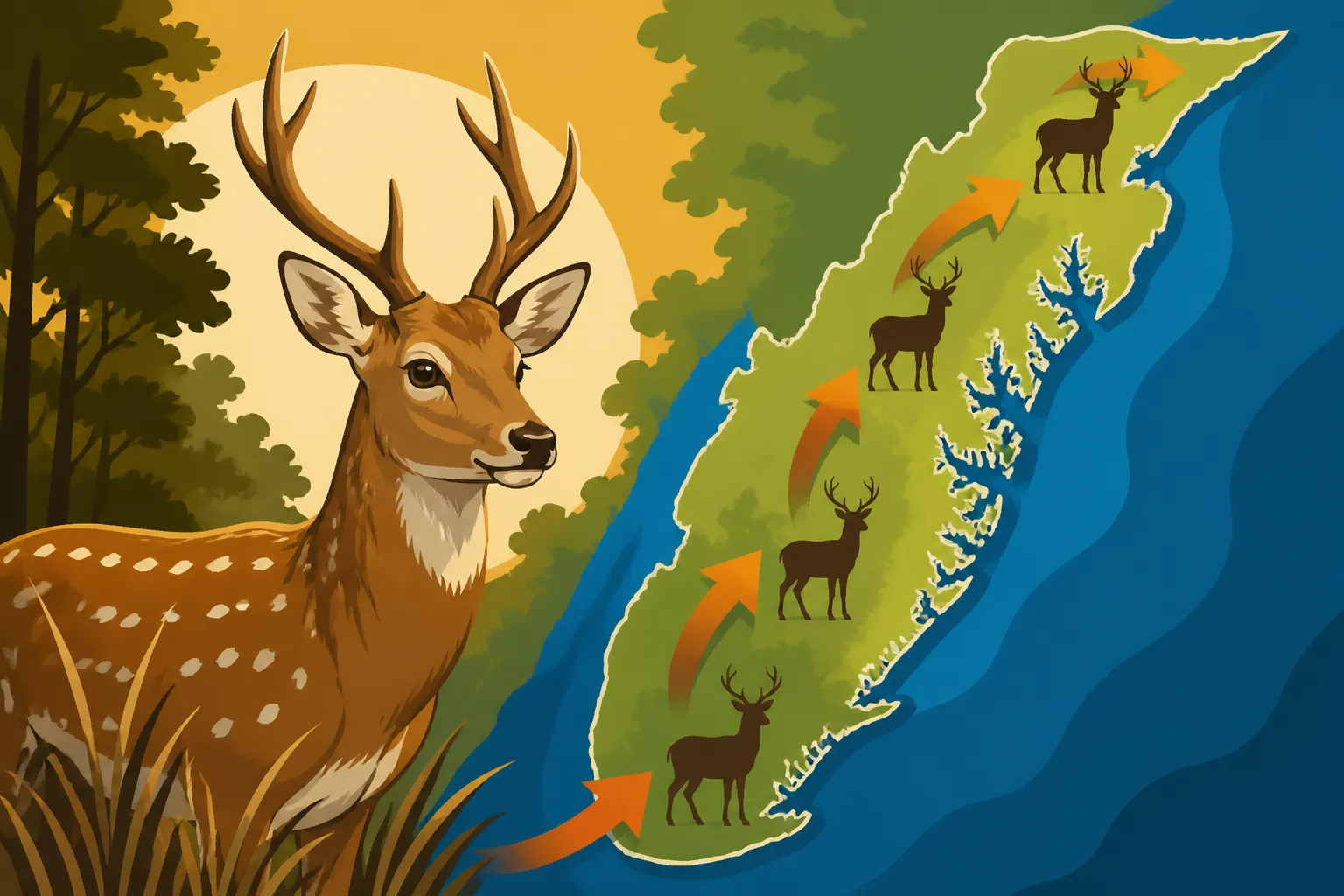
Gradual Expansion North and South
The geographical spread of Sika deer from their Dorchester County origins has been a gradual, methodical process, pushing outward into suitable habitats. To the north, they've been observed and harvested increasingly in Queen Anne's County, and even occasionally in Cecil and Kent counties, though these northern populations are far less dense than those further south. Their movement is often facilitated by river drainages and contiguous blocks of cover. Sika don't seem to mind crossing rivers or open fields if there's good cover on the other side.
To the south, their expansion has extended into the lower Eastern Shore counties, reaching into Virginia's Eastern Shore as well, though Maryland remains their primary stronghold. This southern push is particularly evident in areas with similar marshy characteristics and agricultural landscapes. What's fascinating is their ability to adapt to environments that are less marsh-dominated, demonstrating their continued flexibility. While their spread isn't as explosive as it was in the initial decades post-escape, it is ongoing, with new sightings and harvests reported further from the established core each year. For anyone scouting new territory, knowing How Far Sika Deer Have Spread From Dorchester can be incredibly helpful. Using a mapping application like GoHunt can provide invaluable insights into land features and potential travel corridors for these expanding populations.
Current Distribution and Population Estimates
Today, Sika deer are firmly established across much of the lower and central Eastern Shore of Maryland. The Maryland Department of Natural Resources (DNR) continues to monitor their distribution and population trends through hunter harvest data, observation reports, and specific research projects. While precise population numbers can be elusive for any wild species, it's clear that Sika deer are a robust and significant part of Maryland's deer management strategy.
Their highest densities are consistently found within Dorchester, Wicomico, and Somerset counties. Outside of these areas, their presence becomes more scattered, though stable populations are emerging in other locales. Hunters play a crucial role in providing data through mandatory deer registration, which helps the DNR track harvest numbers and geographic distribution. This data is vital for ensuring sustainable hunting opportunities and managing the deer herd effectively. Understanding their current distribution is key for successful hunting, whether you're targeting whitetails or are specifically focused on Hunting Sika Deer in Maryland's Tidal Marshes.
Here's a simplified look at the approximate spread timeline and key factors:
| Era | Geographic Focus | Key Characteristics of Spread | Contributing Factors |
|---|---|---|---|
| Early 1900s | Hooper's Island (Dorchester) | Confined to private estates; small, controlled populations | Initial importation by Clement Henry for private hunting park |
| 1930s – 1950s | Dorchester County | Initial escape, establishment in surrounding marshes | Major storms/floods damaging fences; Sika adaptability to marsh habitat |
| 1960s – 1980s | Dorchester County (Core) | Significant population growth, gradual spread within county | High reproductive rates; abundant food & cover; low predation |
| 1990s – Present | Dorchester, Wicomico, Somerset, Parts of Caroline/Talbot | Continuous outward expansion into adjacent suitable habitats | Continued high reproductive success; adaptability to diverse landscapes |
Ecological and Management Implications
The successful spread of Sika deer across Delmarva brings with it both exciting hunting opportunities and complex ecological challenges that require ongoing management and hunter cooperation.
Impacts on Native Ecosystems and Whitetail Deer
The introduction and proliferation of any non-native species inevitably raise questions about its impact on the existing ecosystem. Sika deer are no exception. One of the primary concerns is their potential competition with native white-tailed deer for resources. Sika deer share similar dietary preferences with whitetails, including browsing on native vegetation and feeding on agricultural crops. In areas where Sika populations are dense, there's concern that this competition could place additional pressure on habitat and food sources, potentially affecting the health and numbers of whitetail deer. This is particularly true in fragmented habitats or during periods of stress, such as harsh winters.
Beyond competition, Sika deer can also contribute to browse pressure on sensitive native plant communities, especially in marsh ecosystems. Their presence can alter vegetation composition, which in turn might affect other marsh-dwelling species. While research continues to fully understand the extent of these impacts, it's a dynamic situation that wildlife managers actively monitor. It's a delicate balance trying to manage two thriving deer species in the same landscape, and hunters often see this firsthand in the field. This complex interaction is a frequent topic of discussion, especially for those interested in Why Farmers Near Blackwater Worry About Sika.
Management Strategies and Hunter Participation
Given their established presence and ongoing expansion, the Maryland Department of Natural Resources (DNR) actively manages the Sika deer population to maintain healthy herds and mitigate potential ecological impacts. This management primarily revolves around regulating hunting seasons and bag limits. Sika deer have their own specific bag limits and hunting regulations, often distinct from those for whitetails, designed to encourage harvest and control population growth. Hunters are encouraged to participate in Sika deer hunting, using both antlered and antlerless tags, to help manage the herd.
Education is also a key component of management. The DNR works to inform hunters about Sika biology, identification, and the importance of adhering to regulations. Hunter participation is absolutely critical; without hunters taking to the field, population control would be far more challenging and costly. For many, pursuing a Sika stag in the marsh has become a cherished annual tradition, providing both recreation and a vital service to wildlife management. Understanding Maryland's Deer Bag Limits and Antler Rule is important for all deer hunters in the state, including those targeting Sika.
The Future of Sika in Maryland
What does the future hold for Sika deer in Maryland? It's safe to say they are here to stay. Their adaptability, reproductive success, and the unique mosaic of habitats on Delmarva ensure their continued presence. The population will likely continue its slow expansion into new suitable areas, while maintaining its core stronghold in Dorchester County. Future management efforts will likely focus on adaptive strategies, responding to population trends, habitat changes, and new scientific understanding.
For hunters, Sika deer represent a unique and exciting challenge. Their elusive nature, coupled with the rugged terrain they inhabit, makes for a truly memorable hunting experience. As stewards of the land and wildlife, hunters will continue to play a crucial role in the sustainable management of this fascinating introduced species. As we look ahead, the Sika deer will undoubtedly continue to shape the hunting landscape of Maryland, offering a thrilling pursuit that is deeply intertwined with the wild heart of the Delmarva Peninsula.
Disclaimer
Please note: Hunting regulations, season dates, and license requirements are subject to change. Always consult the latest official Maryland Department of Natural Resources (DNR) hunting guide or website before planning any hunting activity. This article is intended for informational purposes only and does not supersede official regulations.