Maryland’s Top Typical and Nontypical Bucks
The dream of a trophy buck, whether it's a massive, perfectly symmetrical typical or a gnarly, character-rich nontypical, is a powerful draw for many hunters here in Maryland. We all spend countless hours in the woods, poring over trail camera photos, and sharing stories around the campfire, hoping to someday cross paths with one of these giants. This guide is all about diving into what makes a Maryland buck truly exceptional, focusing on the official distinctions between typical and nontypical antlers, and exploring where these incredible animals come from and how hunters pursue them in our state.
Understanding Maryland's Trophy Buck Categories
When we talk about "trophy bucks" in Maryland, we're really talking about antlers that meet certain criteria, usually defined by established scoring systems like Boone & Crockett. But even within those systems, there's a big difference between a typical and a nontypical rack. It's not just about size; it's about the very structure and symmetry of the antlers themselves. Hunters often have a personal preference, but truly understanding these categories helps us appreciate the unique beauty and effort behind every big deer taken.
What Defines a "Typical" Rack?
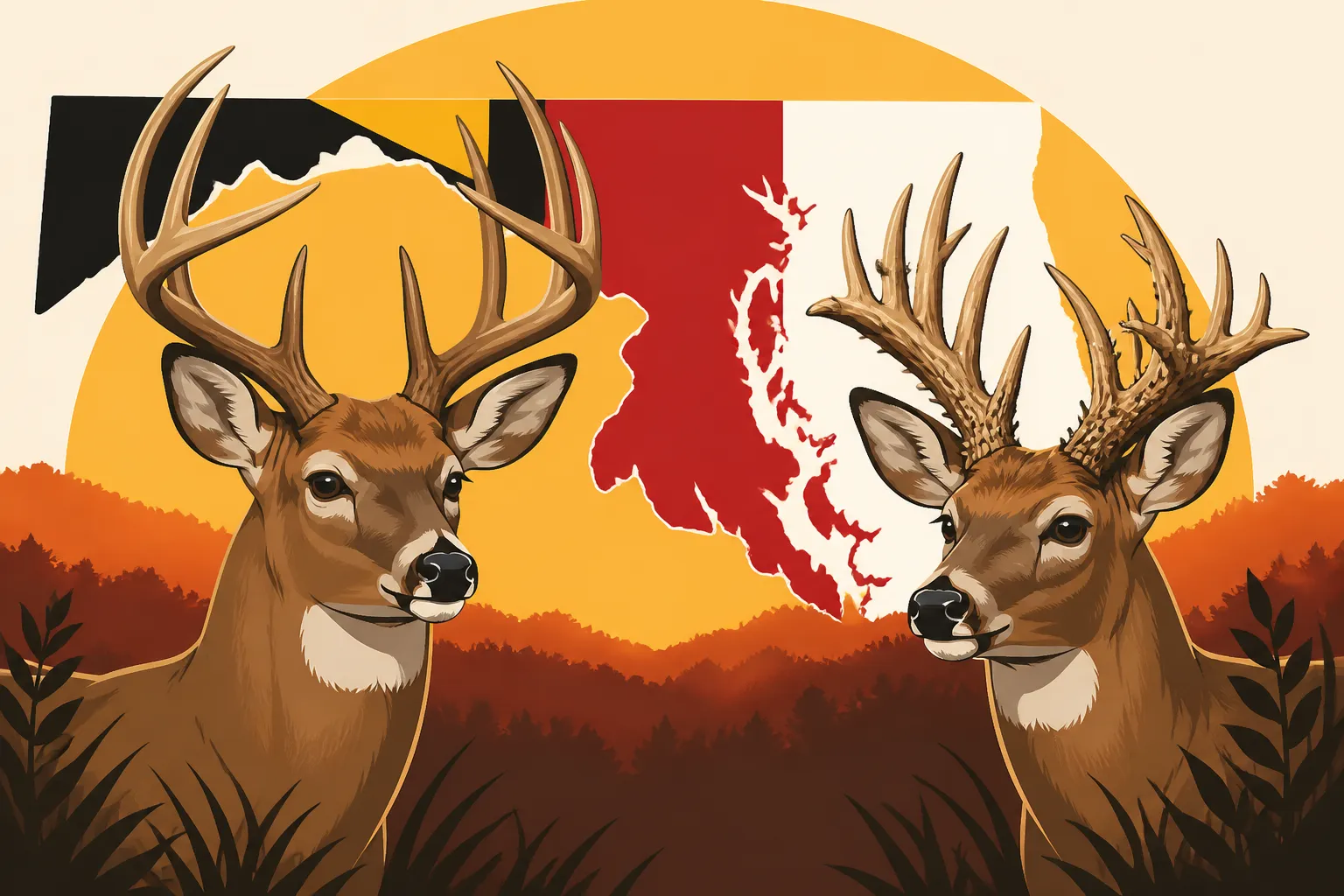
A typical whitetail rack is, at its heart, a marvel of symmetry and orderly growth. When you look at a typical buck, what you're seeing is a main beam that curves outward and forward, with points (tines) growing upward from that main beam. These points are generally paired, meaning a point on one side has a matching point of similar length and shape on the opposite side. The ideal typical rack is almost a mirror image from one side to the other.
The Boone & Crockett scoring system, which is the gold standard for many trophy hunters, heavily favors this symmetry. You measure the length of the main beams, the length of each point (like the G1, G2, G3, etc.), and the circumference at specific spots on the main beam. Then, any abnormal points—those that don't match or grow in an unusual direction—are deducted from the overall score. So, a perfectly symmetrical 10-point buck with no deductions will score much higher as a typical than one with a couple of sticker points or a small drop tine. For many, the challenge of finding that perfectly balanced monarch of the woods is what truly defines a trophy.
The Allure of the "Nontypical" Rack
Now, if typical racks are about order, nontypical racks are about character and wild individuality. These are the bucks that break the mold, with antlers sporting drop tines dangling below the main beam, sticker points jutting out in unexpected directions, or main beams that grow in unique, asymmetrical patterns. Think of those pictures you see of bucks with massive crab claws, triple drop tines, or points that defy explanation – those are your nontypicals.
The scoring for nontypical antlers still uses many of the same measurements as typical racks (main beam length, normal point length, circumferences), but here's the key difference: those abnormal points add to the score, rather than being deducted. The more unique, gnarly, and crazy the antler growth, the higher the score. This is why a nontypical might have a gross score of, say, 180 inches, but its net typical score might be much lower due to deductions for all those character points. For many Maryland hunters, especially those who appreciate the sheer uniqueness and struggle of a deer that has overcome so much, a nontypical is the ultimate prize, often feeling like a more personal victory.
Why the Distinction Matters for Hunters
The distinction between typical and nontypical isn't just a matter of semantics for record books; it deeply influences how hunters pursue deer and what they value in a trophy. Some hunters are absolutely driven by the pursuit of that perfect, symmetrical typical rack. They might pass on a buck with a phenomenal spread and numerous points if those points are highly irregular, holding out for something cleaner. Their goal is often to find a buck that will score exceptionally well without many deductions, perhaps even striving for a clean "perfect" 8-point or 10-point.
On the other hand, many hunters are captivated by the raw character and unique story a nontypical rack tells. A drop tine, a unique fork, or a series of sticker points can make a buck instantly recognizable and unforgettable. For these hunters, a nontypical represents a true one-of-a-kind trophy, a testament to the wildness and unpredictable nature of the animal. In Maryland, where we see a good mix of both, there's a deep appreciation for any truly mature buck. It’s also important to remember that most record books will let you submit a deer as either typical or nontypical, whichever category it scores higher in, so you don't have to choose in the field unless you're specifically targeting one type.
Maryland's Record Book Bucks: Where Do They Come From?
It’s easy to look at a photo of a giant Maryland buck and wonder, "Where do deer like that even exist?" The truth is, trophy bucks don't just appear out of nowhere. They are the result of a complex interplay of factors: rich habitat, strong genetics, proper age structure, and smart management practices, both on private and public lands. Understanding these elements can give you a better idea of where to focus your efforts if you're chasing a truly exceptional Maryland whitetail.
Geographic Hotbeds for Big Bucks
While big bucks can pop up anywhere in Maryland, certain areas consistently produce more trophy-class deer. Generally, the counties with rich agricultural lands and diverse habitat tend to lead the pack. Think about areas on the Eastern Shore or in the central part of the state where there's a mix of corn, soybeans, timber, and thick cover. These agricultural regions provide an abundance of high-quality nutrition year-round, which is absolutely crucial for antler growth. A deer needs a strong diet of protein, minerals, and carbohydrates to reach its full potential, especially when it comes to growing impressive headgear.
Counties with lower hunting pressure or those with specific management goals also play a significant role. Sometimes, it's not just the feed, but the ability of a buck to simply live long enough to grow those incredible antlers. While specific county names fluctuate in the record books, areas that consistently balance hunting opportunity with a chance for bucks to mature often shine. If you're looking for where the biggest deer tend to roam, understanding Maryland's Deer Herd by Region can give you some clues, as habitat and population densities vary widely across the state.
The Role of Genetics and Age
Let's be clear: genetics provide the potential for a trophy rack, but age is what truly unlocks that potential. A buck might have the genes to grow a 170-inch rack, but if he's harvested as a 2.5-year-old, he'll never get there. For a buck to grow truly impressive typical or nontypical antlers, he needs to survive for at least 4.5, 5.5, or even 6.5 years. During these mature years, his body is no longer focused on bone and muscle growth, allowing more energy and nutrients to be diverted to antler development.
This is where management strategies, even broad ones like Maryland's Three-Point Antler Restriction, can indirectly play a role. While designed to improve the age structure of the herd, these rules encourage hunters to pass on younger bucks, giving more of them a chance to reach maturity. Ultimately, the biggest bucks are almost always older bucks. They’ve learned how to evade hunters, predators, and traffic for multiple seasons, which makes them such a challenge to pursue. Understanding What a Mature Maryland Buck Weighs often gives you a good indicator of their age and potential antler mass.
Impact of Management Practices
Whether it's on a sprawling private farm or a carefully managed public land tract, intelligent deer management practices are vital for producing record-book animals. On private land, landowners often implement strategies like planting fall food plots to boost nutrition, practicing quality deer management (QDM) by harvesting more does and passing on young bucks, and limiting overall hunting pressure. These efforts create an environment where bucks not only have excellent food sources but also a greater chance of reaching older age classes.
Even on public lands, the Maryland Department of Natural Resources employs various tactics. This could include controlled hunts, designated primitive weapon areas, or simply managing habitat to provide optimal cover and browse. While public land generally sees more pressure, there are still opportunities to find those older bucks if you're willing to go where others aren't or hunt during less popular times. Keep in mind how rules can differ depending on whether you're hunting in Hunting Maryland's Two Deer Management Regions, as bag limits and season structures can influence local herd dynamics. Utilizing tools like GoHunt can help you identify these pockets of prime habitat and understand hunting pressure.
How to Chase a Maryland Record Buck
Let's face it, hunting a record book buck in Maryland isn't something that just happens by accident for most of us. It requires dedication, a strategic approach, and a lot of patience. It’s a pursuit that often stretches beyond a single season, built on consistent effort and learning from every experience in the field. But the satisfaction of finally connecting with that truly mature animal makes all the hard work worth it.
Scouting for Potential Giants
If you're serious about chasing a record book deer, scouting isn't just something you do a few weeks before the season; it's a year-round commitment. After the season closes, hit the woods to find shed antlers. Not only can this give you a tangible piece of a buck's history, but it helps you understand their travel corridors, bedding areas, and how big they truly are. A shed from a 3.5-year-old buck might indicate his potential for next year.
During the spring and summer, focus on glassing soybean fields, clover plots, or other open areas at dawn and dusk. This is your chance to identify specific bucks and begin to track their patterns. Once the leaves start to drop, transition to finding fresh sign: rub lines, heavily used trails, and especially scrape lines. Bucks use Scrape Lines Along a Maryland Field Edge as communication hubs, and identifying active ones can be a huge indicator of mature buck presence. Trail cameras become your best friend, allowing you to monitor multiple locations without constant human intrusion. Pay attention to changes in patterns as hunting pressure increases and food sources shift, moving towards Late Season Food Sources for Maryland Deer like oak flats or standing corn. Using a mapping application like GoHunt to mark sign, entry/exit routes, and potential stand sites is invaluable for organizing your scouting efforts.
Patience and Persistence Are Key
Perhaps the most frustrating, yet most critical, elements in chasing a record-class buck are patience and persistence. These older deer are absolute masters of their environment. They've survived multiple hunting seasons precisely because they are wary, nocturnal, and incredibly adept at detecting human presence. You might scout a particular buck for an entire year, get him patterned, and then he simply disappears when opening day rolls around. It happens.
The key is not to get discouraged. It means adjusting your strategy, moving your stands, and continuing to scout even during the season. It means passing on younger bucks, even if they're perfectly legal, because you know a true giant is still out there. This can be tough, especially when you've been in the stand for hours, or the season is winding down. But often, the hunters who consistently take the biggest deer are those who are willing to put in the time and pass on numerous smaller opportunities. This is especially true when Hunting the Rut in Early to Mid November, when those older, wiser bucks might make a rare daytime mistake.
Understanding Scoring Basics
While you don't need to be a certified scorer to hunt big deer, having a basic understanding of how typical and nontypical racks are measured can be a real asset in the field. It helps you quickly estimate a buck's potential and decide if he's the deer you're after. For typicals, you're looking for long main beams, good spread, and most importantly, long, symmetrical points. Deductions for asymmetry or abnormal points can significantly drop a typical score.
For nontypicals, you're still looking for those strong typical frame measurements, but then you're adding in the inches from all the "junk" – the drop tines, sticker points, and abnormal growths. A rough way to estimate is to think about the gross score – the total inches of antler before deductions. If you're consistently seeing bucks that look "big," try to mentally add up main beam length, point length, and circumference. There are plenty of online resources and apps that can help you practice field judging. Knowing what makes Judging Three Points on One Antler in the Field important for younger bucks can also help you understand the components of a scoring rack.
Notable Maryland Trophy Categories and What They Represent
Maryland has a proud hunting tradition, and our state’s big game record program is a testament to the quality of deer we have. Having an official record not only celebrates the individual hunter and animal but also helps track trends in herd health and management success across the state.
Maryland's Official Record Keeping
The Maryland Department of Natural Resources maintains an official Big Game Records program that recognizes exceptional whitetail and sika deer. This program typically follows the Boone & Crockett Club's scoring methodology, which provides a consistent, standardized way to measure and compare antlers. When you harvest a truly outstanding buck, getting it officially scored means contacting a certified measurer (often listed on the DNR website). There's usually a waiting period to allow the antlers to dry and shrink slightly, ensuring a stable measurement.
Having your buck entered into the state's record book is a tremendous accomplishment. It's not just about bragging rights; it's a permanent recognition of a truly special animal and a memorable hunt. These records provide valuable data on the distribution of big deer across Maryland, highlighting areas with exceptional habitat and successful management. It also underscores the importance of proper game registration, ensuring accurate population data and management efforts. Make sure you understand The Maryland Deer Registration Deadline After a Kill to ensure your harvest is properly reported.
The Dream Buck: Typical vs. Nontypical Goals
Ultimately, the "dream buck" is a deeply personal choice for every Maryland hunter. For some, it's that majestic, perfectly symmetrical typical 10-point that embodies grace and power. For others, it's the wild, unpredictable nontypical with a story in every point, a true testament to the unique character of the whitetail species. Both are challenging to pursue, and both represent the pinnacle of a deer hunter's quest.
Here's a quick look at the core differences in what you're striving for with each:
| Feature | Typical Rack Goal | Nontypical Rack Goal |
|---|---|---|
| Primary Value | Symmetry, length, consistent point growth | Unique character, abnormal points, mass, wildness |
| Scoring Focus | Maximizing total length with minimal deductions | Maximizing total antler material, including abnormalities |
| Aesthetic | Clean, balanced, classic | Gnarly, complex, one-of-a-kind |
| Challenge | Finding a mature buck with perfect genetic expression | Finding a mature buck with unique, unpredictable growth |
Whether you're holding out for a clean 160-inch typical or a drop-tined nontypical, the journey itself—the scouting, the early mornings, the missed opportunities, and the eventual success—is what makes Maryland hunting so special. Every mature buck taken in our state represents a significant achievement, a deep connection to the land, and a memory that will last a lifetime.
Disclaimer
This article is for general informational purposes only and does not constitute professional advice. Laws, prices and regulations vary by location and change over time. Consult a qualified professional for guidance on your specific situation.