Hunting a Green Ridge Ridgetop Bench
Hunting Maryland's vast Green Ridge State Forest can feel overwhelming. With thousands of acres of timber, finding where the deer consistently travel and feed can be like searching for a needle in a haystack, leading to countless hours walking without seeing much. This guide is dedicated to unlocking one of the most productive yet often overlooked features in this challenging terrain: the ridgetop bench, offering practical strategies to help you locate and hunt them effectively.
Understanding Green Ridge State Forest Terrain
Green Ridge State Forest, nestled in Western Maryland, is a hunter's paradise, but its sheer scale and rugged topography can be daunting. Unlike agricultural areas where deer patterns are often dictated by food plots and field edges, the deer in Green Ridge are true forest dwellers, and understanding their movement within this complex landscape is key to consistent success.
The Challenge of Big Woods Hunting
Imagine yourself standing at the base of a towering ridge, endless timber stretching in every direction. This is the reality of hunting in much of Green Ridge. The forest here is vast, covering thousands of acres, primarily consisting of mixed hardwoods with pockets of pine. Deer have an abundance of cover and food sources spread throughout, making their movements less predictable than in areas with smaller, more fragmented habitat. This can be incredibly frustrating for hunters accustomed to easier scouting or more defined travel corridors. You can spend an entire day still-hunting through beautiful woods and never cut a fresh track, simply because you're not in the right "micro-habitat" that deer prefer. The dense canopy and steep slopes can also play tricks with wind currents and thermals, adding another layer of complexity to scent control and approach. Many hunters find themselves simply wandering, hoping to stumble upon deer, rather than having a precise plan based on habitat features. This is why a deeper understanding of specific terrain features is so vital.
What Makes a Ridgetop Bench Unique
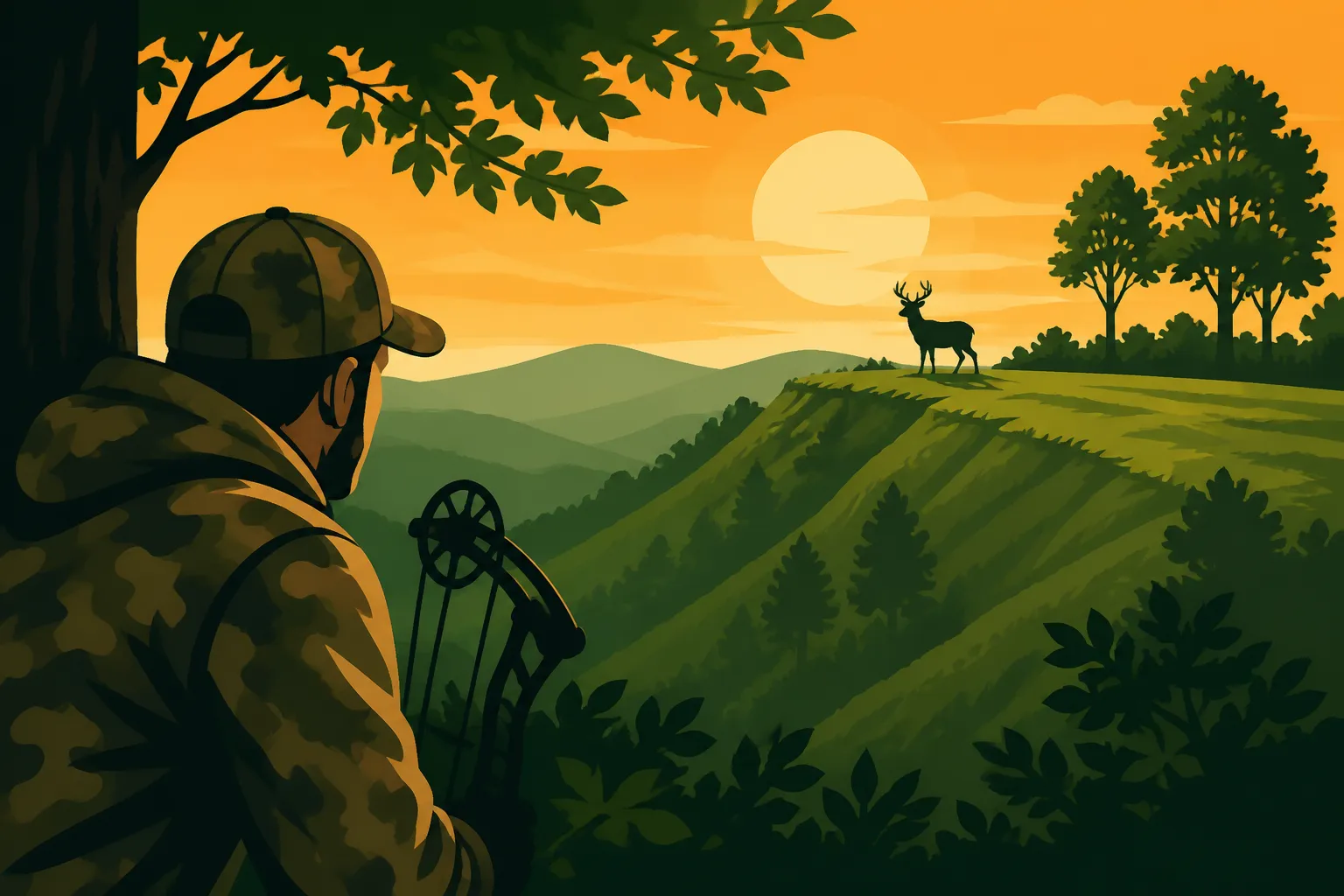
A ridgetop bench isn't just a flat spot on top of a hill; it's a specific, often subtle topographical feature that serves as a deer magnet in big woods country. Picture a steep hillside, and then imagine a slight leveling off, a natural shelf or terrace, sometimes just a few yards wide, running horizontally along the contour of the ridge before the slope steepens again. These benches act as natural travel corridors, bedding areas, and feeding zones. Deer, being creatures of efficiency, prefer to travel horizontally on these benches rather than constantly climbing or descending steep terrain. They offer easier footing and often provide better visibility downhill, making them feel secure. During the rut, bucks will cruise these benches, scent-checking for does, knowing that other deer will use them too. They also tend to catch more sunlight than steep north-facing slopes, promoting different types of forage and offering warmer bedding sites during colder months. These benches are often hidden from casual view from below, requiring dedicated scouting or detailed map work to pinpoint. They are true gems of the big woods, providing predictable deer movement in an otherwise unpredictable landscape.
Identifying Key Features on Topo Maps
Before you ever set foot in Green Ridge, your most powerful scouting tool will be a good mapping application. Forget just looking at basic satellite images; you need topographical data. Platforms like GoHunt, OnX Hunt, or BaseMaps offer incredibly detailed topo lines that reveal elevation changes and, crucially, those subtle benches. Look for areas where the contour lines "bulge out" or spread apart horizontally on a slope, indicating a less steep section or a flat shelf. Often, these benches will be found just below the main ridgetop, or sometimes several distinct benches will cascade down a larger ridge system.
Start by identifying main ridges and drainages. Deer often travel along the edges of these, or where two terrain features merge. Once you've found a prominent ridge, zoom in and meticulously follow the contour lines. You'll be surprised how many benches you can spot digitally. Pay attention to how these benches connect to other features – do they lead to a saddle, a water source, or a distinct change in timber type? These connections are critical. For example, a bench that connects two saddles, or leads to a steep drop-off into a creek bottom, is often a high-traffic area. Identifying these features digitally saves you countless hours of unproductive walking. Remember, deer are lazy; they'll take the path of least resistance, and benches provide exactly that. This digital legwork, especially when combined with aerial photography showing timber changes or potential food sources, is the foundation for an effective hunting strategy. You can even overlay different map layers in tools like GoHunt to see satellite imagery alongside topo lines, revealing both the terrain and the cover. For more general insights into the terrain, consider exploring resources on Hunting Maryland's Western Mountain Forests.
Scouting Ridgetop Benches for Deer Sign
Once you've identified potential benches on your maps, the real work begins: confirming their value on the ground. This combination of digital and boots-on-the-ground scouting is the most effective way to pinpoint productive hunting locations.
Pre-Season Digital Scouting
Before you even lace up your boots, modern mapping applications are your best friend. As mentioned, tools like GoHunt allow you to scrutinize the terrain from your living room. Start by focusing on the steepest sections of Green Ridge. Deer tend to gravitate towards benches in these areas because they offer an easier travel route than constantly traversing steep slopes. Look for benches that connect different habitat types, such as mature oak stands on one end to a thick clearcut or laurel patch on the other. These transitions are often hotbeds of deer activity.
Also, pay close attention to the proximity of benches to water sources or secluded bedding areas. A bench might serve as a primary travel route between a bedding area in thick cover on the ridgetop and a feeding area in an oak flat down below. Using the "slope" or "terrain" overlays available in many apps can highlight these subtle level changes even more clearly than standard contour lines. Make a habit of marking potential benches, saddles, and creek crossings on your digital map. This creates a virtual roadmap for your in-person scouting trips, ensuring you spend your valuable time checking promising locations rather than blindly wandering. For a deeper dive into digital scouting, check out this guide on Scouting Maryland Public Land With Aerial Photos.
On-the-Ground Scouting Techniques
Once you have your marked locations, it's time to hit the woods. The goal of on-the-ground scouting is to confirm deer usage and identify specific patterns. When you find a bench, walk its length slowly, looking for definitive deer sign.
- Trails: Look for worn paths running along the bench. Heavy trails indicate consistent use. Pay attention to where these trails originate and terminate – do they lead to thick bedding cover, a specific mast-producing tree, or a water source?
- Rubs and Scrapes: These are gold, especially during the pre-rut and rut. Rubs on saplings and small trees indicate a buck's presence and travel path. Scrapes, cleared patches of ground with an overhanging branch, are communication hubs. Fresh rubs and scrapes on a bench confirm current buck activity.
- Bedding Areas: Deer often bed on benches, especially if there's good cover like thickets of mountain laurel or dense young timber. Look for flattened areas, often sheltered from the wind and offering a good view downhill.
- Droppings and Tracks: Fresh droppings and clear tracks tell you deer are using the bench recently. Don't just look for deer tracks; try to distinguish between doe and buck tracks if possible (bucks generally have wider, blunter tracks).
- Food Sources: What's growing on or near the bench? In Green Ridge, this often means acorns from oak trees, greenbrier, or other browse. If a bench is littered with fresh acorn caps, you've found a feeding area.
Walk quietly, observe carefully, and avoid contaminating the area with your scent if possible. The more fresh sign you find, the higher the probability of deer activity during hunting season. This detailed ground-truthing helps refine your digital scouting and identify the prime ambush spots. You might also find this guide on Reading Sign in Maryland Mountain Timber useful for sharpening your observational skills.
Reading Wind and Thermals
In mountainous terrain like Green Ridge, wind and thermals are paramount. Ignoring them is a surefire way to spook deer. Thermals are air currents that rise as the sun heats the ground and fall as it cools. In the mornings, air warms and rises up the slopes. In the evenings, as the air cools, it sinks down the slopes.
- Morning Hunt: For a morning hunt on a ridgetop bench, you typically want to approach from below and position yourself so your scent is carried up and over the ridge, ideally away from where you expect deer to approach. As the sun rises and warms the earth, the thermals will start to lift your scent.
- Evening Hunt: For an evening hunt, you'd typically want to approach from above the bench and have your scent carried down the slope as thermals begin to fall.
The prevailing wind also plays a crucial role. Always try to position yourself downwind or crosswind of where you expect deer to appear. In Green Ridge, however, the wind can be notoriously swirly, especially in hollows and draws. Always carry a wind checker (a small bottle of powder or milkweed seeds) and check the wind frequently. You might find a bench where a consistent crosswind or swirling thermal makes it difficult to hunt, in which case you might need to adjust your approach or choose another location. Understanding these air currents is a critical component of successful Wind and Thermals in Western Maryland Terrain.
Scouting Checklist for Ridgetop Benches
| Scouting Phase | Key Actions | Tools & Resources | Expected Outcomes |
|---|---|---|---|
| Digital Scouting | Identify major ridges, draws, and subtle "benches." | GoHunt, OnX Hunt, BaseMaps (topo & aerial layers) | Marked potential benches, saddles, and funnel points. |
| Locate potential water sources, thick cover, and mast-producing areas. | GoHunt, public land maps, timber harvest maps | Prioritized areas for on-the-ground investigation. | |
| On-the-Ground | Confirm deer trails, rubs, and scrapes along identified benches. | Binoculars, scent-free clothing, trail cameras (check rules) | Confirmed deer travel paths and activity levels. |
| Pinpoint bedding areas, fresh droppings, and recent tracks. | Wind checker, field guides for scat/tracks | Identified specific bedding and feeding zones. | |
| Assess prevailing winds and thermal patterns for approach/stand placement. | Wind checker, compass, mental notes | Understanding of how scent will move in the area. |
Effective Hunting Strategies for Green Ridge Benches
With your scouting complete, it's time to put a hunting plan into action. Success on a Green Ridge ridgetop bench often comes down to precise stand placement, a stealthy approach, and understanding when to be patient versus when to move.
Stand Placement and Access Routes
Choosing the right spot for your treestand or ground blind on a bench is paramount. First, consider your access route. You need a path that allows you to get to your stand quietly, without disturbing deer, and, crucially, without crossing where you expect deer to be moving. This might mean circling around the back side of a ridge or using a deep drainage as a stealth corridor. For more on entry and exit, read about Entry Routes Through Cut Corn Before Daylight, even though it's a different terrain, the principles apply.
When placing your stand, aim to be downwind or crosswind of the primary deer trail you've identified. If the bench has multiple trails, try to cover the most active one, especially if it's connected to thick cover or a known food source. Elevation is also key; getting 20-25 feet up in a tree helps carry your scent over deer and improves your shot angle. Ensure you have good shooting lanes, but also enough cover to break up your silhouette. Don't set up directly on the bench if it's too narrow; sometimes placing your stand slightly off the bench, looking down onto it, or just above it, can give you a better vantage point while remaining concealed. Remember to check Treestand Rules on Maryland Public Land before setting anything up, as rules can vary.
Still-Hunting and Stalking Benches
While treestands are effective, still-hunting a ridgetop bench can be incredibly productive, especially during the rut when bucks are cruising. This method involves moving extremely slowly, taking a few steps, then pausing for several minutes to observe your surroundings.
- Patience is Key: The biggest mistake still-hunters make is moving too fast. Imagine covering only 100 yards in an hour. Your eyes should be constantly scanning, not just for deer, but for subtle movements, flicking ears, or the horizontal line of a deer's back in a vertical forest.
- Use Binoculars: Quality binoculars are indispensable. Use them to pick apart every shadow and thicket before taking another step. Often, you'll spot a deer before it sees you, giving you time to evaluate and plan a stalk or shot.
- Silence Your Movement: Wear quiet clothing. Walk with a soft, rolling gait, placing your heel down first and slowly transferring weight. Avoid stepping on crunchy leaves or snapping twigs. Move when the wind is gusting or when other natural sounds can mask your movement.
- Play the Wind: Always hunt into the wind or with a slight crosswind. If the wind shifts, be prepared to adjust your route or find another bench.
- Focus on the Edges: Deer often hug the edge of a bench, where the terrain breaks, offering them cover and a view. Focus your attention on these subtle transitions.
Still-hunting is a highly engaging way to hunt and allows you to cover ground, adapting to fresh sign you might encounter. For more on this method, read about Still-Hunting a Savage River Oak Flat, as many of the principles apply directly to benches.
Calling and Decoying Considerations
While decoying isn't typically practical or advisable for still-hunting ridgetop benches in Green Ridge's dense timber, calling can sometimes be effective, especially during the rut.
- Grunt Calls: A simple tending grunt or contact grunt can sometimes stop a cruising buck or pique the interest of one passing by. Use it sparingly and realistically. Bucks on benches are often on a mission, so an aggressive series of grunts might turn them away if they suspect another buck in their path.
- Doe Bleats: A soft doe bleat can sometimes draw in a buck searching for a mate or make a doe curious enough to investigate. This can be particularly effective when you suspect deer are nearby but aren't actively moving towards you.
- Rattling: In Green Ridge, rattling can sometimes work, particularly in areas with good visibility along a wide bench or near a saddle. However, due to the dense timber, the sound doesn't carry as far as it would in open country. If you do rattle, ensure you're in a position where you can see approaching deer from a distance and have quick shot opportunities. Start with light tickling, then progress to more aggressive sequences. Be aware that rattling can also attract other hunters, especially on public land with significant Hunting Pressure on Maryland Public Land.
The key with calling in Green Ridge is realism and moderation. The deer here are wild and often pressured, so over-calling or unrealistic calls will quickly educate them. Listen more than you call, and only use calls to enhance a situation where you believe deer are already close or moving in your direction.
Gear and Preparation for Mountain Hunting
Green Ridge State Forest is not a place for the unprepared. The rugged terrain, potential for solitude, and variable weather demand careful gear selection and physical readiness.
Essential Equipment for Remote Hunting
Hunting deep in Green Ridge requires more than just your weapon and tags. A well-prepared hunter has a kit for navigation, safety, and comfort.
- Navigation: While you've done your digital scouting with tools like GoHunt, a handheld GPS unit or a fully charged smartphone with offline maps (like the GoHunt app) is critical. Battery banks are a must to keep devices powered. A traditional compass and physical map are also wise backups in case of electronic failure.
- First-Aid Kit: A comprehensive kit capable of handling minor injuries, cuts, and sprains is non-negotiable. Ensure it includes pain relievers, bandages, antiseptic wipes, and any personal medications.
- Water and Food: Carry more water than you think you'll need. Dehydration in rugged terrain is a serious risk. High-energy snacks like granola bars, nuts, or jerky will keep you fueled throughout the day.
- Clothing: Layering is essential. Start with a moisture-wicking base layer, add insulating layers (fleece or down), and top with a waterproof and windproof outer shell. Temperatures can fluctuate wildly in the mountains. Don't forget proper blaze orange, as required by Maryland law, especially during firearm seasons.
- Headlamp/Flashlight: Even if you plan to be out before dark, unexpected delays can occur. A reliable headlamp with extra batteries is crucial for navigating in low light or an unexpected overnight stay.
- Survival Gear: A whistle, fire-starting kit (waterproof matches, lighter), emergency blanket, and knife are basic survival items that should always be in your pack.
- Optics: Good binoculars (8×42 or 10×42) are vital for spotting deer in dense timber. A rangefinder is also extremely useful for accurately judging distances on varied terrain.
Being well-equipped not only increases your chances of success but, more importantly, ensures your safety and comfort in challenging conditions. Remember, you'll also need to have all the necessary Maryland Hunting Licenses and What They Cost before heading out.
Physical Conditioning
Let's be real: hunting Green Ridge is a workout. You'll be climbing steep grades, traversing uneven terrain, and potentially packing out a deer over significant distances. If you're not physically prepared, you'll be miserable, tired, and less effective as a hunter.
- Cardiovascular Fitness: Incorporate activities like hiking, running, or cycling into your routine well before the season. Focus on inclines and uneven terrain if possible.
- Strength Training: Strong legs and a strong core are essential. Lunges, squats, and core exercises will pay dividends when climbing hills or dragging a deer.
- Practice with Your Pack: Hike with your loaded hunting pack to simulate the weight you'll be carrying on a hunt. This will help you identify any discomfort or areas where you need to adjust your gear.
- Hydration and Nutrition: Maintain good hydration and nutrition year-round, not just during hunting season. A healthy body recovers faster and performs better.
Don't underestimate the physical demands of mountain hunting. Being in good shape means you can hunt longer, safer, and enjoy the experience far more. It also means you're better prepared for the arduous task of deer recovery. You might even consider researching Hunting a Green Ridge Permit Zone for specific entry and access rules that could impact your physical exertion. Also, ensuring you have the required Getting a Green Ridge Hunting Permit is a key step in your preparation.
Public Land Etiquette
Green Ridge State Forest is public land, meaning you'll likely encounter other hunters, hikers, and outdoor enthusiasts. Maintaining proper etiquette is crucial for everyone's safety and enjoyment.
- Respect Boundaries: Always be aware of property lines, especially if hunting near private land. Use your GoHunt app or other mapping tools to ensure you're on public ground.
- Share the Resource: If you arrive at a spot and find another hunter already set up, move on. There's plenty of ground in Green Ridge, and it's bad form to crowd someone. Try to find Finding Maryland Ground Others Walk Past to avoid conflicts.
- Leave No Trace: Pack out everything you pack in. Leave the forest cleaner than you found it. This includes all trash, spent casings, and any flagging tape you might use for marking trails (remove it when you leave).
- Safety First: Be mindful of safe shooting directions. Never shoot at sounds or movement without positive identification of your target. Wear your blaze orange.
- Be Polite: A simple nod or friendly greeting goes a long way. Most hunters are respectful, and fostering a positive atmosphere benefits everyone.
- Manage Your Stands: If you use a portable stand, ensure it complies with all public land regulations regarding placement and removal dates. Don't leave stands up year-round unless explicitly permitted, and even then, consider the impact on others.
By practicing good public land etiquette, we ensure that Green Ridge remains a cherished resource for all hunters for generations to come.
Disclaimer
Please remember that hunting regulations and conditions can change. Always consult the Maryland Department of Natural Resources (DNR) official website or current guidebooks for the most up-to-date information on seasons, bag limits, licensing, and specific rules for Green Ridge State Forest before planning your hunt. Safety should always be your top priority.