Sika Deer Versus Whitetail Differences
It’s a scene many Maryland hunters know well: you’re deep in the marsh or a pine thicket on the Eastern Shore, and you hear movement. Your heart pounds. Is it the big whitetail buck you’ve been chasing all season, or is it a savvy sika stag? Distinguishing between these two unique deer species in the field can be tricky, especially when they share overlapping habitats. This guide will walk you through the key differences between Maryland's white-tailed deer and its increasingly common sika deer, helping you confidently identify your quarry and tailor your hunting strategies for success.
Physical Characteristics and Identification
When you’re out in the Maryland woods, the first things you’ll notice about deer are their general appearance. While both are cervids, a closer look reveals some pretty stark differences between white-tailed deer and sika deer that can make all the difference when it comes to positive identification. It's not just about size; subtle markings, vocalizations, and even their antler growth patterns can tell you a lot.
Size and Stature
The most immediate and obvious difference between a white-tailed deer and a sika deer in Maryland is their size. Whitetails are significantly larger animals. A mature white-tailed buck in Maryland can easily weigh anywhere from 150 to over 200 pounds, with some exceptional specimens pushing even heavier, especially in agricultural areas where food is abundant. Does typically range from 100 to 150 pounds. When you see a full-grown whitetail, they have a substantial, often deep-chested build, looking quite robust. Their legs are longer, and they stand taller at the shoulder, giving them a more imposing presence in the timber or across a field.
Sika deer, on the other hand, are considerably smaller, often earning them the nickname "Japanese elk" due to their bugle, but their physical size is more akin to a large dog or a small goat. A mature sika stag (the male) typically weighs between 70 and 100 pounds, rarely exceeding 120 pounds, while hinds (females) usually come in around 50 to 80 pounds. If you've ever wondered What a Maryland Sika Stag Weighs, you'd find they're a fraction of their whitetail counterparts. This smaller stature means they're much more agile and can slip through dense cover with surprising ease, often disappearing where a whitetail would still be crashing through. This size difference is critical, as a young whitetail deer might, at first glance, be mistaken for a mature sika if you're not paying close attention to other features.
Imagine you're hunting a marsh edge in Dorchester County. A deer steps out, and it looks a bit small for a whitetail, but you're not entirely sure. Is it a yearling whitetail, or is it a prime sika stag? If it looks like it could comfortably fit into the backseat of a sedan rather than needing a truck bed, you're likely looking at a sika. This size disparity influences everything from how they move through cover to how much meat you'll be packing out, and it's your first major clue in identification.
Coat Coloration and Markings
Beyond size, the coat coloration and distinct markings provide clear indicators. Maryland's white-tailed deer typically sport a uniform reddish-brown coat in the spring and summer, which transitions to a duller, grayish-brown in the fall and winter. Their most iconic feature, of course, is the bright white underside of their tail, which they "flag" when alarmed or fleeing. This "flag" is unmistakable and is the primary way they communicate danger within their herd. Other white markings include the chin, throat patch, and inner legs, but these are less prominent than the tail.
Sika deer, however, present a more varied and often striking coat. While their base coloration can also be reddish-brown to dark brown, especially in winter, they frequently retain distinct white spots along their flanks and back throughout their lives, though these spots may be less pronounced in older animals or certain subspecies during the winter months. This spotted pattern is a direct contrast to the solid coat of a whitetail. Perhaps even more distinctive is the sika's rump patch. Instead of a large, white underside of the tail that flags, sika deer have a prominent white or cream-colored rump patch, bordered by dark hair, that flares when they are alarmed or excited. Their tail is short, dark, and often tucked down, making the white rump patch the focal point when they flee.
Consider a scenario where you're watching a deer through thick brush. You can't get a full body shot, but you notice a distinct pattern on its side. If you see persistent white spots, even faint ones, throughout the year, you're probably looking at a sika. If it's a uniform brown with no spots, it's almost certainly a whitetail. This difference in markings is incredibly helpful, especially when visibility is limited or when trying to tell a Why Sika Deer Run Smaller Than Whitetails from their larger cousins.
Antler Configuration
The antlers of white-tailed deer and sika deer are another crucial differentiating factor, both in appearance and in how they are managed under Maryland regulations. White-tailed deer antlers typically grow as a main beam from which individual tines (points) sprout upwards. The tines can vary greatly in length, thickness, and number, depending on the deer's age, genetics, and nutrition. Most hunters are familiar with counting points off the main beam, often looking for a specific number to meet antler restrictions like Maryland's three-point rule in Region B.
Sika deer antlers are generally much shorter and thicker in proportion to their length compared to whitetails. A typical sika stag will develop a main beam with a brow tine (or "dagger") and one or two additional points off the main beam. It’s rare to see a sika with more than four points on a side, making an eight-point sika stag a truly exceptional trophy. Often, a mature sika stag might only have two points per side – a brow tine and a main beam with a single fork or even just a spike. Hunters often refer to them as "spikes" or "forked-horn" deer even when mature because of this simpler antler structure. When you're trying to meet Maryland's Three-Point Antler Restriction, it's vital to know if you're looking at a whitetail or a sika, as the rules apply differently, and a sika's typical antler growth might not easily meet the whitetail criteria.
For example, if you see a deer with relatively short, stout antlers that appear to have a brow tine and perhaps one or two more points, but no long, sweeping main beam with multiple tines, you're looking at a sika. A whitetail, even a young one, will usually show a more open, branching structure. Understanding these distinct antler characteristics is not only for identification but also for legal compliance and ethical hunting practices. When you're in the field, use a good pair of binoculars to carefully count and assess the antler structure, and remember that Judging Three Points on One Antler in the Field will look very different between the two species.
Vocalizations and Communication
Beyond what you see, what you hear in the woods can be an absolute dead giveaway. While both deer species are generally quiet, their vocalizations are as distinct as their physical appearances, and listening closely can help you identify them from afar or when they're hidden in cover. This is especially true during their respective rutting seasons.
Sika's Unique Whistle and Roar
If you've spent any time hunting the marshes of Maryland's Eastern Shore, you've likely been startled by the truly bizarre and unforgettable sounds of a sika deer. Unlike the grunts and bleats of a whitetail, sika deer are known for their incredibly diverse and loud vocalizations, especially the stags during the rut. The most famous is the "whistle" or "bugle," a high-pitched, drawn-out call that sounds eerily like a dying animal or a far-off elk. This bugle is used by stags to challenge rivals and attract hinds, and it can be quite unnerving when you hear it for the first time echoing through the thick marsh.
Beyond the rutting bugle, sika deer have a range of other sounds. When alarmed, they might emit a sharp, almost dog-like bark. Hinds will often use soft bleats to communicate with their fawns. But it's that loud, guttural, sometimes shrieking roar or whistle that truly sets them apart. When you're in sika country during late September and October, hearing a stag's whistle is a clear sign of their presence, and it's a sound that you just won't hear from any white-tailed deer. This distinct vocal repertoire is why many hunters specifically target Hunting Sika Stags During Their Fall Whistle, as it offers a unique calling opportunity not found with whitetails. The sheer volume and primal nature of a sika roar in the pre-dawn marsh are things you won't soon forget, and it immediately confirms the species you're dealing with.
Whitetail Grunts, Bleats, and Snorts
White-tailed deer, while not silent, have a much more subtle and less varied vocal range compared to sika. Their most common vocalizations are grunts, bleats, and snorts. A "grunt" is a short, deep sound made by bucks, particularly during the rut, to communicate with does or other bucks. It's often used to express dominance or interest and can be effectively mimicked by hunters using grunt tubes. Does and fawns will make "bleats," softer, higher-pitched sounds used for communication within the family unit, especially when a fawn is calling for its mother or a doe is signaling to her fawn.
Perhaps the most recognized whitetail alarm call is the "snort" or "blow." This is a sudden, sharp expulsion of air through the nostrils, often followed by stomping feet, designed to alert other deer to perceived danger and determine if a threat is real. It's their way of saying, "Something's not right here!" Unlike the far-reaching sika whistle, whitetail vocalizations, while effective for close-range communication, typically don't carry as far or possess the same primal intensity. The absence of any form of a bugle or loud, drawn-out call is a strong indicator that you are dealing with a whitetail, not a sika. Understanding these distinct vocal differences can be a powerful tool in your hunting arsenal, allowing you to use appropriate calls and identify the species even before you lay eyes on them.
Habitat Preferences and Range Overlap
Maryland is a state of incredible ecological diversity, and both white-tailed deer and sika deer thrive here, albeit in different primary habitats. Understanding where each species prefers to live is key to effective scouting and hunting, especially in areas where their ranges converge.
Sika's Marsh and Loblolly Stronghold
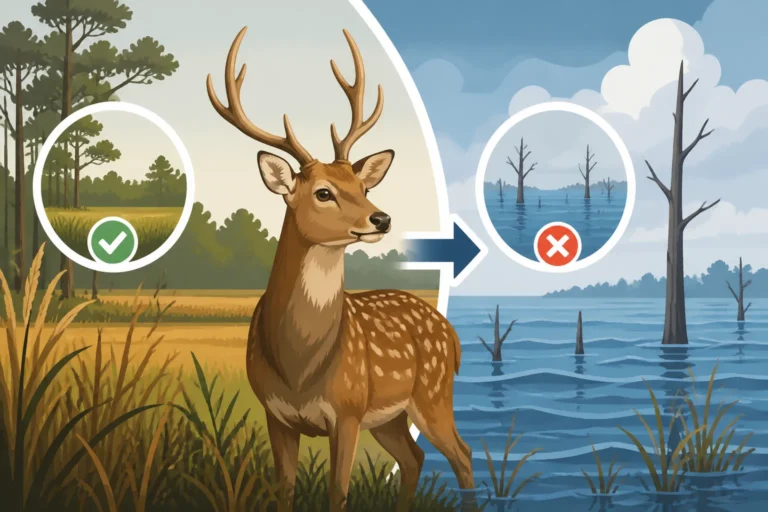
Maryland's sika deer population is largely concentrated on the lower Eastern Shore, particularly in the vast tidal marshes and dense loblolly pine forests of counties like Dorchester, Somerset, and Wicomico. These unique environments provide ideal cover and food sources for sika. The seemingly impenetrable phragmites reeds, marsh grasses, and stunted pine thickets offer excellent concealment from predators and hunters alike. Sika deer are incredibly adapted to these wet, swampy conditions, often navigating marsh guts and ditches with ease. They thrive on the abundant marsh grasses, sedges, and the young growth of pine trees.
Areas around Blackwater National Wildlife Refuge and the surrounding Chesapeake Forest Lands are prime sika territory. When you're out there, you'll see a lot of overlap. They utilize high ground within the marsh, pine islands, and the edges where marsh meets agricultural fields. This preference for thick, often challenging terrain means that Hunting Sika Deer in Maryland's Loblolly Pine Edges or Wading Into a Dorchester Marsh Before Daylight are typical approaches for targeting this species. Their compact size makes them perfectly suited to slipping through dense cover where a larger whitetail would struggle, making them incredibly difficult to spot until you're right on top of them.
Whitetail's Adaptability Across Maryland
In stark contrast, white-tailed deer are the ultimate generalists, found in every single county across Maryland. Their adaptability is legendary, thriving in environments ranging from the rugged, mountainous forests of Western Maryland to the suburban woodlots and agricultural fields of the Piedmont and Eastern Shore. Whitetails utilize a vast array of food sources, from acorns and forest browse to agricultural crops like corn, soybeans, and alfalfa. They can be found in mature hardwoods, dense clear-cuts, creek bottoms, and even surprisingly close to human development.
Whether you're Still-Hunting Western Maryland Mountain Timber or hunting a small parcel near Baltimore, whitetails are the dominant deer species. They are incredibly resilient and have learned to coexist with human activity, making them a common sight even in densely populated areas. This widespread distribution means that regardless of where you hunt in Maryland, you will encounter white-tailed deer. Their success is a testament to their ability to exploit diverse habitats and food sources, allowing them to maintain robust populations across the state's varied landscapes.
Navigating Overlapping Territories
The real challenge for hunters arises in the areas where sika deer have expanded their range and now coexist with white-tailed deer. Primarily, this occurs on the lower Eastern Shore, where sika are slowly but surely pushing northward and westward from their traditional marsh strongholds. In these overlapping zones, you might find both sika and whitetail tracks along the same field edge, or encounter both species feeding in the same clear-cut or patch of woods. This makes identification, both of the deer themselves and their sign, a critical skill.
For instance, when Reading a Marsh Trail for Sika Sign, you might also find larger whitetail tracks. Look for the size of the droppings – sika droppings are noticeably smaller. Rubs and scrapes can also be a clue. While both species will rub trees, sika rubs are generally lower to the ground and smaller in diameter due to their shorter stature. Scrapes from sika might also be smaller. The presence of whistling sounds confirms sika, while grunts suggest whitetails. As sika continue to spread, hunters in areas like Caroline and Queen Anne's counties may increasingly find themselves Hunting Maryland Whitetails on the Same Ground as Sika, requiring a nuanced approach to scouting and identification. Understanding these habitat preferences and the increasing overlap is crucial for anyone hunting in these dynamic Eastern Shore environments.
Behavioral Patterns and Rut Dynamics
The way white-tailed deer and sika deer behave, particularly during their breeding seasons (the rut), is markedly different. These variations impact everything from how you scout to the calling techniques you might employ, and even the timing of your hunts.
Sika Rutting Behavior
The sika deer rut is a truly unique spectacle that typically peaks in late September and October, often a bit earlier than the whitetail rut. During this time, sika stags become incredibly vocal, emitting their distinctive whistles and roars to challenge rival males and attract hinds. They are known for establishing "harems" – a group of hinds that a dominant stag will gather and defend. This behavior, more akin to elk than whitetails, involves aggressive displays, parallel walks, and sometimes intense antler clashes.
Stags will fiercely defend their hinds and territory, often creating wallows in wet ground where they will urinate and roll, marking their scent. This period of intense activity and vocalization makes Hunting Sika Stags During Their Fall Whistle a highly effective and exciting strategy. Hunters can use sika calls, mimicking the whistle or roar, to bring in aggressive stags looking for a fight or an opportunity with hinds. The sika rut is a high-energy, sound-filled affair that truly distinguishes them from their whitetail neighbors, offering a distinct challenge and reward for hunters.
Whitetail Rutting Behavior
The white-tailed deer rut in Maryland typically kicks into high gear from late October through mid-November, though phases can extend beyond these dates. Unlike sika, whitetail bucks are not known for forming harems or bugling. Instead, their rutting behavior is characterized by widespread seeking and chasing. Bucks will create "scrapes" – areas of disturbed earth where they urinate and rub scent glands – and "rubs" – where they rub their antlers on saplings and small trees – as a way to communicate their presence and dominance.
The whitetail rut involves bucks constantly cruising for receptive does, often leading to intense chases and occasional, though usually short, fights. Vocalizations include grunts, which bucks use to communicate with does, and rattling antlers can sometimes mimic the sound of fighting bucks to draw in curious rivals. The intensity of the whitetail rut is often tied to cold fronts and lunar phases, leading to frenetic activity. Hunting the Rut in Early to Mid November is a prime time for whitetail hunters, focusing on pinch points, funnels, and scrape lines. The contrast between the sika's bugling harem defense and the whitetail's more widespread seeking and chasing behavior is a major factor in how hunters approach each species during their respective breeding seasons.
Foraging Habits and Dietary Differences
While both deer are browsers and grazers, their specific dietary preferences also diverge, often tied directly to their preferred habitats. Sika deer are notably adapted to marsh environments, and their diet reflects this. They frequently feed on marsh grasses, sedges, and aquatic vegetation. In areas where agriculture meets the marsh, they will readily venture into fields to browse on soybeans, corn, and winter wheat. Their smaller stature allows them to access dense thickets and browse on vegetation that larger whitetails might struggle to reach. This makes them particularly adept at utilizing the resources of the Eastern Shore's unique ecosystem.
White-tailed deer, with their broader habitat range, also have a more diverse diet. They are opportunistic feeders, consuming a wide variety of plants, including acorns (a critical fall food source), various browse (twigs and leaves from shrubs and trees), agricultural crops, and even fungi. Their diet varies seasonally and geographically; whitetails in Western Maryland's hardwood forests might rely heavily on acorns and forest browse, while those on the Eastern Shore or in agricultural areas might consume more farm crops. Knowing these dietary differences can help you pinpoint where each species is likely to be feeding. For instance, while both might hit a soybean field, a sika might be more entrenched in the adjacent marsh grasses, while a whitetail might be found deeper in the timber browsing on acorns. This understanding is key to effective scouting and placing your stand in the right location, whether you're Hunting a Farm Along the Potomac or Hunting a Loblolly Pine Island in the Marsh.
Hunting Strategies and Considerations
Given their distinct characteristics, habitats, and behaviors, it's no surprise that successful hunting strategies for sika and white-tailed deer also differ significantly. What works for one might not work for the other, especially when it comes to gear and recovery.
Approaching Sika Deer
Hunting sika deer in Maryland requires a specific set of tactics, largely dictated by their dense marsh and pine thicket habitats. Still-hunting or stalking is often very effective, as sika are incredibly wary and use their small size to melt into cover. This involves moving slowly, pausing frequently, and using binoculars to pick apart the dense vegetation. Calling is another highly productive method, especially during the peak of the rut when stags are vocal and aggressive. Mimicking their unique whistle or roar can often draw a stag in, sometimes from a surprising distance. Setting up on marsh islands, pinch points between water and high ground, or along established game trails is also common.
The terrain itself presents challenges. You'll often find yourself wading through knee-deep (or deeper) water and mud, so proper footwear is essential. Many sika hunters swear by Hip Boots Versus Chest Waders in Sika Country to navigate the mucky conditions. When hunting sika, patience is a virtue, and being prepared for a quick, close-range shot is crucial, as they can appear and disappear almost silently. A successful sika hunt often feels more like a cat-and-mouse game in thick cover than a traditional whitetail sit over a food plot.
Strategies for Whitetails
Hunting white-tailed deer in Maryland offers a much broader range of strategies, reflecting their adaptable nature and diverse habitats. Stand hunting from a tree stand or ground blind is perhaps the most popular method, especially when positioned along travel corridors, near food sources (like Hunting a Clover Plot on a Maryland Farm or acorn flats), or overlooking pinch points and funnels. Scent control is paramount for whitetails, as their sense of smell is legendary. Hunters often use scent-eliminating sprays, wash clothes in scent-free detergents, and play the wind meticulously.
Calling strategies for whitetails typically involve grunts, bleats, and rattling antlers to mimic deer communication and attract curious bucks. Still-hunting through timber is also effective, particularly in larger tracts of woods or during the post-rut when bucks are seeking out late-season food sources. Driving deer on private lands is another common tactic, especially in more agricultural areas where deer might bed in thickets or standing crops. Understanding the specific nuances of whitetail behavior, such as their reaction to pressure, their bedding areas, and their preferred travel routes, is key to consistent success. Utilizing tools like GoHunt to scout and understand terrain features can significantly boost your whitetail hunting efforts, helping you identify promising locations like Hunting a Funnel Between Two Grain Fields.
Field Dressing and Recovery Nuances
The physical differences between sika and whitetails, coupled with their preferred habitats, also mean that field dressing and game recovery can be very different experiences. For a sika deer, while the initial field dressing process is similar to a whitetail, their smaller size makes them much easier to handle. However, recovering a sika, especially in their marshy stronghold, can be incredibly challenging. A downed sika can disappear into a dense phragmites stand, and tracking them through knee-deep mud and water after dark is no easy feat. Hunters often face the additional challenge of battling tides, ensuring they can get their animal out before high tide submerges the area. This is why resources like Recovering a Deer From a Tidal Marsh are invaluable.
For a white-tailed deer, the physical exertion of field dressing and dragging out a larger animal is a significant consideration. A mature buck can be a heavy haul, especially from rugged terrain or far off a trail. While their recovery often occurs in more stable ground like timber or agricultural fields, dense clear-cuts or steep mountain slopes can still pose considerable challenges. Both species require prompt field dressing to preserve the meat, especially in warmer weather, and knowing how to efficiently handle the carcass is crucial. Field Dressing a Deer in Warm September Weather applies to both species during the early archery seasons, emphasizing the need for quick action to cool the meat. The primary difference often lies in the specific environmental obstacles encountered during recovery rather than the actual dressing technique itself.
Management and Conservation Outlook
The management of white-tailed deer and sika deer in Maryland is guided by their distinct histories and ecological roles. As an introduced species, sika deer present unique challenges and opportunities compared to the native white-tailed deer.
Sika's Invasive Status and Management
Sika deer were introduced to Maryland in the early 1900s, originally released on James Island in Dorchester County. From there, they gradually spread throughout the Eastern Shore marshes and pine forests. Because they are not native to North America, they are considered an introduced species, and their management often focuses on controlling their population and monitoring their spread. There's ongoing discussion among wildlife biologists about their potential impact on native vegetation and competition with white-tailed deer for resources.
Maryland's Department of Natural Resources (DNR) manages sika deer through hunting regulations designed to encourage harvest. For instance, hunters need to acquire a specific Maryland Sika Deer Stamp Rules in addition to their regular hunting license. The Maryland's Sika Deer Stamp and Bag Limits are often generous, reflecting a desire to manage their numbers. Unlike whitetails, sika deer do not have specific antler point restrictions in Maryland, meaning any antlered sika can be harvested, further encouraging their take. The goal of sika management is to strike a balance between providing hunting opportunities for this unique species and mitigating any potential negative impacts on native ecosystems.
Whitetail Management for Balance
White-tailed deer are Maryland's most abundant and popular big game animal, and their management is a cornerstone of the state's wildlife conservation efforts. The DNR aims to maintain healthy, stable whitetail populations that are in balance with their habitat, while also providing ample recreational hunting opportunities. This involves careful monitoring of population trends, habitat conditions, and hunter harvest data. Maryland employs a variety of tools, including specific Maryland's Deer Bag Limits and Antler Rule that vary by region (Region A and Region B), antler point restrictions (like the three-point rule in Region B), and various season lengths and weapon choices.
The management approach for whitetails often considers factors like agricultural damage, deer-vehicle collisions, and forest health. Hunters play a vital role in this management by participating in harvest efforts, especially in antlerless deer harvest, which helps control population growth and maintain a healthy buck-to-doe ratio. Programs like the Deer Management Permits for farmers also assist in local population control. The overarching goal is sustainable management that ensures healthy deer populations for future generations of hunters and minimizes negative impacts on human interests and the environment.
Future Trends and Hunter's Role
The future of deer hunting in Maryland will likely see continued adaptation to the evolving landscapes and deer populations. Sika deer are slowly but surely expanding their range, and it's plausible that they will become more common in areas further north and west on the Eastern Shore. This means more hunters will encounter both species, necessitating a keen understanding of their differences. For hunters, this presents a unique and exciting opportunity to pursue two distinct deer species within the same state, often in overlapping seasons.
The role of the hunter remains paramount in both conservation and management. By adhering to regulations, reporting harvests accurately, and participating in management discussions, hunters contribute directly to the health of Maryland's deer herds. Staying informed through resources like the Maryland DNR website and platforms like GoHunt, which can provide detailed mapping and species-specific information, will be essential for adapting to these future trends. Whether you're targeting a trophy whitetail or a bugling sika stag, understanding the distinct biology, behavior, and management of these incredible animals will enhance your hunting experience and help preserve Maryland's rich hunting heritage.
| Feature | White-Tailed Deer | Sika Deer |
|---|---|---|
| Size | Larger (Bucks 150-200+ lbs, Does 100-150 lbs) | Smaller (Stags 70-100 lbs, Hinds 50-80 lbs) |
| Coat | Solid reddish-brown (summer) to grayish-brown (winter) | Often spotted (retains spots), darker brown |
| Tail/Rump Patch | Large white "flag" tail | Short, dark tail with prominent white/cream rump patch |
| Antlers | Main beam with upward-growing tines (forked) | Shorter, thicker, simpler structure (often spike/fork) |
| Vocalization | Grunts, bleats, snorts | Unique whistle, bugle, roar, barks |
| Rut Peak | Late October – Mid-November | Late September – October |
| Social Behavior | Solitary or small family groups, bucks seek does | Stags establish harems, more aggressive interaction |
| Primary Habitat | Widespread across Maryland (forests, fields, suburbs) | Primarily Eastern Shore tidal marshes, loblolly pine |
| Status | Native | Introduced/Non-native |
| Management | Population control, herd health, antler rules | Population control, monitoring spread, liberal bag limits |
Disclaimer
Please be aware that hunting regulations, seasons, and bag limits can change. Always consult the latest Maryland Department of Natural Resources (DNR) hunting guide before planning any hunt to ensure you are fully compliant with current laws and regulations. The information provided here is for general guidance and educational purposes only.